The ANGPT1 Monoclonal Antibody (CAB3757) is a high-quality antibody developed for reliable detection and analysis of target proteins. This antibody, produced using rabbit monoclonal technology, exhibits high specificity and sensitivity towards Angpt1 in human samples, making it an excellent choice for various applications such as immunohistochemistry and flow cytometry.Angpt1 is a critical regulator of blood vessel formation and maintenance, making it a key player in processes like wound healing, organ development, and tumor growth. By targeting Angpt1 with this antibody, researchers can investigate its functions in different cell types and disease contexts, thereby advancing our understanding of angiogenesis-related disorders and potential therapeutic interventions.
This antibody is validated for use in WB, IHC-P, ELISA applications and has demonstrated reactivity against Human, Mouse, Rat samples.
Product Name:
ANGPT1 Monoclonal Antibody
SKU:
CAB3757
Size:
20μL, 100μL
Reactivity:
Human, Mouse, Rat
Clone Number:
ARC0248
Conjugate:
Unconjugated
Immunogen:
Synthetic peptide. This information is considered to be commercially sensitive.
Sequence:
EMEG KHKE ELDT LKEE KENL QGLV TRQT YIIQ ELEK QLNR ATTN NSVL QKQQ LELM DTVH NLVN LCTK EGVL LKGG KREE EKPF RDCA DVYQ AGFN KSGI Y
Tested Applications:
WBIHC-PELISA
Recommended Dilution:
WB
1:1000 - 1:2000
IHC-P
1:100 - 1:1000
ELISA
Recommended starting concentration is 1 μg/mL. Please optimize the concentration based on your specific assay requirements.
Synonyms:
AGP1, AGPT, ANG1, HAE5, AGPT-1, ANGPT1
Positive Sample:
U-2 OS, A549, Mouse lung, Rat kidney
Cellular Localization:
Secreted.
Calculated MW:
58kDa
Observed MW:
58kDa/70kDa
This gene encodes a secreted glycoprotein that belongs to the angiopoietin family. Members of this family play important roles in vascular development and angiogenesis. All angiopoietins bind with similar affinity to an endothelial cell-specific tyrosine-protein kinase receptor. The protein encoded by this gene is a secreted glycoprotein that activates the receptor by inducing its tyrosine phosphorylation. It plays a critical role in mediating reciprocal interactions between the endothelium and surrounding matrix and mesenchyme and inhibits endothelial permeability. The protein also contributes to blood vessel maturation and stability, and may be involved in early development of the heart. Mutations in this gene are associated with hereditary angioedema.
Purification Method
Affinity purification
Gene ID
284
RRID
AB_2863136
Buffer Information
Store at -20℃. Avoid freeze / thaw cycles. Buffer: PBS containing 50% glycerol and 0.05% BSA, preserved with proclin300 or sodium azide, pH 7.3.
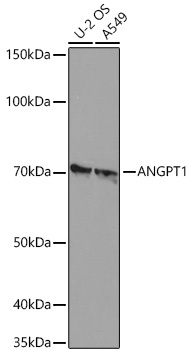
Western blot analysis of various lysates using ANGPT1 Rabbit mAb (CAB3757) at 1:1000 dilution incubated overnight at 4℃. Secondary antibody: HRP-conjugated Goat anti-Rabbit IgG (H+L) (CABS014) at 1:10000 dilution. Lysates/proteins: 25 μg per lane. Blocking buffer: 3% nonfat dry milk in TBST. Detection: ECL Basic Kit (AbGn00020). Exposure time: 3s.
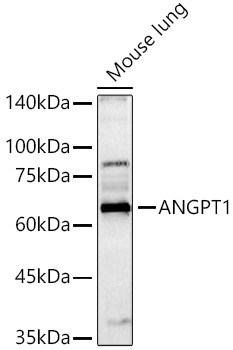
Western blot analysis of lysates from Mouse lung using ANGPT1 Rabbit mAb (CAB3757) at 1:1000 dilution incubated overnight at 4℃. Secondary antibody: HRP-conjugated Goat anti-Rabbit IgG (H+L) (CABS014) at 1:10000 dilution. Lysates/proteins: 25 μg per lane. Blocking buffer: 3% nonfat dry milk in TBST. Detection: ECL Basic Kit (AbGn00020). Exposure time: 90s.




![Anti-ANGPT1 [R06-1F9] Monoclonal Antibody (AGMB00716)](https://cdn11.bigcommerce.com/s-h68l9z2lnx/images/stencil/590x590/products/272005/690723/anti-angpt1-r06-1f9-monoclonal-antibody-agmb00716__78025.1774500700.jpg?c=2 "Anti-ANGPT1 [R06-1F9] Monoclonal Antibody (AGMB00716)")


