Description
DAPI Staining Solution (25µg/mL)
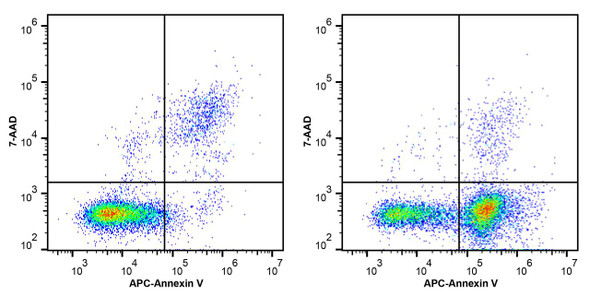
DAPI Staining Solution (25µg/mL) (AKES031) is a ready-to-use liquid DNA-binding fluorescent dye for staining cell nuclei. It is excluded by intact cells and enters cells with compromised membranes, which makes it useful for discriminating dead cells and detecting apoptosis by flow cytometry. It is also used for nuclear staining of fixed cells and tissues for fluorescence microscopy. For research use only.
DAPI (4',6-diamidino-2-phenylindole) is a blue fluorescent dye supplied here as a liquid at 25 µg/mL under the DAPI Staining Solution name. It is a nuclear stain: the dye penetrates cell membranes and localizes to the nucleus, where it binds double-stranded DNA. When bound to double-stranded DNA, its fluorescence is more than 20 times stronger than that of free DAPI, which makes it a sensitive reporter of nuclear DNA content and location.
DAPI is used as a general nuclear counterstain and as a double-stranded DNA stain under certain conditions. Its primary application listed in the product documentation is detection of cell apoptosis, where nuclear staining is read by fluorescence microscopy or flow cytometry. The staining sensitivity for double-stranded DNA is many times higher than that of ethidium bromide (EB), which is a practical reason to select DAPI over EB for DNA-based nuclear detection.
The reagent is applied directly to fixed cells or tissues without a separate dye preparation step. Once bound to DNA, DAPI emits in the blue range, with an excitation/emission of 410/450 nm, corresponding to the Pacific Blue channel on instruments that support this channel set. Signal is read with a fluorescence microscope or a flow cytometer, so the same stain can serve imaging or quantitative single-cell analysis.
The product is suitable for staining the nucleus of all common cells and tissues. Because the reagent is intended for fixed material, samples should be fixed before staining. Handling requires protection from light, since extended exposure to direct light quenches the fluorophore, and stained samples should be analyzed promptly, because apoptosis or necrosis may increase with time after staining. The solution is irritating, so direct contact and inhalation should be avoided. Quantitative performance metrics such as sensitivity limits, linear range, precision, or recovery are not provided in the product documentation.
| Product name: | DAPI Staining Solution (25µg/mL) |
| SKU: | AKES031 |
| Format: | Liquid |
| Target: | Nuclear DNA (double-stranded DNA) |
| Dye: | DAPI |
| Detection channel: | Pacific Blue (Ex/Em 410/450 nm) |
| Applications: | Apoptosis and dead cell discrimination (flow cytometry); nuclear staining (fluorescence microscopy) |
| Sample type: | Suspension cells (validated); fixed cells and tissues |
- Ready-to-use liquid at 25 µg/mL
- Binds double-stranded DNA and stains the nucleus
- Excluded by intact cells; enters late apoptotic and necrotic cells
- Fluorescence more than 20-fold stronger when bound to double-stranded DNA
- Pacific Blue channel, Ex/Em 410/450 nm
- Compatible with Annexin V staining for apoptosis stage discrimination
DAPI binds double-stranded DNA and produces fluorescence that is more than 20 times stronger than DAPI alone. Because intact cells exclude the dye, DAPI signal in flow cytometry marks cells that have lost membrane integrity (late apoptotic or necrotic cells). Stained nuclei are read by fluorescence microscopy or flow cytometry using the Pacific Blue channel (Ex/Em 410/450 nm).
- Discrimination of dead cells during flow cytometric analysis
- Detection of late apoptotic and necrotic cells, combined with Annexin V staining to separate apoptotic stages
- DNA content analysis by flow cytometry
- Nuclear staining of fixed cells and tissues for fluorescence microscopy
- Double-stranded DNA staining under certain conditions
- Phosphate-buffered saline (PBS)
- 1 x Annexin V Binding Buffer
- Annexin V-APC
- Centrifuge capable of 300 g
- Cell counting equipment
- Flow cytometer with Pacific Blue (410/450 nm) detection
- Vortex mixer
- Ice and microcentrifuge tubes
- Lab coat and disposable gloves
Apoptosis and dead cell staining of suspension cells for flow cytometry
- Induce apoptosis in suspension cells with the reagents of interest.
- Collect cells, centrifuge at 300 g for 5 min, and discard the supernatant.
- Wash cells with PBS, resuspend gently, and count cells.
- Aliquot 1 to 5 x 10⁵ cells per tube, centrifuge at 300 g for 5 min, and discard the supernatant.
- Wash cells with PBS, centrifuge, and discard the supernatant.
- Resuspend cells in 500 µL of 1 x Annexin V Binding Buffer.
- Add 5 µL of Annexin V-APC and 5 µL of DAPI Staining Solution (25µg/mL) to each tube.
- Gently vortex and incubate at room temperature for 15 to 20 min in the dark.
- Analyze cells immediately with appropriate instrument settings. Alternatively, place cells on ice in the dark and analyze within 1 hour.
Which sample types can be stained with DAPI Staining Solution (25µg/mL)?
The reagent is suitable for staining the nucleus of all common cells and tissues. It is intended for direct use on fixed cells or fixed tissues.
How should the DAPI reagent be stored, and how long is it stable?
Store at 2-8°C or -20°C, protected from light, and avoid freeze/thaw cycles. The expiration date is 12 months, and the product can be stored at 2-8°C for 12 months with shading light.
What instrument settings should be used to detect the stain?
The excitation/emission is 410/450 nm, which corresponds to the Pacific Blue channel. Signal can be observed with a fluorescence microscope or detected by flow cytometry.
How soon after staining should samples be analyzed, and how should light exposure be managed?
Detect apoptosis as soon as possible after staining to avoid an increase in apoptosis or necrosis. Avoid extended exposure of samples to direct light to protect the fluorophores from quenching.
What safety precautions apply when handling this reagent?
The reagent is irritating, so avoid direct contact with the body and inhalation. Wear lab coats and disposable gloves and follow standard laboratory reagent handling procedures. The product is for research use only.
| Storage: | 2-8°C or -20°C, protected from light |
| Shelf life: | 12 months |
| Shipping: | Ice bag |
| Handling: | Avoid freeze/thaw cycles |
Cautions
- For research use only. Not for diagnostic or therapeutic use.
- This reagent is irritating. Avoid direct contact with skin and avoid inhalation.
- Wear a lab coat and disposable gloves during use.
- Validated only in suspension cells. For adherent cells, enzymatic digestion can increase necrotic or apoptotic cell fractions and affect results.
- Good cell viability is critical to the assay.
- Detect apoptosis as soon as possible after staining to avoid an increase in apoptotic or necrotic cells.
- Avoid extended exposure of samples to direct light to prevent fluorophore quenching.
- Avoid freeze/thaw cycles. Aliquot into small tubes on receipt.