The FANCD2 Monoclonal Antibody (CAB19692) is a high-quality antibody developed for reliable detection and analysis of target proteins. This antibody, produced in rabbits, exhibits high specificity and reactivity with human samples, making it an essential tool for researchers in the fields of genetics, oncology, and molecular biology.FANCD2 is essential for the repair of DNA damage, particularly in response to interstrand crosslinks, making it a crucial factor in maintaining genomic stability and preventing the development of genetic diseases such as Fanconi anemia. The FANCD2 Rabbit Monoclonal Antibody (CAB19692) enables the detection and analysis of FANCD2 protein levels in a variety of cell types, allowing researchers to investigate its role in DNA repair processes and its potential implications in cancer development.
This antibody is validated for use in WB, IP, ELISA applications and has demonstrated reactivity against Human, Mouse, Rat samples.
Product Name:
FANCD2 Monoclonal Antibody
SKU:
CAB19692
Size:
20μL, 100μL
Reactivity:
Human, Mouse, Rat
Clone Number:
ARC0172
Conjugate:
Unconjugated
Immunogen:
Synthetic peptide. This information is considered to be commercially sensitive.
0.5μg-4μg antibody for 200μg-400μg extracts of whole cells
ELISA
Recommended starting concentration is 1 μg/mL. Please optimize the concentration based on your specific assay requirements.
Synonyms:
FA4, FAD, FACD, FAD2, FA-D2, FANCD, FANCD2
Positive Sample:
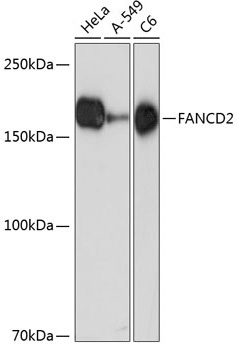
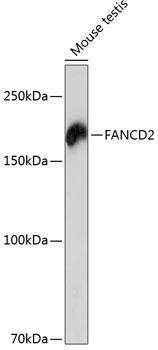
HeLa, A549, C6, Mouse testis
Cellular Localization:
Nucleus.
Calculated MW:
164kDa
Observed MW:
164kDa
The Fanconi anemia complementation group (FANC) currently includes FANCA, FANCB, FANCC, FANCD1 (also called BRCA2), FANCD2, FANCE, FANCF, FANCG, FANCI, FANCJ (also called BRIP1), FANCL, FANCM and FANCN (also called PALB2). The previously defined group FANCH is the same as FANCA. Fanconi anemia is a genetically heterogeneous recessive disorder characterized by cytogenetic instability, hypersensitivity to DNA crosslinking agents, increased chromosomal breakage, and defective DNA repair. The members of the Fanconi anemia complementation group do not share sequence similarity; they are related by their assembly into a common nuclear protein complex. This gene encodes the protein for complementation group D2. This protein is monoubiquinated in response to DNA damage, resulting in its localization to nuclear foci with other proteins (BRCA1 AND BRCA2) involved in homology-directed DNA repair. Alternative splicing results in multiple transcript variants.
Purification Method
Affinity purification
Gene ID
2177
RRID
AB_2862737
Buffer Information
Store at -20℃. Avoid freeze / thaw cycles. Buffer: PBS containing 50% glycerol and 0.05% BSA, preserved with proclin300 or sodium azide, pH 7.3.
Western blot analysis of various lysates using FANCD2 Rabbit mAb (CAB19692) at 1:1000 dilution. Secondary antibody: HRP-conjugated Goat anti-Rabbit IgG (H+L) (CABS014) at 1:10000 dilution. Lysates/proteins: 25μg per lane. Blocking buffer: 3% nonfat dry milk in TBST. Detection: ECL Basic Kit (AbGn00020). Exposure time: 90s.
Western blot analysis of lysates from mouse testis, using FANCD2 Rabbit mAb (CAB19692) at 1:1000 dilution. Secondary antibody: HRP-conjugated Goat anti-Rabbit IgG (H+L) (CABS014) at 1:10000 dilution. Lysates/proteins: 25μg per lane. Blocking buffer: 3% nonfat dry milk in TBST. Detection: ECL Basic Kit (AbGn00020). Exposure time: 3min.



![Anti-FANCD2 [R01-8C5] Monoclonal Antibody (AGMB00305)](https://cdn11.bigcommerce.com/s-h68l9z2lnx/images/stencil/590x590/products/271594/693898/anti-fancd2-r01-8c5-monoclonal-antibody-agmb00305__40556.1774510764.jpg?c=2 "Anti-FANCD2 [R01-8C5] Monoclonal Antibody (AGMB00305)")


