The Phospho-ACC1-S79 Antibody (CABP0298) is a high-quality antibody developed for reliable detection and analysis of target proteins. This antibody, produced in rabbits, is highly specific to human samples and has been validated for use in Western blot applications. By targeting the phosphorylated form of ACACA at serine 79, this antibody enables researchers to investigate the role of ACACA in lipid metabolism and other cellular processes.ACACA is a key enzyme involved in fatty acid biosynthesis and is regulated by phosphorylation at various sites, including serine 79. Phosphorylation of ACACA at serine 79 has been shown to affect its activity and localization within the cell, making it an important site for studying the regulation of lipid metabolism.
This antibody is validated for use in WB, ELISA applications and has demonstrated reactivity against Human, Mouse, Rat samples.
Product Name:
Phospho-ACC1-S79 Antibody
SKU:
CABP0298
Size:
20μL, 100μL
Reactivity:
Human, Mouse, Rat
Conjugate:
Unconjugated
Immunogen:
Synthetic peptide. This information is considered to be commercially sensitive.
Sequence:
SMSG L
Tested Applications:
WBELISA
Recommended Dilution:
WB
1:500 - 1:1000
ELISA
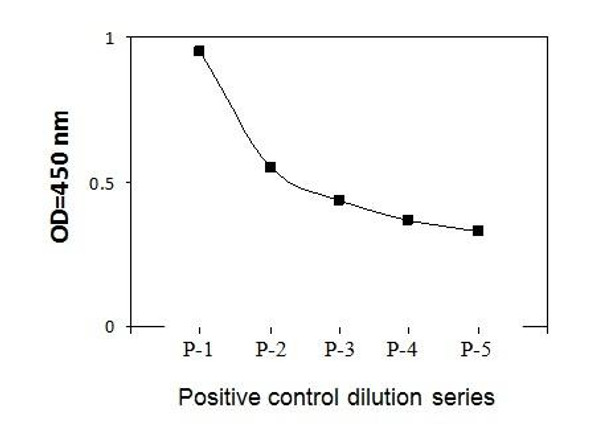
Recommended starting concentration is 1 μg/mL. Please optimize the concentration based on your specific assay requirements.
Acetyl-CoA carboxylase (ACC) is a complex multifunctional enzyme system. ACC is a biotin-containing enzyme which catalyzes the carboxylation of acetyl-CoA to malonyl-CoA, the rate-limiting step in fatty acid synthesis. There are two ACC forms, alpha and beta, encoded by two different genes. ACC-alpha is highly enriched in lipogenic tissues. The enzyme is under long term control at the transcriptional and translational levels and under short term regulation by the phosphorylation/dephosphorylation of targeted serine residues and by allosteric transformation by citrate or palmitoyl-CoA. Multiple alternatively spliced transcript variants divergent in the 5' sequence and encoding distinct isoforms have been found for this gene.
Purification Method
Affinity purification
Gene ID
31
RRID
AB_2770893
Buffer Information
Store at -20℃. Avoid freeze / thaw cycles. Buffer: PBS containing 50% glycerol, preserved with proclin300 or sodium azide, pH 7.3.
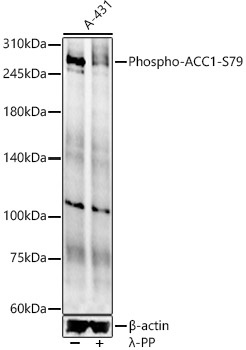
Western blot analysis of lysates from A-431 cells, using Phospho-ACC1-S79 Rabbit pAb (CABP0298) at 1:700 dilution. A-431 cells were treated by λ-PP mixed solution (1ul) at 30℃ for 30 minutes. Secondary antibody: HRP-conjugated Goat anti-Rabbit IgG (H+L) (CABS014) at 1:10000 dilution. Lysates/proteins: 25μg per lane. Blocking buffer: 3% nonfat dry milk in TBST. Detection: ECL Enhanced Kit (AbGn00021). Exposure time: 90s.
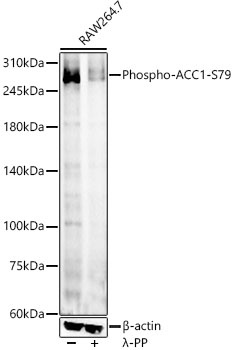
Western blot analysis of lysates from RAW264.7 cells, using Phospho-ACC1-S79 Rabbit pAb (CABP0298) at 1:700 dilution. RAW264. 7 cells were treated by λ-PP mixed solution (1ul) at 30℃ for 30 minutes. Secondary antibody: HRP-conjugated Goat anti-Rabbit IgG (H+L) (CABS014) at 1:10000 dilution. Lysates/proteins: 25μg per lane. Blocking buffer: 3% nonfat dry milk in TBST. Detection: ECL Enhanced Kit (AbGn00021). Exposure time: 90s.