The Leptin receptor is a member of the Class I cytokine receptor family. It mediates the activities of Leptin, a multi-functional hormone produced primarily by adipose tissues that plays roles in food intake, energy metabolism, angiogenesis, reproduction, hematopoiesis, bone metabolism, and immune function. The human Leptin R gene encodes 1165 amino acids (aa) including a signal peptide, an extracellular region with cytokine receptor homology (CRH), multiple fibronectin type III domains and a WSXWS motif, a transmembrane domain, and a cytoplasmic domain that supports JAK/STAT signaling. Soluble Leptin R is the primary Leptin-binding protein in blood, where it maintains a pool of available bioactive Leptin, delays Leptin clearance from circulation, and down-regulates blood-brain transmission of Leptin. In humans, soluble Leptin R levels are inversely proportional to adiposity and are elevated in females versus males. Soluble Leptin R is also found up-regulated in patients with chronic heart failure, end-stage renal disease, and anorexia.It is expressed by tumor-initiating stem cells, and is proposed as a link between cancer and obesity.
Recombinant Human Leptin Receptor is produced by our Mammalian expression system and the target gene encoding Phe22-Asp839 is expressed with a 10His tag at the C-terminus.
Purity:
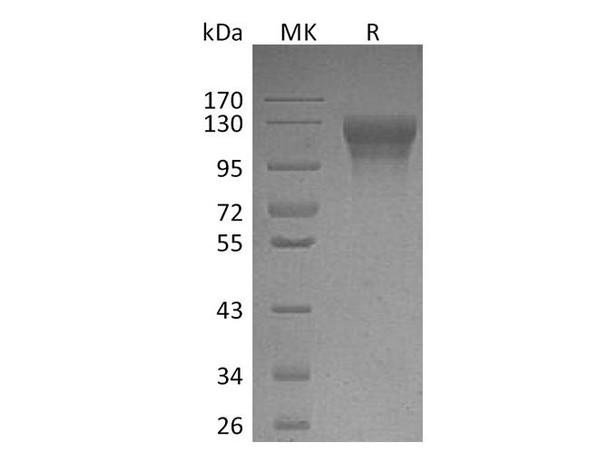
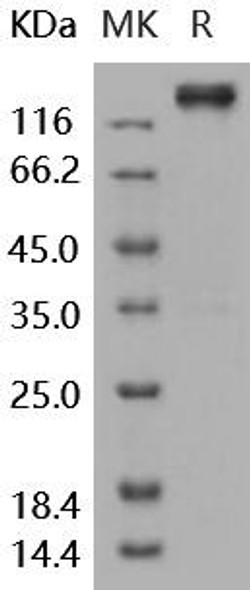
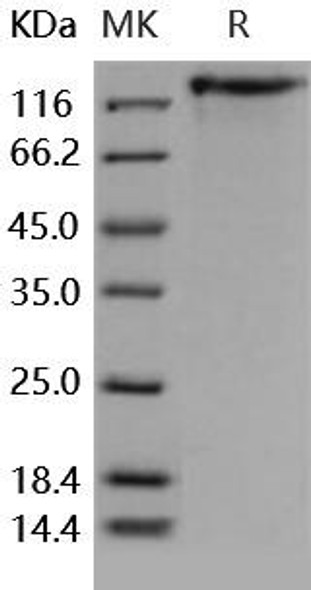
> 95% as determined by reducing SDS-PAGE.
Mol Mass:
94.9 kDa
AP Mol Mass:
100-130 kDa
Formulation:
Lyophilized from a 0.2 µm filtered solution of PBS, pH7.4.
Shipping:
This product is provided as lyophilized powder which is shipped with ice packs.
Stability and Storage:
Lyophilized proteins are stable for up to 12 months when stored at -20 to -80°C. Reconstituted protein solution can be stored at 4-8°C for 2-7 days. Aliquots of reconstituted samples are stable at < -20°C for 3 months.