Osteopetrosis-associated transmembrane protein 1 (OSTM1) is a Single-pass type I membrane protein. It is expressed in many hematopoietic cells of the myeloid and lymphoid B- and T-lineages. The analysis of OSTM1 association with CLCN7 demonstrated that OSTM1 requires CLCN7 to localize to lysosomes, whereas the formation of a CLCN7-OSTM1 complex is required to stabilize CLCN7. The researches found that OSTM1 plays a major role in myelopoiesis and lymphopoiesis and provided evidence of a crosstalk mechanism between hematopoietic cells for osteoclast activation. Thus, OSTM1 has a important role in osteoclast function and activation. The loss of function of OSTM1 results in deregulation of multiple hematopoietic lineages in addition to osteoclast lineage, OSTM1-defect patients display the most severe recessive osteopetrotic phenotype and die at early ages. Furthermore, it is suggested that OSTM1 has a primary role in neural development not related to lysosomal dysfunction. The canonical Wnt/beta-catenin signaling pathway may be a molecular basis for OSTM1 mutations and severe autosomal recessive osteopetrosis (ARO).
Product Name:
Human OSTM1 Recombinant Protein (RPES2500)
Product Code:
RPES2500
Size:
50 µg
Species:
Human
Expressed Host:
HEK293 Cells
Synonyms:
GIPN,GL,HSPC019,OPTB5
Accession:
NP_054747.2
Sequence:
Met 1-Pro 284
Fusion tag:
C-His
Endotoxin:
<1.0 EU per µg as determined by the LAL method.
Protein Construction:
A DNA sequence encoding the extracellular domain of human OSTM1 (NP_054747.2) (Met 1-Pro 284) was expressed, fused with a C-terminal polyhistidine tag.
Purity:
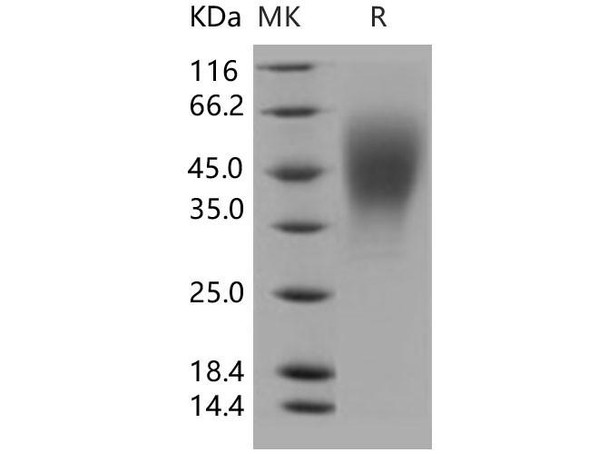
> 97 % as determined by reducing SDS-PAGE.
Mol Mass:
29.7 kDa
AP Mol Mass:
40-50 kDa
Formulation:
Lyophilized from sterile PBS, pH 7.4
Shipping:
This product is provided as lyophilized powder which is shipped with ice packs.
Stability and Storage:
Lyophilized proteins are stable for up to 12 months when stored at -20 to -80°C. Reconstituted protein solution can be stored at 4-8°C for 2-7 days. Aliquots of reconstituted samples are stable at < -20°C for 3 months.