Ubiquitin-Conjugating Enzyme Variant 1a (UBE2V1) is a member of the Ubiquitin-conjugating (E2) enzyme family. The E2 catalytic core domain of UBE2V1 lacks an active site cysteine residue, rendering it catalytically inactive on its own. However, in the cytoplasm UBE2V1 is able to form a catalytically active complex with UBE2N/Ubc13, which mediates the synthesis Lys63-linked Ubiquitin chains and is required for NF-kappa B activation. UBE2V1 is required for UBE2N (Ubc13)/UBE2V1 Complex-dependent Lys63-linked Ubiquitin chain formation. More specifically, UBE2V1 orients the Ubiquitin molecule to favor linkage at Lys63 via a non-covalent interaction with the Ubiquitin molecule. The UBE2V1-UBE2N heterodimer catalyzes the synthesis of non-canonical poly-ubiquitin chains that are linked through Lys63. This type of poly-ubiquitination activates IKK and does not seem to involve protein degradation by the proteasome. UBE2V1 plays a role in the activation of NF-kappa-B mediated by IL1B, TNF, TRAF6, and TRAF2. It mediates transcriptional activation of target genes. UBE2V1 also controls the progress through the cell cycle and differentiation, the error-free DNA repair pathway and contributes to the survival of cells after DNA damage.
Recombinant Human Ubiquitin-Conjugating Enzyme E2 Variant 1 is produced by our E.coli expression system and the target gene encoding Ala2-Asn147 is expressed with a 6His tag at the C-terminus.
Purity:
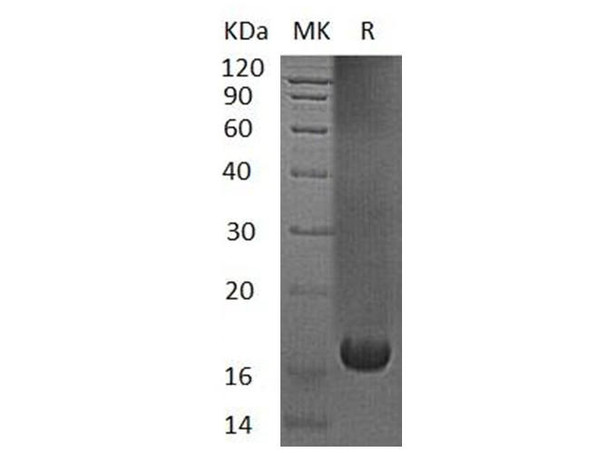
> 95 % as determined by reducing SDS-PAGE.
Mol Mass:
17.5 kDa
AP Mol Mass:
17 kDa
Formulation:
Supplied as a 0.2 µm filtered solution of 50mM HEPES, 100mM NaCl, pH 8.0.
Shipping:
This product is provided as liquid. It is shipped at frozen temperature with blue ice/gel packs.Upon receipt, store it immediately at<-20°C.
Stability and Storage:
Store at < -20°C, stable for 6 months. Please minimize freeze-thaw cycles.