Fc fragment of IgE, low affinity II, receptor for (CD23) or CD23 antigen is a member of the cluster of differentiation family. The cluster of differentiation (cluster of designation) (often abbreviated as CD) is a protocol used for the identification and investigation of cell surface molecules present on white blood cells initially but found in almost any kind of cell of the body, providing targets for immunophenotyping of cells. Physiologically, CD molecules can act in numerous ways, often acting as receptors or ligands (the molecule that activates a receptor) important to the cell. A signal cascade is usually initiated, altering the behavior of the cell (see cell signaling). Some CD proteins do not play a role in cell signaling, but have other functions, such as cell adhesion. CD23/FCER2 is a B-cell specific antigen, and a low-affinity receptor for IgE. It has essential roles in B cell growth and differentiation, and the regulation of IgE production. This protein also exists as a soluble secreted form, then functioning as a potent mitogenic growth factor. Increased levels of soluble CD23/FCER2 cause the recruitment of non-sensitised B-cells in the presentation of antigen peptides to allergen-specific B-cells, therefore increasing the production of allergen specific IgE. IgE, in turn, is known to upregulate the cellular expression of CD23 and Fc epsilon RI (high-affinity IgE receptor).
Product Name:
Mouse CD23 Recombinant Protein (RPES0134)
Product Code:
RPES0134
Size:
50µg
Species:
Mouse
Expressed Host:
HEK293 Cells
Synonyms:
CD23,Fce2,Fcer2,Fcer2a,Ly-42
Accession:
P20693-1
Sequence:
Glu 51-Pro 331
Fusion tag:
N-His
Endotoxin:
<1.0 EU per µg of the protein as determined by the LAL method.
Protein Construction:
A DNA sequence encoding the extracellular domain of mouse FCER2A isoform A (P20693-1) (Glu 51-Pro 331) was fused with a polyhistidine tag at the N-terminus.
Purity:
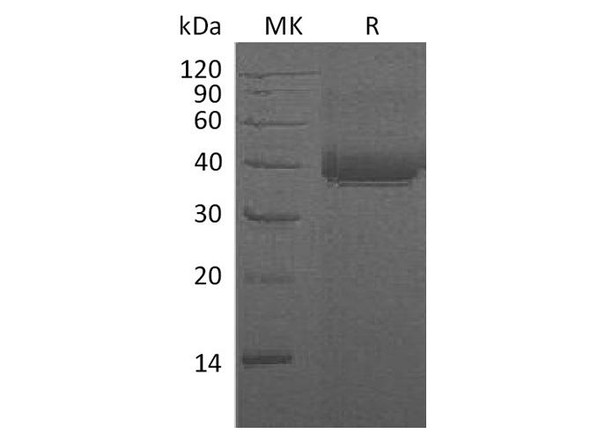
> 92 % as determined by SDS-PAGE
Mol Mass:
34.3 kDa
AP Mol Mass:
40-45 kDa
Formulation:
Lyophilized from sterile PBS, pH 7.4
Shipping:
This product is provided as lyophilized powder which is shipped with ice packs.
Stability and Storage:
Lyophilized proteins are stable for up to 12 months when stored at -20 to -80°C. Reconstituted protein solution can be stored at 4-8°C for 2-7 days. Aliquots of reconstituted samples are stable at < -20°C for 3 months.