Description
7-AAD Viability Staining Solution (100µg/mL)
7-AAD Viability Staining Solution (AKES030) is a 100 µg/mL liquid DNA-binding dye for flow cytometric dead cell discrimination. 7-AAD is efficiently excluded by cells with intact membranes and enters late apoptotic or necrotic cells to stain DNA. It is used with Annexin V to distinguish cells at different apoptotic stages. For Research Use Only.
7-AAD (7-aminoactinomycin D) is a fluorescent probe that binds nucleic acids with a high DNA binding constant. Its key property is membrane impermeance: intact, biologically active cells efficiently exclude the dye, so it reports loss of plasma membrane integrity rather than staining living cells. The reagent is supplied as a 100 µg/mL liquid, and its dyeing position is the cell nucleus, where it stains DNA once it gains access to the cell interior.
Researchers use 7-AAD for dead cell discrimination and DNA analysis during flow cytometric analysis. Because membrane integrity is lost in late apoptotic and necrotic cells, the dye enters these cells and stains their DNA, which allows them to be distinguished from cells that remain intact. Combined with Annexin V, 7-AAD distinguishes cells at different apoptotic stages. The dye is also applied to fixed and permeabilized cells for broad-spectrum fluorescent staining, and it is presented as a substitute for propidium iodide (PI) in multiple fluorescent staining panels.
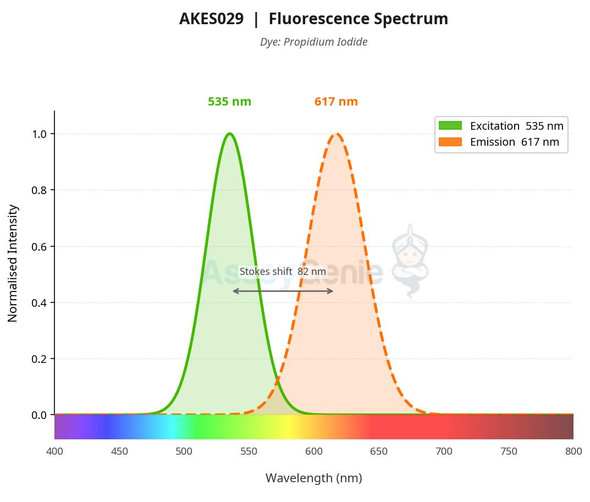
In practice, 7-AAD is excited by a 546 nm argon ion laser. Its emission spectrum is narrower than that of PI and lies at a longer wavelength in the far-infrared region, which reduces interference with other detection channels. The dye is added to treated cells as a fluorescent stain and the sample is then analyzed by flow cytometry, with apoptosis or necrosis detected as soon as possible after staining.
The sources describe use on treated cells, including fixed and permeabilized cells, but they do not list specific tissue or fluid sample types. The reagent is light sensitive and should be stored at 2 to 8°C with protection from light. Samples should be kept away from direct light for extended periods to protect the fluorophore from quenching. The reagent is irritating, so direct contact with skin and inhalation should be avoided, and lab coats and disposable gloves should be worn during handling. The product is for research use only.
| Product name: | 7-AAD Viability Staining Solution (100µg/mL) |
| SKU: | AKES030 |
| Format: | Liquid |
| Concentration: | 100 µg/mL |
| Primary application: | Flow cytometry: dead cell discrimination and apoptosis analysis |
| Excitation: | 546 nm argon ion laser |
| Staining location: | Nucleus (DNA) |
| Intended use: | Research Use Only |
- Liquid format at 100 µg/mL (7-AAD)
- DNA-binding dye excluded by intact cells
- Stains late apoptotic and necrotic cells with compromised membranes
- Excited by 546 nm argon ion laser; far-red emission with less spectral overlap than PI
- Compatible with Annexin V staining for apoptosis staging
- Validated for suspension cells
7-AAD binds DNA with a high binding constant and is efficiently excluded by cells with intact plasma membranes. Cells with lost membrane integrity, including late apoptotic and necrotic cells, take up the dye and stain nuclear DNA. Fluorescence is read by flow cytometry using a 546 nm excitation source.
- Discrimination of dead and necrotic cells in flow cytometry
- Staging of apoptosis when combined with Annexin V
- DNA analysis in flow cytometric workflows
- Fluorescent staining of necrotic cells
- Broad-spectrum DNA staining of fixed and permeabilized cells
- Substitute for PI in multiplex fluorescent panels
| Component | Storage |
| 7-AAD Reagent (100µg/mL) | 2-8°C, protect from light (shading light) |
- Phosphate-buffered saline (PBS)
- 1 x Annexin V Binding Buffer
- Annexin V-APC (user-supplied)
- Centrifuge capable of 300 g
- Flow cytometer with 546 nm excitation
- Cell counter
- Microcentrifuge tubes
- Lab coat and disposable gloves
Staining suspension cells
- Induce apoptosis in suspension cells with the reagents of interest.
- Collect cells, centrifuge at 300 g for 5 min, and discard the supernatant.
- Wash cells with PBS, resuspend gently, and count.
- Aliquot 1-5 x 10⁵ cells per tube, centrifuge at 300 g for 5 min, and discard the supernatant.
- Wash cells with PBS, centrifuge, and discard the supernatant.
- Resuspend cells in 500 µL of 1 x Annexin V Binding Buffer.
- Add 5 µL of Annexin V-APC and 5 µL of 7-AAD Reagent (100 µg/mL) to each tube.
- Gently vortex and incubate at room temperature for 15-20 min in the dark.
- Analyze immediately on the flow cytometer. Alternatively, place cells on ice in the dark and analyze within 1 hour.
Which sample types can be stained with 7-AAD?
The manual describes staining of treated cells to distinguish necrotic cells, and staining of fixed and permeabilized cells for broad-spectrum fluorescent staining. The sources do not list specific tissue or fluid sample types.
Does 7-AAD stain live cells?
No. Intact, biologically active cells cannot be permeated by 7-AAD. The dye stains only cells that have lost membrane integrity or that have been fixed and permeabilized.
How should the reagent be stored and how long is it stable?
Store at 2 to 8°C with protection from light. The expiration date is 12 months, and the product is shipped on an ice bag.
What excitation and emission characteristics should I plan for?
7-AAD is excited by a 546 nm argon ion laser. Its emission is narrower than that of PI and lies at a longer wavelength in the far-infrared region, which provides less interference with other detection channels.
How soon after staining should samples be analyzed?
Detect apoptosis as soon as possible after staining. Delay allows the number of apoptotic or necrotic cells to increase, which can alter results.
Can 7-AAD be combined with Annexin V?
Yes. Using 7-AAD together with Annexin V allows cells at different apoptotic stages to be distinguished.
| Storage temperature: | 2-8°C |
| Light protection: | Store and handle in the dark (shading light) |
| Shelf life: | 12 months |
| Aliquoting: | Split into small tubes before use |
| Freeze/thaw: | Avoid freeze/thaw cycles |
| Shipping: | Ice bag |
Cautions
- Research Use Only. Not for diagnostic or therapeutic use.
- The product is irritating. Avoid direct contact with skin and inhalation.
- Sensitive to light. Avoid extended exposure of samples to direct light to prevent fluorophore quenching.
- Avoid freeze/thaw cycles; aliquot into small tubes.
- For maximal performance, use within 12 months.
- Analyze as soon as possible after staining to limit increases in apoptosis or necrosis.
- Validated only in suspension cells. Enzymatic digestion of adherent cells may increase necrotic or apoptotic fractions and affect results.
- Maintain cell viability; it is critical to the assay.
- Wear a lab coat and disposable gloves during use.