Description
Adenosine Deaminase (ADA) Activity Assay Kit
The Adenosine Deaminase (ADA) Activity Assay Kit (MAES0141) quantifies ADA enzyme activity in serum, plasma, and animal tissue homogenates using a colorimetric endpoint read at 550 nm on a microplate reader. ADA is a nucleic acid metabolic enzyme involved in cellular immune activity, and its activity is used as a research marker alongside ALT or GGT for liver injury studies. The kit is supplied for Research Use Only.
Adenosine deaminase (ADA) is an enzyme that hydrolyzes adenosine to form hypoxanthine riboside. That product is then hydrolyzed by purine riboside phosphatase to yield hypoxanthine and phosphate ribose, so ADA sits at the entry point of this purine catabolic sequence. Measuring ADA activity therefore reports on the rate of adenosine turnover in a sample.
Researchers measure ADA activity in liver and renal function studies, which is the research area listed for this kit. The recommended dilution table includes mouse liver, rat kidney, rat heart, and rat spleen tissue homogenates, as well as mouse and human serum, which indicates the range of animal models the method has been applied to. The kit is labeled for research use only and must not be used for clinical diagnosis.
The assay is a colorimetric, coupled-enzyme method. ADA activity generates hypoxanthine, which xanthine oxidase converts to hydrogen peroxide. Peroxidase then drives the reaction of hydrogen peroxide with 4-aminoantipyrine and a color source to form a red product. This product has its maximum absorbance at 550 nm, and the change in absorbance is proportional to ADA activity. Sample (10 µL) is mixed with working solution, chromogenic agent is added, and the plate is incubated at 37°C. Absorbance is read at 550 nm after 7 min (A1) and again after a further 10 min (A2).
The kit is validated for serum, plasma, and animal tissue samples. Serum or plasma can be tested directly. If testing does not occur on the day of collection, serum or plasma can be stored at -80°C for up to one month. Tissue is homogenized in cold normal saline and clarified by centrifugation, and the supernatant is kept on ice until testing. Because tissue activity is normalized to protein, the protein concentration of the supernatant must be determined separately.
The assay has an analytical sensitivity of 0.03 U/L and a detection range of 0.03 to 99 U/L. Intra-assay precision is 3% CV and inter-assay precision is 6% CV. Spike recovery averaged 98%, with individual recoveries between 95% and 103% across low, middle, and high standard concentrations.
| Product Name: | Adenosine Deaminase (ADA) Activity Assay Kit |
| SKU: | MAES0141 |
| Size: | 96 Assays |
| Sample Types: | Serum, plasma, animal tissue |
| Detection Method: | Colorimetric |
| Instrument: | Microplate reader (550 nm) |
| Assay Time: | 40 min |
| Sample Volume: | 10 µL |
| Detection Range: | 0.03-99 U/L |
| Sensitivity: | 0.03 U/L |
| Intra-assay CV: | 3% |
| Inter-assay CV: | 6% |
| Analyte: | Adenosine deaminase (ADA), synonym ADA |
| Sample Types: | Serum, plasma, animal tissue |
| Detection Range: | 0.03-99 U/L |
| Analytical Sensitivity: | 0.03 U/L |
| Average Recovery: | 98% (three concentrations, six replicates each) |
| Intra-assay CV (three human serum samples, 20 replicates): | 2.8-3.4% |
| Inter-assay CV (three human serum samples, 20 runs in duplicate, three operators): | 5.9-6.1% |
| Research Area: | Enzymes; liver function |
- Colorimetric, two-read kinetic-style assay (A1 at 7 min, A2 at 17 min) read at 550 nm
- Detection range 0.03-99 U/L; analytical sensitivity 0.03 U/L
- Validated sample types: serum, plasma, and animal tissue homogenates
- Sample volume 10 µL; total assay time 40 min
- Intra-assay CV 3% and inter-assay CV 6%
- Average recovery 98% across low, middle, and high standards
ADA hydrolyzes the substrate adenosine to form hypoxanthine riboside. Purine riboside phosphatase then hydrolyzes hypoxanthine riboside to produce hypoxanthine and phosphate ribose. Xanthine oxidase converts hypoxanthine to hydrogen peroxide (H2O2), which, in the presence of peroxidase, 4-aminoantipyrine, and a color source, forms a red substance. This product has a maximum absorption peak at 550 nm, and the change in absorbance is proportional to ADA activity.
- Measurement of ADA activity in serum and plasma from animal studies
- Profiling ADA activity in animal tissue homogenates, including lymphoid tissues
- Liver function and liver injury biomarker studies, used alongside ALT or GGT
- Enzyme activity studies related to nucleic acid metabolism and cellular immune function
| Component | Quantity | Storage |
| Working Reagent 1 (working solution) | 20 mL × 1 vial | 2-8°C, 12 months, protect from light |
| Chromogenic Agent | 10 mL × 1 vial | 2-8°C, 12 months, protect from light |
| Reagent 3 Standard (1 mmol/L) | 4 mL × 1 vial | 2-8°C, 12 months |
| Microplate | 96 wells | No special requirement |
| Plate Sealer | 2 pieces | No special requirement |
| Sample Layout Sheet | 1 piece | No special requirement |
- Micropipettes and multichannel pipette
- Centrifuge (including microcentrifuge for small reagent volumes)
- Microplate reader capable of 550 nm absorbance
- Water bath or incubator set to 37°C
- Double-distilled water (standard dilution)
- Normal saline (0.9% NaCl) for sample dilution and tissue homogenization
- PBS (0.01 M, pH 7.4) for tissue washing
- Homogenizer (Dounce type) and 4°C cold setup for tissue preparation
- Protein concentration assay for tissue supernatants (user-supplied)
Serum/plasma
- Detect serum or plasma samples directly in the assay.
- If samples are not tested on the same day, store serum or plasma at -80°C for up to one month.
- Sample volume per well is 10 µL.
- Recommended dilution factor: mouse serum, 1; human serum, 1. Dilute with normal saline (0.9% NaCl) or PBS (0.01 M, pH 7.4) when a dilution is required.
- For sample types not listed, perform a pretest to confirm the dilution factor.
Animal tissue
- Harvest the amount of tissue needed for each assay. The initial recommendation is 20 mg.
- Wash the tissue in cold PBS (0.01 M, pH 7.4).
- Homogenize 20 mg of tissue in 180 µL of normal saline (0.9% NaCl) with a Dounce homogenizer at 4°C. This yields a 10% homogenate.
- Centrifuge at 10,000 × g for 10 min to remove insoluble material. Collect the supernatant and keep it on ice for detection.
- Determine the protein concentration of the supernatant using a separate protein assay. The result is required for the calculation.
- Recommended dilution factor: 10% mouse liver homogenate, 1; 10% rat kidney homogenate, 1; 10% rat heart homogenate, 2-3; 10% rat spleen homogenate, 2-3. Dilute with normal saline (0.9% NaCl).
- For tissue types not listed, perform a pretest to confirm the dilution factor.
Reagent and standard preparation
- Equilibrate all reagents to room temperature before use.
- Prepare a fresh set of standards for each assay and discard working standard dilutions after use.
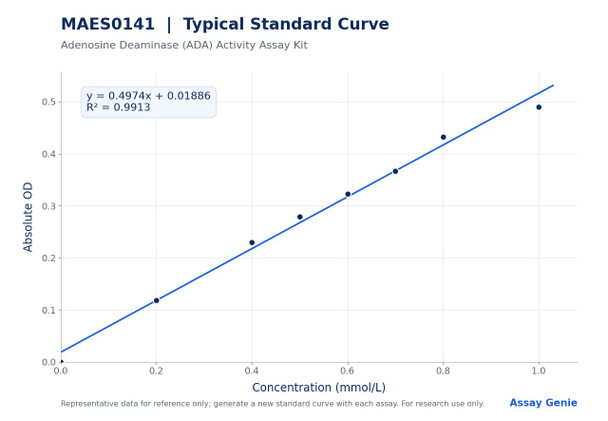
- Dilute the 1 mmol/L standard with double-distilled water as follows: 0 mmol/L (0 µL standard, 200 µL water); 0.2 mmol/L (40 µL, 160 µL); 0.4 mmol/L (80 µL, 120 µL); 0.5 mmol/L (100 µL, 100 µL); 0.6 mmol/L (120 µL, 80 µL); 0.7 mmol/L (140 µL, 60 µL); 0.8 mmol/L (160 µL, 40 µL); 1.0 mmol/L (200 µL, 0 µL).
Sample preparation
- Serum or plasma: assay directly. If not assayed the same day, store at -80°C for up to one month.
- Tissue: wash tissue in cold PBS (0.01 M, pH 7.4) and homogenize 20 mg tissue in 180 µL normal saline (0.9% NaCl) with a Dounce homogenizer at 4°C.
- Centrifuge at 10000 × g for 10 min. Collect the supernatant and keep on ice.
- Determine protein concentration of the supernatant for the tissue calculation.
- Dilute samples as needed. Recommended dilution factors: 10% mouse liver homogenate 1; 10% rat kidney homogenate 1; 10% rat heart homogenate 2-3; 10% rat spleen homogenate 2-3; mouse serum 1; human serum 1. Use normal saline (0.9% NaCl) as diluent. Pretest other sample types to confirm dilution factor.
Assay procedure
- Add 10 µL of each standard to standard wells and 10 µL of each sample to sample wells.
- Add 180 µL of Working Reagent 1 to each well.
- Add 90 µL of Chromogenic Agent to each well. Add quickly with a multichannel pipette, completing addition within 2 min.
- Incubate at 37°C for 7 min.
- Read absorbance at 550 nm (A1) for sample wells.
- Incubate at 37°C for 10 min.
- Read absorbance at 550 nm (A2) for standard and sample wells. Standard wells need only A2.
Calculation
- Average duplicate readings for each standard. Subtract the mean blank (standard 0 mmol/L) OD from all standard readings to obtain absolute OD values.
- Plot absolute OD (A2) against standard concentration and fit a linear standard curve y = ax + b.
- Serum or plasma: ADA activity (U/L) = (A2 − A1 − b) ÷ a × 1000 ÷ T × f, where T = 10 min and f = sample dilution factor. One unit is the amount of enzyme that produces 1 µmol hypoxanthine riboside per minute per L at 37°C.
- Tissue: ADA activity (U/g prot) = (A2 − A1 − b) ÷ a × 1000 ÷ T × f ÷ Cpr, where Cpr is protein concentration in g prot/L.
Serum (plasma): ADA activity (U/L) = (A2 − A1 − b) ÷ a × 1000* ÷ T × f; Tissue: ADA activity (U/gprot) = (A2 − A1 − b) ÷ a × 1000* ÷ T × f ÷ Cpr
- Standard curve: y = ax + b, where y is the absolute OD value (the mean standard OD minus the blank OD) and x is the standard concentration in mmol/L. For standards, only A2 is used.
- A1: OD value after the first incubation at 37°C for 7 min.
- A2: OD value after the second incubation at 37°C for 10 min.
- a: slope of the standard curve. b: intercept of the standard curve.
- T: second incubation time, 10 min.
- 1000*: conversion factor, 1 mmol = 1000 µmol.
- Serum/plasma results are expressed in U/L. One unit is the amount of enzyme that produces 1 µmol of hypoxanthine riboside per liter of serum or plasma per minute at 37°C.
- Tissue results are expressed in U/gprot. One unit is the amount of enzyme that produces 1 µmol of hypoxanthine riboside per gram of tissue protein per minute at 37°C.
- Cpr: protein concentration of the tissue sample in gprot/L, determined separately.
- f: dilution factor of the sample before testing. For undiluted samples, f is 1.
What sample types can be tested with this kit?
The kit detects ADA activity in serum, plasma, and animal tissue samples. Recommended dilution factors are provided for mouse liver, rat kidney, rat heart, and rat spleen homogenates, and for mouse and human serum.
How should samples be stored before testing?
Serum or plasma tested on the same day of collection requires no storage. If testing is delayed, serum or plasma can be stored at -80°C for up to one month. Tissue supernatants should be kept on ice until detection.
How should the kit be stored, and what is its shelf life?
The kit components should be stored at 2-8°C, protected from light. The product is valid for 12 months under these conditions.
What should I do if my sample reads outside the detection range?
The detection range is 0.03 to 99 U/L. If a sample is not within the detection range, an additional dilution or concentration should be performed before testing.
What instrument settings and assay time are required?
Absorbance is measured at 550 nm on a microplate reader. The total assay time is approximately 40 min, including a 7 min incubation at 37°C followed by a 10 min incubation at 37°C before the second reading.
What key steps are critical for a reliable result?
Add the chromogenic agent quickly, using a multichannel pipette, and complete the addition within 2 min. Avoid bubbles when transferring reagents or samples into the microplate. The standard curve is fitted using the A2 values.