Description
Adipogenesis Fluorescence Assay Kit
The Adipogenesis Fluorescence Assay Kit (MAES0252) is a fluorometric kit for quantifying triglyceride content in tissue and cell lysates. Enzymatic conversion of triglycerides generates fluorescent products read at Ex/Em 535/587 nm. Researchers use it to quantify lipid accumulation in adipogenesis and lipid and energy metabolism studies.
Triglycerides are the lipid analyte quantified by the Adipogenesis Fluorescence Assay Kit, and triglyceride accumulation is the measured readout. The kit determines triglyceride content in tissue and cell samples. Results are reported in µmol per gram of protein, which normalizes the lipid signal to sample protein and allows comparison across samples with different sizes or lipid loads. The kit is supplied with a black 96-well microplate and is for research use only, not clinical diagnosis.
The product page lists glycolysis and lipid metabolism and energy metabolism as the research areas for this kit. Triglyceride measurement therefore supports studies of lipid storage and energy metabolism in tissue and cell models. Literature that cites this product also reports use alongside a free fatty acids (NEFA/FFA) fluorometric assay kit and a glucose uptake fluorometric assay kit. This indicates that researchers pair the triglyceride readout with related lipid and glucose measurements in the same studies.
The assay is fluorometric. Triglycerides are converted by enzyme to hydrolytic products, which are then catalyzed by the enzyme to form fluorescent substances. Fluorescence is read at an excitation wavelength of 535 nm and an emission wavelength of 587 nm. The chromogenic working solution is prepared fresh for each run by mixing 196 µL of enzyme working solution with 4 µL of probe per well, giving 200 µL per well and protecting it from light. Then 20 µL of standard or sample supernatant is combined with 200 µL of working solution, mixed, and incubated at 37°C for 5 min before reading on a fluorescence microplate reader.
Tissue and cell samples are supported, including adherent and suspension cells. For tissue, an initial 20 mg is washed in cold PBS (0.01 M, pH 7.4) and homogenized in 180 µL of extraction solution at 4°C. For cells, an initial 1×10^4 cells are washed in PBS and disrupted in 200 µL of extraction solution with an ultrasonic cell disruptor at 4°C. Lysates are centrifuged at 10000×g for 10 min, and supernatants are kept on ice. Supernatants are then heated at 90-100°C for 30 min and cooled to room temperature before testing. Kit components are stored at 2-8°C or -20°C for 12 months, protected from light, as specified in the manual's storage table.
Performance figures show an analytical sensitivity of 1.4 µmol/L, determined as two standard deviations above the mean of 20 zero-standard replicates. The detection range is 1.4-32 µmol/L. Intra-assay CV is 4.0% on the product page, and the manual reports 3.8-4.3% across three porcine heart tissue samples. Inter-assay CV is 8.4% on the product page, and the manual reports 7.6-9.7%. Recovery of standards at 8, 20, and 25 µmol/L averaged 98%, with individual recoveries of 96-100%. The assay time is 20 min.
| Product Name: | Adipogenesis Fluorescence Assay Kit |
| SKU: | MAES0252 |
| Sample Type: | Tissue and cell lysates |
| Assay Type: | Quantitative |
| Assay Time: | 20 min |
| Detection Method: | Fluorescence (fluorometric) |
| Detection Instrument: | Fluorescence microplate reader (Ex/Em = 535 nm/587 nm) |
| Research Area: | Glycolysis and Lipid Metabolism; Energy Metabolism |
| Intended Use: | Research use only |
| Sensitivity: | 1.4 µmol/L |
| Detection Range: | 1.4-32 µmol/L |
| Intra-assay CV: | 4.0% |
| Inter-assay CV: | 8.4% |
| Sample Volume: | 20 µL per well |
| Excitation / Emission: | 535 nm / 587 nm |
| Average Recovery: | 98% |
- Fluorometric detection at Ex/Em 535 nm/587 nm on a fluorescence microplate reader
- Quantitative triglyceride measurement over 1.4-32 µmol/L
- Sensitivity of 1.4 µmol/L
- Validated for tissue and cell samples with a 20 µL sample input per well
- Assay time of 20 min after sample preparation and standard curve setup
Triglycerides were converted by enzyme to produce hydrolytic products, which were catalyzed by the enzyme to produce fluorescent substances. The triglyceride accumulation can be calculated by measuring the fluorescence intensity at the excitation wavelength of 535 nm and the emission wavelength of 587 nm.
- Quantification of triglyceride accumulation in adipogenesis and adipocyte differentiation studies
- Lipid metabolism research in tissue homogenates
- Energy metabolism studies using cell lysates
- Comparison of triglyceride content across treatment or genotype groups, normalized to protein content
| Component | Storage |
| Enzyme Working Solution | 2-8°C, 12 months, protect from light |
| Extraction Solution | 2-8°C or -20°C, 12 months |
| Probe | -20°C, 12 months, protect from light |
| 1 mmol/L Standard | 2-8°C, 12 months, protect from light |
| Black microplate (96 wells) | No storage requirement |
- Micropipettor
- Incubator set to 37°C
- Centrifuge capable of 10000×g
- Fluorescence microplate reader with Ex/Em 535 nm/587 nm filters
- Ice and a 90-100°C heat block or water bath
- Dounce or equivalent tissue homogenizer (tissue samples)
- Ultrasonic cell disruptor (cell samples)
- PBS (0.01 M, pH 7.4)
- User-supplied protein concentration assay for lysate normalization
Tissue
- Harvest the amount of tissue needed for each assay (initial recommendation 20 mg).
- Wash tissue in cold PBS (0.01 M, pH 7.4).
- Homogenize 20 mg tissue in 180 µL extraction solution with a dounce homogenizer at 4°C.
- Centrifuge at 10000×g for 10 min to remove insoluble material. Collect the supernatant and keep it on ice for detection.
- Determine the protein concentration of the supernatant with a separate protein assay.
- Place on ice for 30 min.
- Heat the supernatant at 90-100°C for 30 min to ensure lipids are completely dissolved in extraction solution. Cool to room temperature for detection. If turbidity is present, centrifuge again and take the supernatant for determination.
- Dilution: the lipid content of tissue samples is relatively high, so test 2-3 dilutions in a pre-experiment and choose an appropriate ratio. The diluent is extraction solution. Recommended dilution factors (for reference only): 10% porcine heart tissue homogenate, 3-6; 10% porcine liver tissue homogenate, 8-10.
Cells (adherent or suspension)
- Harvest the number of cells needed for each assay (initial recommendation 1×10^4 cells).
- Wash cells with PBS (0.01 M, pH 7.4).
- Homogenize 1×10^4 cells in 200 µL extraction solution with an ultrasonic cell disruptor at 4°C.
- Centrifuge at 10000×g for 10 min to remove insoluble material. Collect the supernatant and keep it on ice for detection.
- Determine the protein concentration of the supernatant with a separate protein assay.
- Heat the supernatant at 90-100°C for 30 min to ensure lipids are completely dissolved in extraction solution. Cool to room temperature for detection.
- Dilution: the diluent is extraction solution. Recommended dilution factors (for reference only): CHO cell (10^6), 1; 293T cell (10^6), 1. For other sample types, perform a pretest to confirm the dilution factor.
Tissue sample preparation
- Harvest the tissue amount needed for each assay (initial recommendation 20 mg).
- Wash tissue in cold PBS (0.01 M, pH 7.4).
- Homogenize 20 mg tissue in 180 µL extraction solution with a Dounce homogenizer at 4°C.
- Centrifuge at 10000×g for 10 min. Collect the supernatant and keep it on ice.
- Determine protein concentration of the supernatant with a user-supplied protein assay.
- Place on ice for 30 min.
- Heat the supernatant at 90-100°C for 30 min to dissolve lipids completely. Cool to room temperature.
- If turbidity is present, centrifuge again and use the supernatant.
Triglyceride content(µmol/gprot)=(ΔF-b)÷a÷Cpr×f
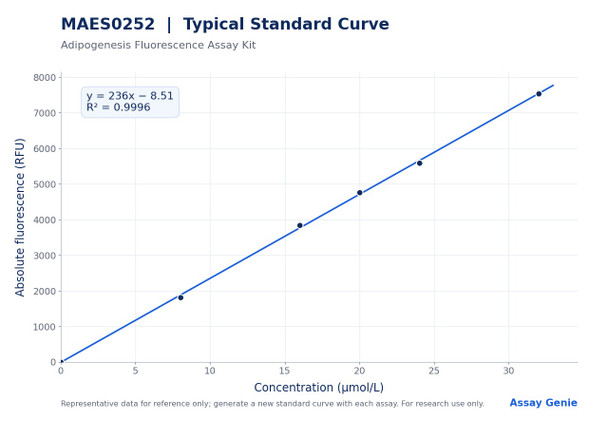
- Standard curve: average duplicate readings for each standard, subtract the mean blank (standard #1, 0 µmol/L) fluorescence from all standards, and plot absolute fluorescence (y) against concentration (x) to obtain y = ax + b. Use graph software or Excel.
- ΔF = F(sample) − F(blank), where F(blank) is the fluorescence value when the standard concentration is 0.
- a and b are the slope and intercept of the standard curve (y = ax + b).
- Cpr is the protein concentration of the sample in gprot/L, determined separately.
- f is the dilution factor of the sample before testing. Multiply by f to correct for dilution.
- Standard concentrations are in µmol/L. The result is expressed as µmol of triglyceride per gram of protein (µmol/gprot).
Which sample types are supported?
Tissue and cell samples (adherent or suspension) are supported. For other sample types, the manual recommends a pretest to confirm the dilution factor.
How should reagents be stored?
Store components at 2-8°C or -20°C for 12 months, protected from light, as specified in the manual's storage table. Do not mix components from different kits.
What should I do if my sample is out of range?
The detection range is 1.4-32 µmol/L. If the concentration is not within this range, perform an extra dilution or concentration of the sample. Pretest several dilutions to select an appropriate factor.
What are the key points for accurate results?
Wash the preparation equipment several times before preparing the chromogenic working solution to prevent impurity contamination. Prepare the working solution fresh and protect it from light. If the heated tissue supernatant is turbid, centrifuge again and use the supernatant.
What instrument settings are required?
Use a fluorescence microplate reader with excitation at 535 nm and emission at 587 nm. The manual specifies a black 96-well microplate.
What is the assay time?
The assay time is 20 min, including a 5 min incubation at 37°C after the working solution is added.
| Storage: | Reagent 3: -20°C; other components: 2-8°C; protect from light |
| Shelf Life: | 12 months |
Notes
- For research use only; do not use in clinical diagnosis.
- Protect the chromogenic working solution from light and prepare it on the spot before use.
- Discard working standard dilutions after use and always prepare a fresh standard curve.
- Do not mix reagents from different kits; centrifuge small-volume reagents before use.
- Wash preparation equipment several times before preparing the chromogenic working solution to prevent impurity contamination.
- Store reagents strictly according to the preservation conditions in the Adipogenesis Fluorescence Assay Kit manual.