Description
alpha-Amylase and beta-amylase Activity Assay Kit
The alpha-Amylase and beta-amylase Activity Assay Kit (MAES0019) measures total alpha- and beta-amylase activity in serum, plasma, saliva, and tissue samples. Enzyme activity is detected colorimetrically: reducing sugars released by amylase react with 3,5-dinitrosalicylic acid (DNS) under heating to form a brown-red product read at 540 nm. The kit is supplied for research use only and is intended for amylase activity measurements in enzyme and sample-comparison studies.
The kit quantifies amylase activity in biological samples, reported as combined alpha- and beta-amylase activity, written as (α+β) amylase activity. Results reflect the catalytic output of the sample rather than a protein mass concentration. For serum, plasma, and saliva, one unit is defined as the production of 1 mg of reducing sugar catalyzed by 1 mL of sample per minute. For tissue, one unit is defined per 1 mg of tissue protein or per 1 g of tissue (fresh weight) per minute. The product page assigns the kit to the amino acids and proteins research area.
The manual states that the kit is intended to measure amylase activity in serum, plasma, saliva, and tissue samples, and that it is for research use only and not for clinical diagnosis. Worked examples in the manual include human plasma and serum, rat serum, and tissue homogenates from 1% corn grain and 1% Daucus carota (carrot), which indicates use across mammalian fluids and plant tissue. The sources do not name specific disease models or physiological conditions, so the intended applications are defined by these sample types and species.
The assay is colorimetric. The reducing sugar produced by the enzymatic reaction reacts with 3,5-dinitrosalicylic acid under heating to form a brown-red substance. In the manual procedure, the sample and substrate are incubated at 40°C for 5 min, chromogenic agent is added, and the mixture is heated at 95°C for 5 min and then cooled in running water. Supernatant is transferred to a microplate, and absorbance is read at 540 nm, with an acceptable instrument range of 535-540 nm. The product page lists an assay time of 30 min.
Serum, plasma, saliva, and tissue homogenates are supported. Serum and plasma are tested directly, and serum or plasma not tested the same day can be stored at -80°C for one month. Saliva should be collected in a sterile container and centrifuged to remove particulates, with fresh samples recommended. Tissue is weighed, homogenized in distilled water on ice, clarified by centrifugation, and brought to a defined volume before testing. Precipitated samples should be centrifuged at 4000 g for 5 min at room temperature, and the supernatant used.
Reported performance includes an analytical sensitivity of 0.008 U/mL and a detection range of 0.01-0.37 U/mL. In the manual, intra-assay CV ranged from 2.4% to 3.2% across three human serum samples assayed 20 times, and inter-assay CV ranged from 3.0% to 4.0% across 20 runs by three operators. The product page lists intra-assay CV of 2.8% and inter-assay CV of 3.6%. Mean recovery was 97%, with individual recoveries of 95-99% at low, middle, and high concentrations.
| Product name: | alpha-Amylase and beta-amylase Activity Assay Kit |
| SKU: | MAES0019 |
| Size: | 96 Assays |
| Sample types: | Serum, plasma, saliva, tissue |
| Detection method: | Colorimetric (DNS reducing-sugar reaction) |
| Instrument: | Microplate reader, 535-540 nm (optimum 540 nm) |
| Assay time: | 30 min |
| Sensitivity: | 0.008 U/mL |
| Detection range: | 0.01-0.37 U/mL |
| Recovery rate: | 97% |
| Intra-assay CV: | 2.4-3.2% (three human serum samples, n = 20 replicates each) |
| Inter-assay CV: | 3.0-4.0% (three human serum samples, 20 runs in duplicate, three operators) |
| Research area: | Enzymes |
| Research Use Only: | Yes |
| Sample types: | Serum, plasma, saliva, tissue homogenate |
| Sensitivity: | 0.008 U/mL (zero standard + 2 SD, n = 20) |
| Detection range: | 0.01-0.37 U/mL |
| Recovery: | 97% average (high, middle, low standards; individual recoveries 95-99%) |
| Sample volume per reaction: | 75 µL sample (manual) |
| Reaction volume: | 150 µL (sample or control plus substrate or water, plus chromogenic agent) |
| Recommended dilution, human plasma: | 10-15 fold |
| Recommended dilution, human serum: | 10-15 fold |
| Recommended dilution, human saliva: | 15-25 fold |
| Recommended dilution, mouse serum: | 15-25 fold |
| Recommended dilution, rat serum: | 15-25 fold |
| Recommended dilution, 1% corn grain tissue homogenate: | 2-5 fold |
| Absolute OD guidance: | If absolute OD exceeds 0.800, dilute the sample further |
- Colorimetric DNS reducing-sugar detection, read at 540 nm on a microplate reader
- Measures alpha- and beta-amylase activity in serum, plasma, saliva, and tissue samples
- Sensitivity 0.008 U/mL; detection range 0.01-0.37 U/mL
- Assay time approximately 30 min after reagent preparation
- Recovery rate 97%; intra-assay and inter-assay CV reported in % (see Overview)
- Supplied as 96 Assays with reagents, 96-well microplate, plate sealers, and sample layout sheet
The reducing sugar reacts with 3,5-dinitrosalicylic acid under heating conditions to produce a brown-red substance. Amylase activity can be calculated by measuring the OD value at 540 nm. Each sample is run in a sample tube and a control tube; the control tube receives sample without substrate (with water in place of substrate), and the sample-minus-control absorbance (ΔA) is used in the activity calculation.
- Measurement of alpha- and beta-amylase activity in serum and plasma samples from research animals and human sources
- Amylase activity profiling in saliva samples
- Tissue homogenate enzyme activity comparisons, including plant tissue such as corn grain homogenate
- Enzyme activity comparisons across sample types, dilutions, or experimental conditions
| Component | Quantity | Storage |
| Reagent 1: Substrate | 10 mL x 1 vial | 2-8°C, 12 months |
| Reagent 2: Chromogenic Agent | 20 mL x 1 vial | 2-8°C, 12 months, protect from light |
| Reagent 3: Standard (10 mg/mL) | 1.5 mL x 1 vial | 2-8°C, 12 months |
| 96-well microplate | 1 plate (96 wells) | No requirement |
| Plate sealer | 2 pieces | — |
| Sample layout sheet | 1 piece | — |
- Test tubes (1.5 mL EP tubes)
- Vortex mixer
- Centrifuge (capable of 3000 x g and 4000 x g)
- Water bath set to 40°C and 95°C
- Ice-water bath and homogenizer (tissue samples)
- Microplate reader capable of reading 535-540 nm (540 nm optimum)
- Double-distilled water (standard and sample dilution, control tubes)
- Pipettes and tips
- Running water for cooling tubes
Serum/plasma
- Serum and plasma are detected directly without extraction.
- If serum or plasma is not tested on the day of collection, store it at -80°C for up to one month.
- Dilute human plasma and human serum 10-15-fold.
- Dilute human saliva, mouse serum, and rat serum 15-25-fold.
- Use double distilled water as the diluent, as stated in the manual.
- For sample types not listed, perform a pretest to confirm the dilution factor.
Saliva
- Collect saliva in a sterile container.
- Remove particulates by centrifugation at 3000 × g for 10 min.
- Fresh saliva is recommended.
- Dilute human saliva 15-25-fold using double distilled water.
Tissue
- Weigh 0.1 g of tissue.
- Add 0.9 mL of distilled water and homogenize with a homogenizer in an ice-water bath.
- Transfer the homogenate to an EP tube and incubate at room temperature for 15 min, mixing every 5 min.
- Centrifuge at 3000 × g at room temperature for 10 min.
- Collect the supernatant and add double distilled water to a final volume of 10 mL. Mix thoroughly; this is the α-amylase solution.
- Dilute 1% corn grain tissue homogenate 2-5-fold using double distilled water.
- For tissue types not listed, perform a pretest to confirm the dilution factor.
Reagent and standard preparation
- Equilibrate all reagents to room temperature before use.
- If substrate or chromogenic agent contains precipitate, heat at 70-80°C in a water bath until dissolved, then cool to 40°C with fresh water before use.
- Prepare a fresh set of standards for each assay; discard working standard dilutions after use.
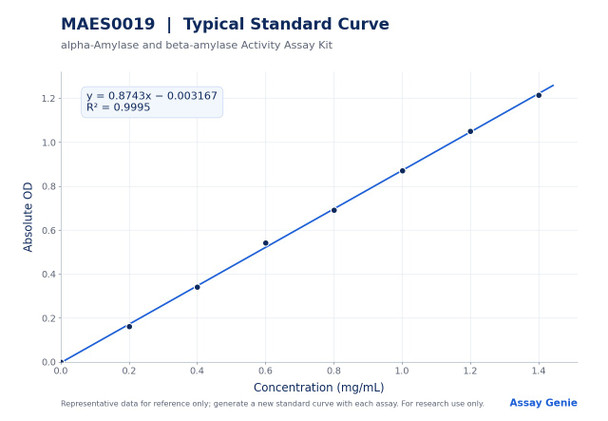
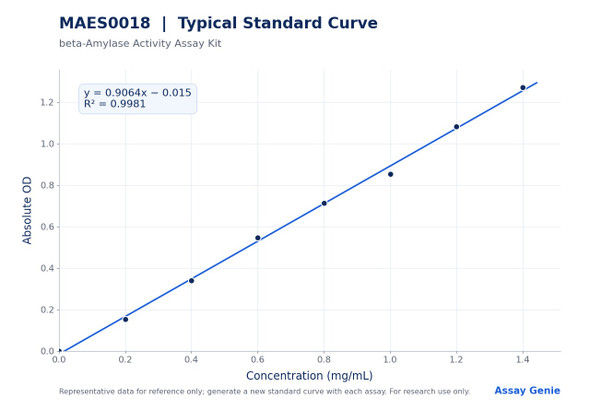
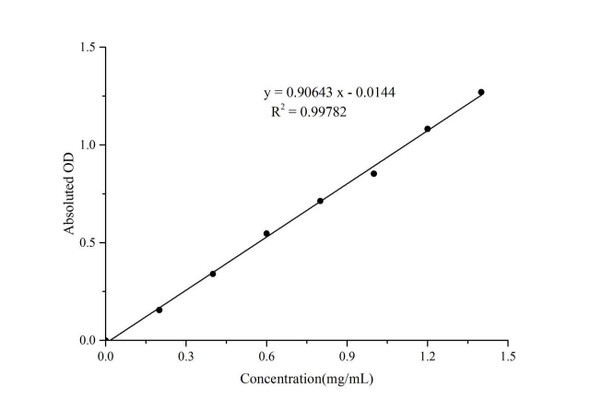
- Dilute the 10 mg/mL standard with double-distilled water to 0, 0.2, 0.4, 0.6, 0.8, 1.0, 1.2, and 1.4 mg/mL (standard volumes 0, 20, 40, 60, 80, 100, 120, and 140 µL; double-distilled water 1000, 980, 960, 940, 920, 900, 880, and 860 µL, respectively).
- Centrifuge small reagent volumes before use to ensure sufficient recovery.
Sample preparation
- Serum and plasma: assay directly. If not assayed the same day, serum or plasma can be stored at -80°C for up to one month.
- Saliva: collect into a sterile container, centrifuge for 10 min at 3000 x g to remove particulates, and use fresh saliva where possible.
- Tissue: weigh 0.1 g of tissue, add 0.9 mL double-distilled water, homogenize in an ice-water bath, transfer to an EP tube, incubate at room temperature for 15 min with oscillation every 5 min, centrifuge at 3000 x g for 10 min at room temperature, and bring the supernatant to a final volume of 10 mL with double-distilled water.
- Dilute samples per the recommended factors (for example, human serum or plasma 10-15 fold, rat serum 15-25 fold). For sample types not listed, run a pretest to confirm the dilution factor.
Standard curve
- Label 1.5 mL EP tubes A to H in duplicate. Add 75 µL of each standard to its tube.
- Add 75 µL substrate to each tube.
- Add 150 µL chromogenic agent to each tube.
- Mix thoroughly and incubate at 95°C for 5 min. Cool tubes under running water, then transfer 250 µL of supernatant per tube to the microplate.
- Read OD at 540 nm.
Sample assay
- Sample tube: add 75 µL sample. Control tube: add 75 µL sample.
- Sample tube: add 75 µL substrate. Control tube: add 75 µL double-distilled water.
- Incubate sample and control tubes in a 40°C water bath for 5 min.
- Add 150 µL chromogenic agent to each tube.
- Mix thoroughly and incubate at 95°C for 5 min. Cool under running water, transfer 250 µL supernatant per tube to the microplate, and read OD at 540 nm.
(α+β) Amylase activity (U/mL) = (ΔA-b) ÷ a × V3 ÷ t ÷ V2 × f
- ΔA is the absolute OD of the sample, calculated as OD sample minus OD control (control tube contains double distilled water in place of substrate).
- a is the slope and b is the intercept of the standard curve, y = ax + b, where y is the absolute OD of the standard and x is its concentration in mg/mL.
- V3 is the total volume of the enzymatic reaction, 0.15 mL (sample plus substrate).
- V2 is the volume of sample added to the reaction, 0.075 mL.
- t is the reaction time, 5 min.
- f is the dilution factor of the sample before testing. Multiply by f to correct for dilution; for undiluted samples, f = 1.
- Result units are U/mL for serum, plasma, and saliva.
- For tissue normalized to protein: (α+β) Amylase activity (U/mg prot) = (ΔA-b) ÷ a × V3 ÷ t ÷ V2 × f ÷ Cpr, where Cpr is the protein concentration of the sample in mg prot/mL.
- For tissue normalized to fresh weight: (α+β) Amylase activity (U/g fresh weight) = (ΔA-b) ÷ a × V3 ÷ t ÷ w × V1 ÷ V2 × f, where V1 is the prepared tissue volume (10 mL), w is the tissue weight (0.1 g), and V2 and V3 are as defined above.
Which sample types can be tested with this kit?
The kit is intended for amylase activity in serum, plasma, saliva, and tissue samples. Serum and plasma are tested directly, while saliva and tissue require the preparation steps in the manual.
How should the kit and samples be stored?
Kit reagents are stored at 2-8°C for 12 months, and the chromogenic agent should be protected from light. Serum or plasma not tested the same day can be stored at -80°C for one month.
What should I do if my sample is out of range?
The detection range is 0.01-0.37 U/mL. If the absolute OD is above 0.800, dilute the sample appropriately, and if the concentration is outside the range, use an extra dilution or concentration of the sample.
What are the key points for avoiding assay problems?
Equilibrate all reagents to room temperature and prepare fresh standards for each run. Heat any precipitate in substrate or chromogenic agent to 70-80°C in a water bath until dissolved, then cool to 40°C. Do not mix components from different kits.
What instrument settings and assay time are needed?
Read absorbance at 540 nm on a microplate reader, with a usable range of 535-540 nm. The product page lists an assay time of 30 min.