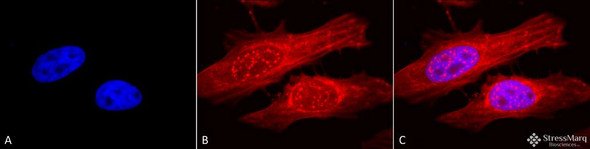
Alpha-B Crystallin Antibody [3A10.C9] is a mouse monoclonal antibody directed against Alpha-B Crystallin, offered by Assay Genie for research applications. Reported applications include WB, IHC, ELISA and ICC/IF. Reported reactivity: Human, Rat and Bovine. Supplied as IgG1, purified by Protein G.
Alpha B Crystallin (CRYAB) is a small heat shock protein (sHSP) originally identified as a structural component of the vertebrate eye lens. While it contributes to lens transparency by preventing protein aggregation, CRYAB is now recognized for its broader role as a molecular chaperone and cytoprotective agent in various tissues, including the central nervous system. CRYAB shares structural and functional similarities with other sHSPs such as HSP25 and HSP27. It binds to misfolded or denatured proteins, stabilizing them in a soluble state and preventing toxic aggregation—a key pathological feature in neurodegenerative diseases like Alzheimer’s, Parkinson’s, and multiple sclerosis. Under cellular stress, CRYAB becomes phosphorylated, enhancing its chaperone activity and contributing to protein quality control. Unlike its Alpha A counterpart, Alpha B Crystallin is widely expressed beyond the lens, including in glial cells, neurons, and muscle tissue. It interacts with diverse cellular components such as membrane proteins, cytoskeletal elements, nuclear proteins, and DNA, supporting its role in maintaining intracellular architecture and stress resilience. Importantly, CRYAB is overexpressed in several neurological disorders and has been shown to inhibit apoptosis by blocking caspase activation. This anti-apoptotic function positions CRYAB as a promising therapeutic target and biomarker in neurodegenerative disease research, with potential applications in neuroprotection, inflammation modulation, and regenerative medicine. This antibody is also available conjugated to ATTO 390, ATTO 488, ATTO 594, APC, Biotin, FITC, HRP, PerCP and RPE. Supplied in 200 µg. For research use only; not for diagnostic or therapeutic procedures.
Product Name:
Alpha-B Crystallin Antibody [3A10.C9]
Product SKU:
STMA00040
Size:
200 µg
Target:
Alpha-B Crystallin
Host Species:
Mouse
Antibody Type:
Monoclonal
Clone ID:
3A10.C9
Research Areas:
Cancer, Heat Shock, Cell Signaling, Protein Trafficking, Chaperone Proteins, Neuroscience
Buffer:
PBS pH7.2, 50% glycerol, 0.09% sodium azide
Storage & Shipping:
Store at -20°C. Shipped on Blue Ice or 4°C. Conjugated variants should be stored according to the product label.
Format:
Liquid
Applications:
WB, IHC, ELISA, ICC/IF
Antibody Isotype:
IgG1
Purification:
Protein G Purified
Concentration:
1 mg/ml
Reactivity:
Human, Rat, Bovine
Recommended Dilution:
WB (1:2000), ICC/IF (1:100); optimal dilutions for assays should be determined by the user.
Specificity:
Detects ~20kDa (predicted mol.weight is ~21kDa). Does not cross-react with αA-crystallin, βL-crystallin, ΒH-crystallin, γ-crystallin, HSP25, HSP27 or HSP47 proteins.
Guarantee:
12 months from date of dispatch
Immunogen:
Native Human Alpha B Crystallin
Immunogen Species:
Human
Accession Number:
NP_001876.1
Gene ID:
1410
Swiss-Prot:
P02511
Cellular Localization:
Cytoplasm | Nucleus
Alternative Names:
Alpha B Crystallin, CRYAB, CRYA2, HSPB5, Heat Shock Protein Beta-5, Heat Shock Protein Family B Member 5, Alpha-Crystallin B Chain, Crystallin Alpha B, Alpha (B)-Crystallin, HEL-S-101, CMD1II, CTPP2, CTRCT16, MFM2, Rosenthal Fiber Component, Epididymis Secretory Protein Li 101, Heat-Shock 20 KD Like-Protein, Renal Carcinoma Antigen NY-REN-27
References:
1. Merck K.B. et al. (1993) J Biol Chem. 268: 1046-1052. 2. Horwitz J. (1992) Proc Natl Acad Sci USA. 89(21): 10449-10453. 3. Cobb B.A. and Petrash J.M. (2002) Biochemistry. 41: 483-490 4. Horwitz J. (2003) Exp Eye Res. 76: 145-153. 5. Bullard B. et al. (2004) J Biol Chem. 279: 7917-7924. 6. Gangalum R.K., Schibler M.J. and Bhat S.P. (2004) J Biol Chem. 279: 43374.43377. 7. Maddala R. and Rao V.P. (2005) Exp Cell Res. 306: 203-215. 8. Yaung J., et al. (2007) Molecular Vision 13: 566-577. 9. Head M.W. et al. (2000) Neuropathol Appl Neurobiol. 26: 304-312. 10. Banduseela V.C., et al. (2009) Physiol Genomics. 39(3): 141-159.




![Anti-Alpha B Crystallin [R02-7A2] Monoclonal Antibody (AGMB01803)](https://cdn11.bigcommerce.com/s-h68l9z2lnx/images/stencil/590x590/products/273092/676478/anti-alpha-b-crystallin-r02-7a2-monoclonal-antibody-agmb01803__80719.1773029549.jpg?c=2 "Anti-Alpha B Crystallin [R02-7A2] Monoclonal Antibody (AGMB01803)")
![Anti-Alpha B Crystallin [R06-4Z-5] Monoclonal Antibody (AGMB03808)](https://cdn11.bigcommerce.com/s-h68l9z2lnx/images/stencil/590x590/products/275097/676691/anti-alpha-b-crystallin-r06-4z-5-monoclonal-antibody-agmb03808__84269.1773030257.jpg?c=2 "Anti-Alpha B Crystallin [R06-4Z-5] Monoclonal Antibody (AGMB03808)")