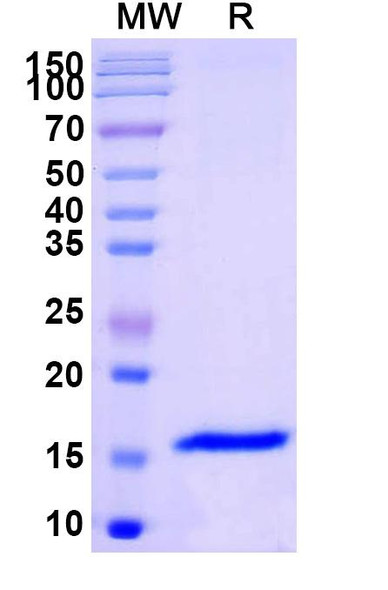
Anti-Human CD22 Recombinant Nanobody (SAA2691) is a recombinant nanobody targeting Human CD22 (clone SAA2691). Format: VHH-8His (alpaca host). Reactivity: Human. Supplied as a liquid in 0.01M PBS pH 7.4. Applications: ELISA. Endotoxin: <10 EU/mg. Purity: >95% as determined by SDS-PAGE. For research use only.
B-cell receptor CD22 is a ~95 kDa protein. Most highly expressed siglec (sialic acid-binding immunoglobulin-like lectin) on B-cells that plays a role in various aspects of B-cell biology including differentiation, antigen presentation, and trafficking to bone marrow. Binds to alpha 2,6-linked sialic acid residues of surface molecules such as CD22 itself, CD45 and IgM in a cis configuration. Can also bind to ligands on other cells as an adhesion molecule in a trans configuration. Acts as an inhibitory coreceptor on the surface of B-cells and inhibits B-cell receptor induced signaling, characterized by inhibition of the calcium mobilization and cellular activation. Mechanistically, the immunoreceptor tyrosine-based inhibitory motif domain is phosphorylated by the Src kinase LYN, which in turn leads to the recruitment of the protein tyrosine phosphatase 1/PTPN6, leading to the negative regulation of BCR signaling. CD22 is the therapeutic target of inotuzumab ozogamicin (Besponsa).
Product Name:
Anti-Human CD22 Recombinant Nanobody (SAA2691)
Size:
50 µg, 100 µg, 1 mg
Product SKU:
GXRM04903
Target:
B-cell receptor CD22
Host Species:
Alpaca
Antibody Type:
Monoclonal
Clone ID:
SAA2691
Reactivity:
Human
Buffer:
0.01M PBS pH 7.4.
Storage & Shipping:
Store at 2 to 8°C for frequent use. Store at -20 to -80°C for twelve months from the date of receipt.
Format:
Liquid
Applications:
ELISA
Antibody Isotype:
VHH-8His
Purity:
>95% as determined by SDS-PAGE.
Purification:
Protein A/G purified from cell culture supernatant.