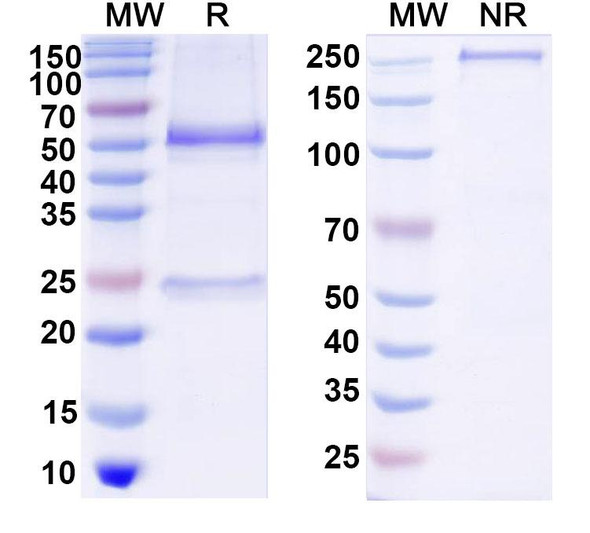
Anti-NGF Recombinant Monoclonal Antibody (PG110) is a recombinant monoclonal antibody targeting NGF (clone PG110). It is a human IgG4, kappa antibody. Reactivity: Human. Supplied as a liquid in 0.01M PBS pH 7.4. Applications: ELISA, flow cytometry and functional assays. Purity: >95% as determined by SDS-PAGE. For research use only.
Beta-nerve growth factor (NGF) is a ~26 kDa protein. Nerve growth factor is important for the development and maintenance of the sympathetic and sensory nervous systems. Extracellular ligand for the NTRK1 and NGFR receptors, activates cellular signaling cascades to regulate neuronal proliferation, differentiation and survival (Probable). The immature NGF precursor (proNGF) functions as a ligand for the heterodimeric receptor formed by SORCS2 and NGFR, and activates cellular signaling cascades that lead to inactivation of RAC1 and/or RAC2, reorganization of the actin cytoskeleton and neuronal growth cone collapse. In contrast to mature NGF, the precursor form (proNGF) promotes neuronal apoptosis (in vitro). Inhibits metalloproteinase-dependent proteolysis of platelet glycoprotein VI.
Product Name:
Anti-NGF Recombinant Monoclonal Antibody (PG110)
Size:
50 µg, 100 µg, 1 mg
Product SKU:
GXRM04499
Target:
Beta-NGF
Host Species:
Human
Antibody Type:
Monoclonal
Clone ID:
PG110
Reactivity:
Human
Buffer:
0.01M PBS pH 7.4.
Storage & Shipping:
Store at 2 to 8°C for frequent use. Store at -20 to -80°C for twelve months from the date of receipt.
Format:
Liquid
Applications:
ELISA, FCM, Functional assay
Recommended Dilutions:
ELISA: 1:2000-1:20000
Antibody Isotype:
IgG4, kappa
Purity:
>95% as determined by SDS-PAGE.
Purification:
Protein A/G purified from cell culture supernatant.