The CCL1 Polyclonal Antibody (CAB10670) is a high-quality antibody developed for reliable detection and analysis of target proteins. This antibody, produced in rabbits, offers high reactivity with human samples and is validated for use in Western blot applications. By binding specifically to the CCL1 protein, researchers can easily detect and analyze its expression in a variety of cell types, making it an ideal choice for studies in immunology and cancer research.CCL1, also known as I-309, plays a crucial role in recruiting immune cells to sites of inflammation and infection.
This antibody is validated for use in WB, ELISA applications and has demonstrated reactivity against Human samples.
Product Name:
CCL1 Polyclonal Antibody
SKU:
CAB10670
Size:
20μL, 100μL
Reactivity:
Human
Conjugate:
Unconjugated
Immunogen:
Recombinant protein (or fragment).This information is considered to be commercially sensitive.
Sequence:
KSMQ VPFS RCCF SFAE QEIP LRAI LCYR NTSS ICSN EGLI FKLK RGKE ACAL DTVG WVQR HRKM LRHC PSKR K
Tested Applications:
WBELISA
Recommended Dilution:
WB
1:500 - 1:1000
ELISA
Recommended starting concentration is 1 μg/mL. Please optimize the concentration based on your specific assay requirements.
Synonyms:
P500, SISe, TCA3, I-309, SCYA1, CCL1
Positive Sample:
RPMI 8226
Cellular Localization:
Secreted.
Calculated MW:
11kDa
Observed MW:
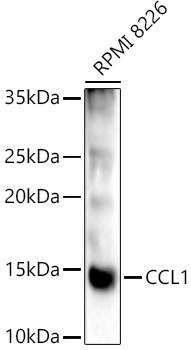
14kDa
This antimicrobial gene is one of several chemokine genes clustered on the q-arm of chromosome 17. Chemokines form a superfamily of secreted proteins involved in immunoregulatory and inflammatory processes. The superfamily is divided into four subfamilies based on the arrangement of the N-terminal cysteine residues of the mature peptide. This chemokine, a member of the CC subfamily, is secreted by activated T cells and displays chemotactic activity for monocytes but not for neutrophils. It binds to the chemokine (C-C motif) receptor 8.
Purification Method
Affinity purification
Gene ID
6346
RRID
AB_2768750
Buffer Information
Store at -20℃. Avoid freeze / thaw cycles. Buffer: PBS containing 50% glycerol, preserved with proclin300 or sodium azide, pH 7.3.
Western blot analysis of lysates from RPMI 8226 cells, using CCL1 Rabbit pAb (CAB10670) at 1:1000 dilution. Secondary antibody: HRP-conjugated Goat anti-Rabbit IgG (H+L) (CABS014) at 1:10000 dilution. Lysates/proteins: 25μg per lane. Blocking buffer: 3% nonfat dry milk in TBST. Detection: ECL Basic Kit (AbGn00020). Exposure time: 90s.