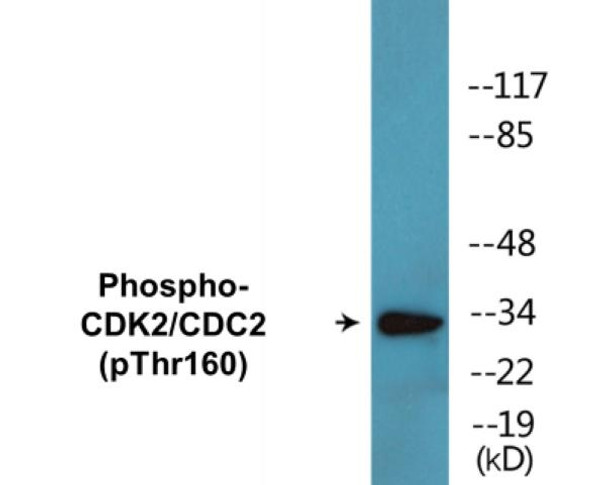
Description
CDK2 (Phospho-Thr160)Colorimetric Cell-Based ELISA Kit
The CDK2 Phospho-Thr160 Colorimetric Cell-Based ELISA Kit is a powerful tool for accurately measuring levels of CDK2 phosphorylated at threonine 160 in cell lysates. This kit offers high sensitivity and specificity, enabling researchers to obtain reliable and reproducible results for a variety of research applications.CDK2 is a key regulator of cell cycle progression, and phosphorylation at threonine 160 is an important post-translational modification that impacts its activity. Dysregulation of CDK2 phosphorylation has been implicated in various diseases, including cancer, making it a valuable target for therapeutic intervention.
By using the CDK2 Phospho-Thr160 Colorimetric Cell-Based ELISA Kit, researchers can gain valuable insights into the role of CDK2 phosphorylation in cellular processes, disease development, and potential treatment strategies. This kit is an essential tool for studying cell cycle regulation and identifying novel therapeutic targets in cancer and other related disorders.
| Product Name: | CDK2 (Phospho-Thr160)Colorimetric Cell-Based ELISA Kit |
| Product Code: | CBCAB00398 |
| ELISA Type: | Cell-Based |
| Target: | CDK2 (Phospho-Thr160) |
| Reactivity: | Human, Mouse, Rat |
| Dynamic Range: | > 5000 Cells |
| Detection Method: | Colorimetric 450 nm |
| Format: | 2 x 96-Well Microplates |
The CDK2 (Phospho-Thr160) Colorimetric Cell-Based ELISA Kit is a convenient, lysate-free, high throughput and sensitive assay kit that can detect CDK2/CDC2 protein phosphorylation and expression profile in cells. The kit can be used for measuring the relative amounts of phosphorylated CDK2/CDC2 in cultured cells as well as screening for the effects that various treatments, inhibitors (ie. siRNA or chemicals), or activators have on CDK2/CDC2 phosphorylation.
Qualitative determination of CDK2 (Phospho-Thr160) concentration is achieved by an indirect ELISA format. In essence, CDK2 (Phospho-Thr160) is captured by CDK2 (Phospho-Thr160)-specific primary antibodies while the HRP-conjugated secondary antibodies bind the Fc region of the primary antibody. Through this binding, the HRP enzyme conjugated to the secondary antibody can catalyze a colorimetric reaction upon substrate addition. Due to the qualitative nature of the Cell-Based ELISA, multiple normalization methods are needed:
| 1. | A monoclonal antibody specific for human GAPDH is included to serve as an internal positive control in normalizing the target absorbance values. |
| 2. | Following the colorimetric measurement of HRP activity via substrate addition, the Crystal Violet whole-cell staining method may be used to determine cell density. After staining, the results can be analysed by normalizing the absorbance values to cell amounts, by which the plating difference can be adjusted. |
| Database Information: | Gene ID: 1017, UniProt ID: P24941, OMIM: 116953, Unigene: Hs.19192/Hs.689624 |
| Gene Symbol: | CDK2 |
| Sub Type: | Phospho |
| UniProt Protein Function: | CDK2: a protein kinase of the CDK family. An important component of the cell cycle machinery. Activity of CDK2 is maximal during S phase and G2. Cdk2/cyclin E kinase activity is important for the G1 to S transition and phosphorylates the Rb protein. In S-phase, active cdk2/cyclin A complexes predominate and phosphorylate E2F, and the active cdk2 complex persists in the nucleus through G2. Part of the Rb pathway disregulated in most tumors. Target of several candidate cancer drugs. However, inhibition does not always prevent cancer cell growth, possibly due to CDK redundancy. Inhibitors: BMS-265246, BMS-265246-01, R-roscovitine (CYC200, CYC202), SU9516, R547, L868276 |
| UniProt Protein Details: | Protein type:Kinase, protein; EC 2.7.11.22; Protein kinase, CMGC; Protein kinase, Ser/Thr (non-receptor); Cell cycle regulation; CMGC group; CDK family; CDK1 subfamily; CDK/CDK1 subfamily Chromosomal Location of Human Ortholog: 12q13 Cellular Component: Cajal body; centrosome; chromosome, telomeric region; X chromosome; condensed chromosome; cytosol; Y chromosome; nucleoplasm; transcription factor complex; cytoplasm; cyclin-dependent protein kinase holoenzyme complex; nucleus; endosome Molecular Function:cyclin binding; protein binding; cyclin-dependent protein kinase activity; metal ion binding; histone kinase activity; ATP binding Biological Process: G1 DNA damage checkpoint; meiosis; mitosis; positive regulation of transcription, DNA-dependent; histone phosphorylation; DNA repair; DNA damage response, signal transduction by p53 class mediator resulting in cell cycle arrest; peptidyl-serine phosphorylation; regulation of ubiquitin-protein ligase activity during mitotic cell cycle; anaphase-promoting complex-dependent proteasomal ubiquitin-dependent protein catabolic process; cell division; positive regulation of cell proliferation; Ras protein signal transduction; mitotic cell cycle; DNA replication; G2/M transition of mitotic cell cycle; blood coagulation; centrosome duplication; potassium ion transport; G1/S transition of mitotic cell cycle; positive regulation of DNA replication initiation |
| NCBI Summary: | This gene encodes a member of a family of serine/threonine protein kinases that participate in cell cycle regulation. The encoded protein is the catalytic subunit of the cyclin-dependent protein kinase complex, which regulates progression through the cell cycle. Activity of this protein is especially critical during the G1 to S phase transition. This protein associates with and regulated by other subunits of the complex including cyclin A or E, CDK inhibitor p21Cip1 (CDKN1A), and p27Kip1 (CDKN1B). Alternative splicing results in multiple transcript variants. [provided by RefSeq, Mar 2014] |
| UniProt Code: | P24941 |
| NCBI GenInfo Identifier: | 116051 |
| NCBI Gene ID: | 1017 |
| NCBI Accession: | P24941.2 |
| UniProt Secondary Accession: | P24941,O75100, A8K7C6, |
| UniProt Related Accession: | P24941 |
| Molecular Weight: | 30,035 Da |
| NCBI Full Name: | Cyclin-dependent kinase 2 |
| NCBI Synonym Full Names: | cyclin-dependent kinase 2 |
| NCBI Official Symbol: | CDK2 |
| NCBI Official Synonym Symbols: | CDKN2; p33(CDK2) |
| NCBI Protein Information: | cyclin-dependent kinase 2; p33 protein kinase; cdc2-related protein kinase; cell division protein kinase 2 |
| UniProt Protein Name: | Cyclin-dependent kinase 2 |
| UniProt Synonym Protein Names: | Cell division protein kinase 2; p33 protein kinase |
| Protein Family: | Cyclin-dependent kinase |
| UniProt Gene Name: | CDK2 |
| UniProt Entry Name: | CDK2_HUMAN |
| Component | Quantity |
| 96-Well Cell Culture Clear-Bottom Microplate | 2 plates |
| 10X TBS | 24 mL |
| Quenching Buffer | 24 mL |
| Blocking Buffer | 50 mL |
| 15X Wash Buffer | 50 mL |
| Primary Antibody Diluent | 12 mL |
| 100x Anti-Phospho Target Antibody | 60 µL |
| 100x Anti-Target Antibody | 60 µL |
| Anti-GAPDH Antibody | 60 µL |
| HRP-Conjugated Anti-Rabbit IgG Antibody | 12 mL |
| HRP-Conjugated Anti-Mouse IgG Antibody | 12 mL |
| SDS Solution | 12 mL |
| Stop Solution | 24 mL |
| Ready-to-Use Substrate | 12 mL |
| Crystal Violet Solution | 12 mL |
| Adhesive Plate Seals | 2 seals |
The following materials and/or equipment are NOT provided in this kit but are necessary to successfully conduct the experiment:
- Microplate reader able to measure absorbance at 450 nm and/or 595 nm for Crystal Violet Cell Staining (Optional)
- Micropipettes with capability of measuring volumes ranging from 1 µL to 1 ml
- 37% formaldehyde (Sigma Cat# F-8775) or formaldehyde from other sources
- Squirt bottle, manifold dispenser, multichannel pipette reservoir or automated microplate washer
- Graph paper or computer software capable of generating or displaying logarithmic functions
- Absorbent papers or vacuum aspirator
- Test tubes or microfuge tubes capable of storing ≥1 ml
- Poly-L-Lysine (Sigma Cat# P4832 for suspension cells)
- Orbital shaker (optional)
- Deionized or sterile water
*Note: Protocols are specific to each batch/lot. For the correct instructions please follow the protocol included in your kit.
| Step | Procedure |
| 1. | Seed 200 µL of 20,000 adherent cells in culture medium in each well of a 96-well plate. The plates included in the kit are sterile and treated for cell culture. For suspension cells and loosely attached cells, coat the plates with 100 µL of 10 µg/ml Poly-L-Lysine (not included) to each well of a 96-well plate for 30 minutes at 37°C prior to adding cells. |
| 2. | Incubate the cells for overnight at 37°C, 5% CO2. |
| 3. | Treat the cells as desired. |
| 4. | Remove the cell culture medium and rinse with 200 µL of 1x TBS, twice. |
| 5. | Fix the cells by incubating with 100 µL of Fixing Solution for 20 minutes at room temperature. The 4% formaldehyde is used for adherent cells and 8% formaldehyde is used for suspension cells and loosely attached cells. |
| 6. | Remove the Fixing Solution and wash the plate 3 times with 200 µL 1x Wash Buffer for five minutes each time with gentle shaking on the orbital shaker. The plate can be stored at 4°C for a week. |
| 7. | Add 100 µL of Quenching Buffer and incubate for 20 minutes at room temperature. |
| 8. | Wash the plate 3 times with 1x Wash Buffer for 5 minutes each time. |
| 9. | Add 200 µL of Blocking Buffer and incubate for 1 hour at room temperature. |
| 10. | Wash 3 times with 200 µL of 1x Wash Buffer for 5 minutes each time. |
| 11. | Add 50 µL of 1x primary antibodies Anti-CDK2 (Phospho-Thr160) Antibody, Anti-CDK2 Antibody and/or Anti-GAPDH Antibody) to the corresponding wells, cover with Parafilm and incubate for 16 hours (overnight) at 4°C. If the target expression is known to be high, incubate for 2 hours at room temperature. |
| 12. | Wash 3 times with 200 µL of 1x Wash Buffer for 5 minutes each time. |
| 13. | Add 50 µL of 1x secondary antibodies (HRP-Conjugated AntiRabbit IgG Antibody or HRP-Conjugated Anti-Mouse IgG Antibody) to corresponding wells and incubate for 1.5 hours at room temperature. |
| 14. | Wash 3 times with 200 µL of 1x Wash Buffer for 5 minutes each time. |
| 15. | Add 50 µL of Ready-to-Use Substrate to each well and incubate for 30 minutes at room temperature in the dark. |
| 16. | Add 50 µL of Stop Solution to each well and read OD at 450 nm immediately using the microplate reader. |
(Additional Crystal Violet staining may be performed if desired – details of this may be found in the kit technical manual.)