Description
Cell Ferrous Iron Colorimetric Assay Kit
The Cell Ferrous Iron Colorimetric Assay Kit (MAES0220) quantifies ferrous iron (Fe2+) in cell lysates. Fe2+ in the sample forms a complex with the kit probe that absorbs maximally at 593 nm, and the absorbance is read on a microplate reader. Researchers use the kit to measure cellular Fe2+ content as part of iron homeostasis and ferroptosis studies. For Research Use Only.
Ferrous iron (Fe2+) is the reduced form of iron measured by this kit. Iron is an essential metal in living organisms and plays important physiological roles. Fe2+ is a key element in heme and hemoglobin and participates in numerous biochemical reactions. Because results are reported relative to cell number, the kit expresses Fe2+ content as nmol per 10^6 cells, which allows comparison of iron levels across cell samples processed under the same conditions.
Researchers measure cellular Fe2+ to study iron-dependent biology in cell models. The literature cited for this kit centers on ferroptosis, an iron-dependent form of cell death, in non-small cell lung cancer, bladder cancer, colorectal cancer, and renal allograft ischemia-reperfusion injury. Related studies examine ferritinophagy mediated by NCOA4, regulation of SLC7A11/xCT, and photoactivated metallo-nano prodrugs that trigger ferroptosis for chemotherapy and photodynamic efficacy. These applications make intracellular Fe2+ a relevant readout for ferroptosis research. The kit is for research use only and is not intended for clinical diagnosis.
The assay is colorimetric. Fe2+ in the sample binds a probe to form a complex with a maximum absorption peak at 593 nm, and the Fe2+ concentration is determined indirectly from the optical density (OD) measured at 593 nm. Standards from 0 to 35 µmol/L are prepared by diluting a 100 µmol/L iron standard in buffer solution. Each sample is run with a control well that receives control solution in place of chromogenic solution. After 80 µL of chromogenic solution is added to standard and sample wells, the plate is mixed and incubated at 37°C for 10 min before reading.
The kit is designed for cell samples, both adherent and suspension cultures. Cells are harvested, washed with PBS (0.01 M, pH 7.4), and lysed in buffer solution on ice. Lysates are clarified by centrifugation at 15000×g for 10 min, and the supernatant is kept on ice until assayed. HepG2, molt-4, Jurkat, and HEL cells are used at a dilution factor of 1. Fresh cell samples are recommended. For other sample types, a pretest is needed to confirm the dilution factor.
Performance data in the manual were generated with HepG2 cells. The analytical sensitivity is 0.4 µmol/L, and the detection range is 0.4 to 35 µmol/L. Intra-assay precision, based on 20 replicates of three samples, gave coefficients of variation (CV) from 1.1% to 1.5%. Inter-assay precision, from 20 runs in duplicate by three operators, gave CVs from 1.2% to 1.7%. Recovery of standards at 6.8, 17.5, and 35.0 µmol/L was 97% to 102%, with an average recovery of 99%.
| Product name: | Cell Ferrous Iron Colorimetric Assay Kit |
| SKU: | MAES0220 |
| Sample type: | Cells |
| Assay type: | Quantitative |
| Detection method: | Colorimetric |
| Instrument: | Microplate reader (590-600 nm; optimum 593 nm) |
| Assay time: | 40 min |
| Detection range: | 0.4-35 µmol/L |
| Sensitivity: | 0.4 µmol/L |
| Storage: | 2-8°C, protect from light |
| Detection method: | Colorimetric |
| Measured analyte: | Ferrous iron (Fe2+) |
| Wavelength: | 593 nm (read range 590-600 nm) |
| Detection range: | 0.4-35 µmol/L |
| Sensitivity: | 0.4 µmol/L |
| Intra-assay CV: | 1.1-1.5% |
| Inter-assay CV: | 1.2-1.7% |
| Recovery: | 97-102% across three spiked concentrations (6.8, 17.5, and 35.0 µmol/L expected) |
| Assay time: | 40 min |
- Colorimetric detection of Fe2+ read at 593 nm (microplate reader, 590-600 nm)
- Quantitative assay with a 0.4-35 µmol/L detection range
- Analytical sensitivity of 0.4 µmol/L
- Approximately 40 min assay time from complex formation to reading
- Intra-assay CV of 1.1-1.5% and inter-assay CV of 1.2-1.7%
- Validated for cell samples; kit storage at 2-8°C for 12 months
Fe2+ in the sample binds the kit probe to form a complex with a maximum absorption peak at 593 nm. Absorbance at 593 nm is measured, and Fe2+ concentration is calculated from a standard curve prepared with a 1 mmol/L iron standard diluted to 0-35 µmol/L.
- Quantification of Fe2+ content in cell lysates for iron metabolism studies
- Measurement of cellular iron changes in ferroptosis research
- Assessment of iron homeostasis in cell models treated with experimental compounds
- Comparison of Fe2+ content across cell types, such as HepG2, Jurkat, Molt-4, and HEL cells, as listed in the sample dilution guidance
| Component | Quantity | Storage |
| Buffer solution (Reagent 1) | Included | 2-8°C, 12 months, protect from light |
| Control solution (Reagent 2) | Included | 2-8°C, 12 months, protect from light |
| Chromogenic solution (Reagent 3) | Included | 2-8°C, 12 months, protect from light |
| 1 mmol/L iron standard (Reagent 4) | Included | 2-8°C, 12 months, protect from light |
| Microplate | Included | No special storage requirement |
- Microplate reader capable of 590-600 nm reading (593 nm optimum)
- Incubator set to 37°C
- Centrifuge capable of 15000×g
- Ice box
- Phosphate-buffered saline (PBS), 0.01 M, pH 7.4
- Cells for analysis (initial recommendation 1×10^6 cells per assay)
- Pipettes and tips
Cells (adherent or suspension)
- Harvest the number of cells needed for each assay. The initial recommendation is 1×10^6 cells.
- Wash cells with PBS (0.01 M, pH 7.4).
- Lyse 1×10^6 cells with 200 µL of buffer solution. Place on ice and mix well every 5 min. Lyse for 10 min in total.
- Centrifuge at 15000×g for 10 min. Collect the supernatant and keep it on ice for detection.
- Dilution: for HepG2, molt-4, Jurkat, and HEL cells, use a dilution factor of 1 with buffer solution as the diluent. For other sample types, perform a pretest to confirm the dilution factor.
Sample preparation (cells, adherent or suspension)
- Harvest the number of cells needed for each assay (initial recommendation 1×10^6 cells).
- Wash cells with PBS (0.01 M, pH 7.4).
- Lyse 1×10^6 cells with 200 µL buffer solution on ice. Mix well every 5 min and lyse for 10 min.
- Centrifuge at 15000×g for 10 min. Collect the supernatant and keep it on ice for detection.
- Dilute samples if needed. The recommended dilution factor is 1 for HepG2, Molt-4, Jurkat, and HEL cells; pretest other sample types to confirm the dilution factor.
Standard preparation
- Equilibrate all reagents to room temperature before use.
- Prepare 100 µmol/L iron standard fresh by mixing 100 µL of 1 mmol/L iron standard with 900 µL buffer solution.
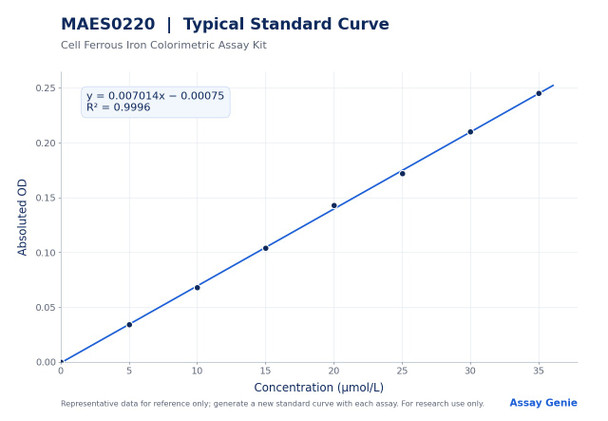
- Prepare the standard curve fresh for each assay by diluting the 100 µmol/L standard with buffer solution to 0, 5, 10, 15, 20, 25, 30, and 35 µmol/L. For example, 35 µmol/L uses 175 µL of 100 µmol/L standard and 325 µL buffer solution; 0 µmol/L uses 500 µL buffer solution alone.
- Discard working standard dilutions after use.
Assay
- Add 80 µL of each standard to the standard wells, 80 µL of sample to the sample wells, and 80 µL of sample to the control wells.
- Add 80 µL of control solution to the control wells.
- Add 80 µL of chromogenic solution to the sample and standard wells.
- Mix thoroughly and incubate at 37°C for 10 min.
- Measure the OD of each well at 593 nm.
Calculation
- Average the duplicate readings for each standard.
- Subtract the mean OD of the blank standard (standard 1, 0 µmol/L) from all standard readings to obtain absolute OD values.
- Plot absolute OD (y) against concentration (x) and fit a linear standard curve (y = ax + b).
- For cell samples, calculate Fe2+ content (nmol/10^6 cells) = (ΔA − b) ÷ a × (N ÷ V) × f, where ΔA = absolute OD (sample OD − control OD), N = number of cells/10^6, V = volume of buffer solution used for cell lysis (mL), and f = sample dilution factor.
Fe2+ content (nmol/10^6) = (∆A − b) ÷ a ÷ N × V × f
- ∆A is the absolute OD, calculated as the sample OD minus the control OD.
- a and b are the slope and intercept of the standard curve, y = ax + b, where y is the absolute OD of the standard and x is its concentration in µmol/L. The absolute OD of each standard is its mean OD minus the mean OD of the blank (standard ①).
- N is the number of cells, in units of 10^6 cells.
- V is the volume of buffer solution used in the cell preparation step, in mL.
- f is the dilution factor of the sample before testing. Use 1 for HepG2, molt-4, Jurkat, and HEL cells.
- The result is reported in nmol per 10^6 cells.
What sample types can I use with this kit?
The kit is designed for cell samples, both adherent and suspension. HepG2, molt-4, Jurkat, and HEL cells are listed with a dilution factor of 1. For other sample types, run a pretest to confirm the dilution factor before use.
How should I store the kit components?
Store reagents at 2 to 8°C, protected from light, for 12 months. Reagents from different kits must not be mixed. Equilibrate all reagents to room temperature before use.
What should I do if my sample is outside the detection range?
The detection range is 0.4 to 35 µmol/L. If the concentration is not within this range, take an extra dilution or concentration of the sample. Standards must be freshly prepared for each run and working standard dilutions discarded after use.
What key points affect assay performance?
Aliquot the chromogenic solution into smaller quantities before use to avoid contamination. Avoid bubbles when transferring reagents or samples into the microplate. Use fresh cell samples for detection.
What instrument settings should I use?
Read the microplate at 593 nm. The manual specifies a microplate reader with a 590 to 600 nm measurement range, with 593 nm as the optimum wavelength.
How long does the assay take?
The assay time is 40 min. The mixed plate is incubated at 37°C for 10 min before OD measurement.
| Storage: | 2-8°C, protect from light |
| Shelf life: | 12 months |
| Shipping: | Ice bag |
Notes
- For Research Use Only. Not for clinical diagnosis or therapeutic use.
- Equilibrate all reagents to room temperature before use.
- Prepare the 100 µmol/L iron standard and the standard curve fresh for each assay; discard working dilutions after use.
- Aliquot the chromogenic solution into smaller volumes before use to limit contamination.
- Avoid bubbles when transferring reagents or samples into the microplate.
- Use fresh cell samples.
- If sample concentration falls outside the detection range, dilute or concentrate the sample.
- Pretest sample types not listed in the dilution guidance to confirm the dilution factor.
- Centrifuge small reagent volumes before use.
- Do not mix reagents from different kits.