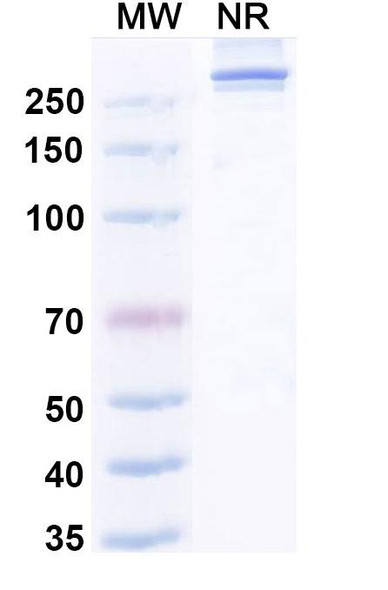
Efprezimod alfa (Research-Grade) is a research-grade biosimilar monoclonal antibody targeting Signal transducer CD24. Reactivity: Human. Supplied as a liquid in 0.01M PBS pH 7.4. Applications: functional assays. Endotoxin: < 10 EU/mg. Purity: >95% as determined by SDS-PAGE. For research use only.
Signal transducer CD24 (Siglec-10) is a ~8 kDa protein. May have a pivotal role in cell differentiation of different cell types. Signaling could be triggered by the binding of a lectin-like ligand to the CD24 carbohydrates, and transduced by the release of second messengers derived from the GPI-anchor. Modulates B-cell activation responses. Promotes AG-dependent proliferation of B-cells, and prevents their terminal differentiation into antibody-forming cells. In association with SIGLEC10 may be involved in the selective suppression of the immune response to danger-associated molecular patterns (DAMPs) such as HMGB1, HSP70 and HSP90.
Human alkaline phosphatase, tissue-nonspecific isozyme/AP-TNAP soluble fragment fused to a human immunoglobulin G4 heavy chain constant region fragment fused to a deca-aspartate peptide, disulfide bridged dimer.