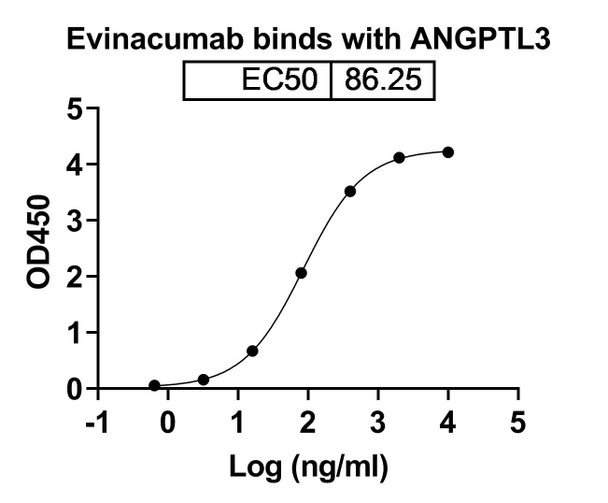
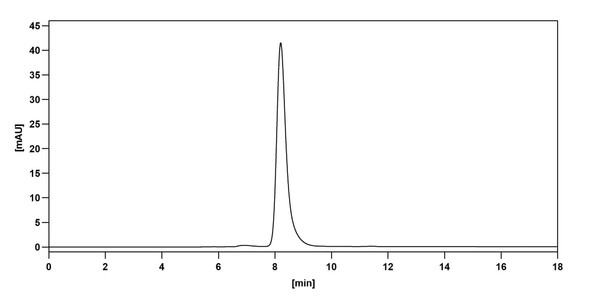
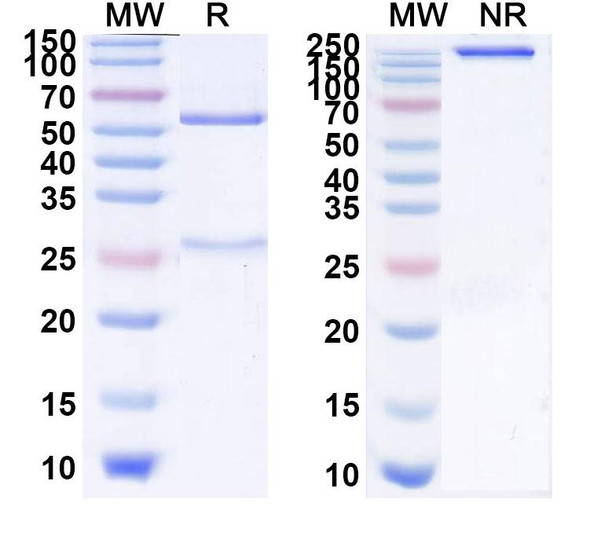
Evinacumab Antibody is a research-grade biosimilar monoclonal antibody targeting ANG-5. It is a human IgG4-kappa antibody. Reactivity: Human. Supplied as a liquid in 0.01M PBS pH 7.4. Applications: ELISA, flow cytometry, functional assays and in vivo research. Endotoxin: < 10 EU/mg. Purity: >95% purity as determined by SDS-PAGE. For research use only.
Angiopoietin-related protein 3 (ANGPTL3) is a ~53 kDa protein. Acts in part as a hepatokine that is involved in regulation of lipid and glucose metabolism. Proposed to play a role in the trafficking of energy substrates to either storage or oxidative tissues in response to food intake. Has a stimulatory effect on plasma triglycerides (TG), which is achieved by suppressing plasma TG clearance via inhibition of LPL activity. The inhibition of LPL activity appears to be an indirect mechanism involving recruitment of proprotein convertases PCSK6 and FURIN to LPL leading to cleavage and dissociation of LPL from the cell surface; the function does not require ANGPTL3 proteolytic cleavage but seems to be mediated by the N-terminal domain, and is not inhibited by GPIHBP1. Can inhibit endothelial lipase, causing increased plasma levels of high density lipoprotein (HDL) cholesterol and phospholipids.
Product Name:
Evinacumab Antibody
SKU:
GXBS00635
Size:
100 µg, 1 mg
Antibody Type:
Monoclonal Antibody
Target:
ANG-5
Isotype:
IgG4-kappa
Host Species:
Human
Reactivity:
Human
Applications:
ELISA, FCM, Functional assay, Research in vivo
Expression Host:
Mammalian cells
Synonyms:
REGN1500, 1446419-85-7
Purity:
>95% as determined by SDS-PAGE.
Endotoxin Level:
< 10 EU/mg
Formulation:
0.01M PBS pH 7.4.
State of Matter:
Liquid
Regulatory Status:
For research use only. Not suitable for clinical or therapeutic use.
Product Preparation:
Protein A/G purified from cell culture supernatant.
Storage and Handling:
Store at 2 to 8°C for frequent use. Store at -20 to -80°C for twelve months from the date of receipt.