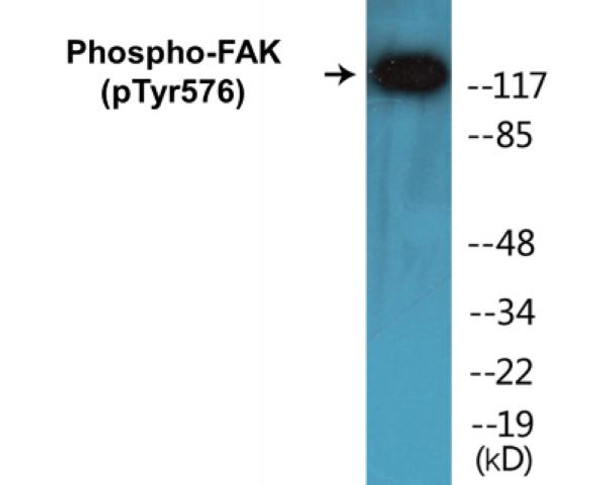
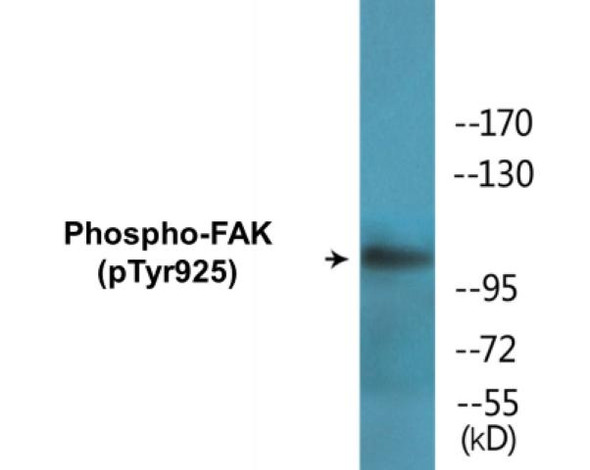
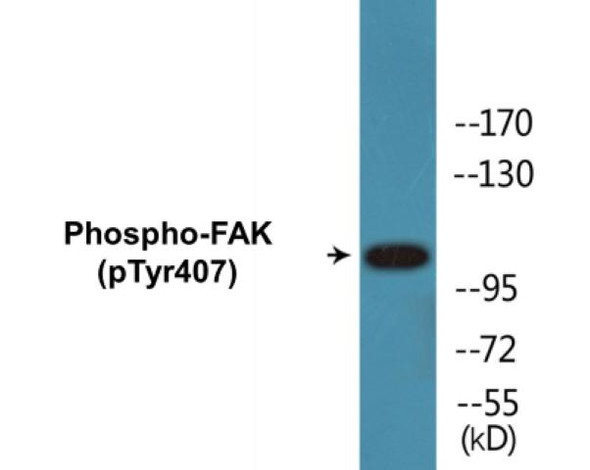
Description
FAK (Phospho-Tyr576)Colorimetric Cell-Based ELISA Kit
The FAK (Focal Adhesion Kinase) Phospho-Tyr576 Colorimetric Cell-Based ELISA Kit is a sophisticated tool for researchers looking to study the phosphorylation of FAK at the tyrosine 576 site in cell-based assays. This kit offers high sensitivity and specificity, allowing for accurate and reproducible results in a variety of experimental settings.FAK is a key player in cell signaling pathways, regulating processes such as cell adhesion, migration, and survival. The phosphorylation of tyrosine 576 on FAK is known to be involved in various cellular functions, making it a crucial target for study in fields such as cancer research, cell biology, and drug discovery.
With the FAK Phospho-Tyr576 Colorimetric Cell-Based ELISA Kit, researchers can gain insights into the phosphorylation status of FAK in cell cultures, helping to unravel the complex signaling networks that govern cellular behavior. This kit is an invaluable tool for advancing our understanding of FAK biology and uncovering new therapeutic strategies for diseases associated with FAK dysregulation.
| Product Name: | FAK (Phospho-Tyr576)Colorimetric Cell-Based ELISA Kit |
| Product Code: | CBCAB01269 |
| ELISA Type: | Cell-Based |
| Target: | FAK (Phospho-Tyr576) |
| Reactivity: | Human, Mouse, Rat |
| Dynamic Range: | > 5000 Cells |
| Detection Method: | Colorimetric 450 nm |
| Format: | 2 x 96-Well Microplates |
The FAK (Phospho-Tyr576) Colorimetric Cell-Based ELISA Kit is a convenient, lysate-free, high throughput and sensitive assay kit that can detect FAK protein phosphorylation and expression profile in cells. The kit can be used for measuring the relative amounts of phosphorylated FAK in cultured cells as well as screening for the effects that various treatments, inhibitors (ie. siRNA or chemicals), or activators have on FAK phosphorylation.
Qualitative determination of FAK (Phospho-Tyr576) concentration is achieved by an indirect ELISA format. In essence, FAK (Phospho-Tyr576) is captured by FAK (Phospho-Tyr576)-specific primary (1ø) antibodies while the HRP-conjugated secondary (2ø) antibodies bind the Fc region of the 1ø antibody. Through this binding, the HRP enzyme conjugated to the 2ø antibody can catalyze a colorimetric reaction upon substrate addition. Due to the qualitative nature of the Cell-Based ELISA, multiple normalization methods are needed:
| 1. | A monoclonal antibody specific for human GAPDH is included to serve as an internal positive control in normalizing the target absorbance values. |
| 2. | Following the colorimetric measurement of HRP activity via substrate addition, the Crystal Violet whole-cell staining method may be used to determine cell density. After staining, the results can be analysed by normalizing the absorbance values to cell amounts, by which the plating difference can be adjusted. |
| Database Information: | Gene ID: 5747, UniProt ID: Q05397, OMIM: 600758, Unigene: Hs.395482 |
| Gene Symbol: | PTK2 |
| Sub Type: | Phospho |
| UniProt Protein Function: | FAK: a tyrosine kinase of the FAK family required for cell migration and contact-dependent survival signaling. Activated by tyrosine-phosphorylation in response to either integrin clustering induced by cell adhesion or antibody cross-linking, or via G-protein coupled receptor (GPCR) occupancy by ligands such as bombesin or lysophosphatidic acid, or via LDL receptor occupancy. Downstream of integrins and Src, upstream of Ras/MAPK. Localizes to focal adhesions that form between cells growing in the presence of extracellular matrix constituents. Interacts with CAS family members and with GIT1, SORBS1 and BCAR3. Interacts with Shb. Required for full Ras transformation of fibroblasts. Increased expression in breast and other cancers, related to chromosome 8q amplification. Overexpression and activation associated with increased migration, invasion and progression of ovarian cancer, and with progression in hepatocellular carcinoma, thyroid cancer, and acute myelogenous leukemia. siRNA increases chemosensitivity of pancreatic adenocarcinoma xenografts. Inhibitor: ISI15421 (antisense). Four splice-variant isoforms have been observed. |
| UniProt Protein Details: | Protein type:Kinase, protein; Protein kinase, tyrosine (non-receptor); EC 2.7.10.2; Protein kinase, TK; TK group; Fak family Chromosomal Location of Human Ortholog: 8q24.3 Cellular Component: extrinsic to internal side of plasma membrane; cytoskeleton; focal adhesion; lamellipodium; apical plasma membrane; cytoplasm; stress fiber; plasma membrane; microtubule organizing center; cell cortex; cytosol; nucleus Molecular Function:JUN kinase binding; signal transducer activity; protein binding; protein-tyrosine kinase activity; non-membrane spanning protein tyrosine kinase activity; SH2 domain binding; actin binding; protein kinase binding; ATP binding; protein kinase activity; receptor binding Biological Process: heart morphogenesis; axon guidance; extracellular matrix organization and biogenesis; peptidyl-tyrosine phosphorylation; establishment of nucleus localization; apoptosis; protein amino acid autophosphorylation; neuron migration; cell motility involved in cell locomotion; negative regulation of synaptogenesis; regulation of cell shape; regulation of cell adhesion mediated by integrin; transforming growth factor beta receptor signaling pathway; positive regulation of cell proliferation; ephrin receptor signaling pathway; negative regulation of axonogenesis; angiogenesis; vasculogenesis; placenta development; cell structure disassembly during apoptosis; integrin-mediated signaling pathway; epidermal growth factor receptor signaling pathway; platelet activation; central nervous system neuron axonogenesis; regulation of osteoblast differentiation; positive regulation of phosphoinositide 3-kinase activity; signal complex assembly; cytoskeleton organization and biogenesis; microtubule cytoskeleton organization and biogenesis; negative regulation of organ growth; regulation of cell proliferation; positive regulation of phosphoinositide 3-kinase cascade; positive regulation of protein kinase B signaling cascade; embryonic development; establishment of cell polarity; positive regulation of protein kinase activity; regulation of focal adhesion formation; endothelial cell migration; innate immune response; positive regulation of protein amino acid phosphorylation; negative regulation of cell-cell adhesion; blood coagulation; vascular endothelial growth factor receptor signaling pathway; regulation of cytoskeleton organization and biogenesis; negative regulation of apoptosis; positive regulation of cell migration |
| NCBI Summary: | This gene encodes a cytoplasmic protein tyrosine kinase which is found concentrated in the focal adhesions that form between cells growing in the presence of extracellular matrix constituents. The encoded protein is a member of the FAK subfamily of protein tyrosine kinases but lacks significant sequence similarity to kinases from other subfamilies. Activation of this gene may be an important early step in cell growth and intracellular signal transduction pathways triggered in response to certain neural peptides or to cell interactions with the extracellular matrix. Several transcript variants encoding different isoforms have been found for this gene, but the full-length natures of only three of them have been determined. [provided by RefSeq, Dec 2010] |
| UniProt Code: | Q05397 |
| NCBI GenInfo Identifier: | 3183518 |
| NCBI Gene ID: | 5747 |
| NCBI Accession: | Q05397.2 |
| UniProt Secondary Accession: | Q05397,Q14291, Q8IYN9, Q9UD85, B4E2N6, F5H4S4, J3QT16 |
| UniProt Related Accession: | Q05397 |
| Molecular Weight: | 1052 |
| NCBI Full Name: | Focal adhesion kinase 1 |
| NCBI Synonym Full Names: | protein tyrosine kinase 2 |
| NCBI Official Symbol: | PTK2 |
| NCBI Official Synonym Symbols: | FAK; FADK; FAK1; FRNK; PPP1R71; p125FAK; pp125FAK |
| NCBI Protein Information: | focal adhesion kinase 1; FADK 1; PTK2 protein tyrosine kinase 2; FAK-related non-kinase polypeptide; focal adhesion kinase isoform FAK-Del33; focal adhesion kinase-related nonkinase; protein phosphatase 1 regulatory subunit 71; protein phosphatase 1, regulatory subunit 71 |
| UniProt Protein Name: | Focal adhesion kinase 1 |
| UniProt Synonym Protein Names: | Focal adhesion kinase-related nonkinase; FRNK; Protein phosphatase 1 regulatory subunit 71; PPP1R71; Protein-tyrosine kinase 2; p125FAK; pp125FAK |
| Protein Family: | Focal adhesion kinase |
| UniProt Gene Name: | PTK2 |
| UniProt Entry Name: | FAK1_HUMAN |
| Component | Quantity |
| 96-Well Cell Culture Clear-Bottom Microplate | 2 plates |
| 10X TBS | 24 mL |
| Quenching Buffer | 24 mL |
| Blocking Buffer | 50 mL |
| 15X Wash Buffer | 50 mL |
| Primary Antibody Diluent | 12 mL |
| 100x Anti-Phospho Target Antibody | 60 µL |
| 100x Anti-Target Antibody | 60 µL |
| Anti-GAPDH Antibody | 60 µL |
| HRP-Conjugated Anti-Rabbit IgG Antibody | 12 mL |
| HRP-Conjugated Anti-Mouse IgG Antibody | 12 mL |
| SDS Solution | 12 mL |
| Stop Solution | 24 mL |
| Ready-to-Use Substrate | 12 mL |
| Crystal Violet Solution | 12 mL |
| Adhesive Plate Seals | 2 seals |
The following materials and/or equipment are NOT provided in this kit but are necessary to successfully conduct the experiment:
- Microplate reader able to measure absorbance at 450 nm and/or 595 nm for Crystal Violet Cell Staining (Optional)
- Micropipettes with capability of measuring volumes ranging from 1 µL to 1 ml
- 37% formaldehyde (Sigma Cat# F-8775) or formaldehyde from other sources
- Squirt bottle, manifold dispenser, multichannel pipette reservoir or automated microplate washer
- Graph paper or computer software capable of generating or displaying logarithmic functions
- Absorbent papers or vacuum aspirator
- Test tubes or microfuge tubes capable of storing ≥1 ml
- Poly-L-Lysine (Sigma Cat# P4832 for suspension cells)
- Orbital shaker (optional)
- Deionized or sterile water
*Note: Protocols are specific to each batch/lot. For the correct instructions please follow the protocol included in your kit.
| Step | Procedure |
| 1. | Seed 200 µL of 20,000 adherent cells in culture medium in each well of a 96-well plate. The plates included in the kit are sterile and treated for cell culture. For suspension cells and loosely attached cells, coat the plates with 100 µL of 10 µg/ml Poly-L-Lysine (not included) to each well of a 96-well plate for 30 minutes at 37 °C prior to adding cells. |
| 2. | Incubate the cells for overnight at 37 °C, 5% CO2. |
| 3. | Treat the cells as desired. |
| 4. | Remove the cell culture medium and rinse with 200 µL of 1x TBS, twice. |
| 5. | Fix the cells by incubating with 100 µL of Fixing Solution for 20 minutes at room temperature. The 4% formaldehyde is used for adherent cells and 8% formaldehyde is used for suspension cells and loosely attached cells. |
| 6. | Remove the Fixing Solution and wash the plate 3 times with 200 µL 1x Wash Buffer for five minutes each time with gentle shaking on the orbital shaker. The plate can be stored at 4 °C for a week. |
| 7. | Add 100 µL of Quenching Buffer and incubate for 20 minutes at room temperature. |
| 8. | Wash the plate 3 times with 1x Wash Buffer for 5 minutes each time. |
| 9. | Add 200 µL of Blocking Buffer and incubate for 1 hour at room temperature. |
| 10. | Wash 3 times with 200 µL of 1x Wash Buffer for 5 minutes each time. |
| 11. | Add 50 µL of 1x primary antibodies Anti-FAK (Phospho-Tyr576) Antibody, Anti-FAK Antibody and/or Anti-GAPDH Antibody) to the corresponding wells, cover with Parafilm and incubate for 16 hours (overnight) at 4 °C. If the target expression is known to be high, incubate for 2 hours at room temperature. |
| 12. | Wash 3 times with 200 µL of 1x Wash Buffer for 5 minutes each time. |
| 13. | Add 50 µL of 1x secondary antibodies (HRP-Conjugated AntiRabbit IgG Antibody or HRP-Conjugated Anti-Mouse IgG Antibody) to corresponding wells and incubate for 1.5 hours at room temperature. |
| 14. | Wash 3 times with 200 µL of 1x Wash Buffer for 5 minutes each time. |
| 15. | Add 50 µL of Ready-to-Use Substrate to each well and incubate for 30 minutes at room temperature in the dark. |
| 16. | Add 50 µL of Stop Solution to each well and read OD at 450 nm immediately using the microplate reader. |
(Additional Crystal Violet staining may be performed if desired – details of this may be found in the kit technical manual.)