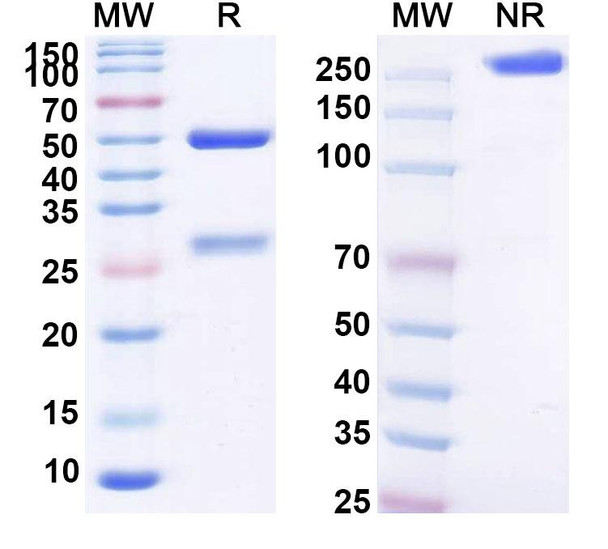
Galiximab Antibody is a research-grade biosimilar monoclonal antibody targeting CD80. It is a chimeric IgG1-lambda antibody. Reactivity: Human. Supplied as a liquid in 0.01M PBS pH 7.4. Applications: ELISA, flow cytometry, functional assays and in vivo research. Endotoxin: < 10 EU/mg. Purity: >95% purity as determined by SDS-PAGE. For research use only.
T-lymphocyte activation antigen CD80 (B7-1) is a ~33 kDa protein. Costimulatory molecule that belongs to the immunoglobulin superfamily that plays an important role in T-lymphocyte activation. Acts as the primary auxiliary signal augmenting the MHC/TCR signal in naive T-cells by acting as a ligand for the CD28 receptor which is constitutively expressed on the cell surface of T-cells. In turn, activates different signaling pathways such as NF-kappa-B or MAPK leading to the production of different cytokines. Also acts as an inhibitor of T-cell activation by acting as a ligand for CTLA4, a decoy receptor, thereby blocking CD28-mediated T-cell priming. In addition, CD28/CD80 costimulatory signal stimulates glucose metabolism and ATP synthesis of T-cells by activating the PI3K/Akt signaling pathway.
Product Name:
Galiximab Antibody
SKU:
GXBS00161
Size:
100 µg, 1 mg
Antibody Type:
Monoclonal Antibody
Target:
CD80
Isotype:
IgG1-lambda
Host Species:
Chimeric
Reactivity:
Human
Applications:
ELISA, FACS, Functional assay, Research in vivo
Expression Host:
Mammalian cells
Synonyms:
IDEC-114, 357613-77-5
Purity:
>95% purity as determined by SDS-PAGE.
Endotoxin Level:
< 10 EU/mg
Formulation:
0.01M PBS pH 7.4
State of Matter:
Liquid
Regulatory Status:
For research use only. Not suitable for clinical or therapeutic use.
Product Preparation:
Protein A/G purified from cell culture supernatant.
Storage and Handling:
Store at 2 to 8°C for frequent use. Store at -20 to -80°C for twelve months from the date of receipt.