Description
T7 RNAi transcription kit
GenieScribe T7 RNAi Transcription Kit is a T7-based in vitro transcription kit optimised for synthesis of double-stranded and small interfering RNA (dsRNA/siRNA) for RNA-interference studies. It efficiently produces high-quality RNAi reagents from templates carrying a T7 promoter.
T7 RNA polymerase transcribes RNA from DNA templates containing a T7 promoter, using the four NTPs as substrates. Optimised for double-stranded RNA, the kit transcribes both 21 bp siRNA and long dsRNA, and a typical reaction yields 20–80 μg RNA. DNase I and RNase T1 remove the template and single-stranded RNA, and the included RNA Clean-up Beads purify the product quickly and efficiently. Purified transcripts can be delivered by cationic liposome, calcium phosphate co-precipitation, electroporation, DEAE-dextran or microinjection. For single-stranded RNA, use the GenieScribe T7 High Yield RNA Transcription Kit. For research use only.
Key Features
| siRNA and long dsRNA | Transcribes both 21 bp siRNA and long-fragment dsRNA. | |
| High yield | A typical reaction yields 20–80 μg RNA. | |
| Clean product | DNase I and RNase T1 digestion removes template DNA and single-stranded RNA. | |
| Fast purification | Included RNA Clean-up Beads remove proteins, free nucleotides and salts quickly and efficiently. |
Specifications
| Method | T7 RNA polymerase in vitro transcription |
| Products | 21 bp siRNA and long dsRNA |
| Template | Linearised plasmid with T7 promoter, PCR product or chemically synthesised DNA |
| Yield | 20–80 μg RNA per reaction |
| Purification | Magnetic beads (included) |
| Shelf life | 2 years |
Components
| Components | 25 rxns | 50 rxns |
| T7 Enzyme Mix | 50 μl | 100 μl |
| 10× Transcription Buffer | 50 μl | 100 μl |
| 10× Annealing Buffer | 250 μl | 500 μl |
| NTP Mix | 200 μl | 400 μl |
| DNase I | 25 μl | 50 μl |
| RNase T1 (100 U/μl) | 25 μl | 50 μl |
| RNase T1 Dilution Buffer | 300 μl | 600 μl |
| Control Template* | 5 μl | 10 μl |
| RNase-free H2O | 5 ml | 5 ml |
| RNA Clean-up Beads | 2 ml | 4 ml |
Box 1: T7 Enzyme Mix through Control Template. Box 2: RNase-free H2O and RNA Clean-up Beads. *The Control Template is a 500 bp PCR product with a T7 promoter at both ends, at 0.5 μg/μl.
Storage
Store at -30 ~ -15°C.
You will also need: RNase-free tubes and tips, a PCR instrument, a magnetic stand and absolute ethanol.
- Prepare the template
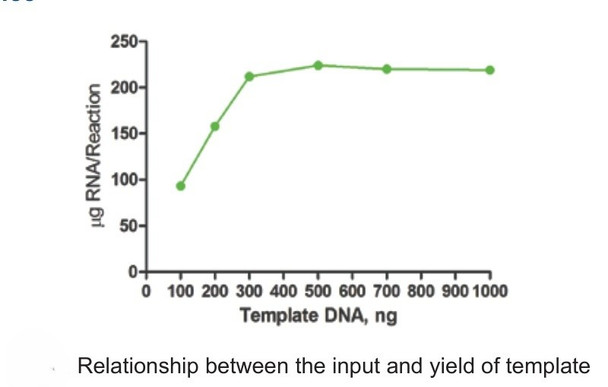
- Long dsRNA: amplify the target with specific primers carrying a T7 promoter (TAATACGACTCACTATAGGG) at the 5' end. Transcription starts at the GGG. The PCR product can be used without purification, but purification increases RNA yield. Recommended input: 0.5 μg.
- Choose one of three schemes: (1) transcribe Template 1 and Template 2 in separate tubes, then anneal the products at 1:1; (2) transcribe Template 1 and Template 2 together in one tube; (3) transcribe Template 3, which has promoters at both ends, then anneal. Schemes (1) and (2) generally give higher yields.
- siRNA: synthesise four single-stranded DNA oligos and anneal them into two templates. Each template strand consists of a 6-base enhancer (GATCAC), the 20-base T7 promoter, the 19–21-base target sequence and two 3' T bases: GATCACTAATACGACTCACTATAGGG X19-21TT.
- Anneal each oligo pair:
| Components | Volume |
| RNase-free H2O | 14 μl |
| Oligonucleotide A1 (or B1), 100 μM | 2 μl |
| Oligonucleotide A2 (or B2), 100 μM | 2 μl |
| 10× Annealing Buffer | 2 μl |
| Temperature | Time |
| 95°C | 2 min |
| 95 ~ 22°C | 0.1°C/sec |
| 22°C | 10 min |
A1/A2 and B1/B2 must be complementary. Annealing gives two 10 μM templates that can be transcribed directly.
- Set up the transcription reaction
- Example for the mixed-template scheme:
| Components | Volume |
| NTP Mix | 8 μl |
| 10× Transcription Buffer | 2 μl |
| T7 Enzyme Mix | 2 μl |
| DNA Template 1 | 1–4 μl |
| DNA Template 2 | 1–4 μl |
| RNase-free H2O | Up to 20 μl |
- Add Templates 1 and 2 at a 1:1 ratio, 0.5 μg each. Mix gently by pipetting and spin down.
- Transcribe
- Incubate at 37°C for 2 h in a PCR instrument. For RNA <0.3 kb, extend to 4 h or more; overnight incubation does not affect product quality.
- Anneal (dsRNA >800 bp)
- Products <800 bp transcribed in the same tube anneal to dsRNA on their own. For dsRNA >800 bp, incubate at 72°C for 10 min and cool naturally. If the two strands were transcribed in separate tubes, mix the products before annealing.
- Digest template and single-stranded RNA
- Dilute RNase T1 from 100 U/μl to 10 U/μl with RNase T1 Dilution Buffer. Use the diluted enzyme immediately; do not store it. RNase T1 degrades single-stranded RNA and the three G bases at the 5' end.
| Components | Volume |
| Transcription product | 20 μl |
| RNase-free H2O | 17 μl |
| DNase I | 1 μl |
| RNase T1 (10 U/μl) | 2 μl |
| Total | 40 μl |
- Mix gently by pipetting, spin down and incubate at 37°C for 30 min.
- Check the transcripts
- Analyse long dsRNA by agarose gel electrophoresis and siRNA by polyacrylamide gel (PAGE). Because of its small size, siRNA bands appear diffuse.
- Purify with RNA Clean-up Beads
- Equilibrate the beads (stored at 4°C) at room temperature for 30 min; invert or vortex before use. Prepare 80% ethanol fresh with RNase-free H2O.
- Add 80 μl beads to the transcript and pipette at least 10 times to mix. For transcripts <100 bp, also add 200 μl isopropanol and mix thoroughly.
- Incubate at room temperature for 8 min. Place on the magnetic stand for about 5 min and remove the clear supernatant without disturbing the beads.
- On the stand, add 200 μl freshly prepared 80% ethanol, incubate for 30 sec and remove the supernatant. Repeat once.
- Air-dry the beads for 5–10 min, until the surface is no longer glossy. Do not over-dry, as this reduces elution.
- Remove from the stand, add 40 μl RNase-free H2O, rinse the beads off the tube wall, mix and incubate at room temperature for 3 min.
- Return to the stand and transfer the clear eluate to a new RNase-free tube, leaving 1–2 μl behind to avoid carrying over beads.
- Measure A260 to determine concentration and store the RNA at -20°C.
Q1: Which dsRNA transcription scheme should I choose?
- Choose from three schemes: transcribe two single-promoter templates separately and then anneal; transcribe them together in one tube; or transcribe one template with promoters at both ends. The first two generally give higher yields, and the two templates must be used at a 1:1 ratio; otherwise sense and antisense strands are unequal and more single-stranded RNA remains after annealing.
Q2: How should I design siRNA templates?
- siRNA templates are short, so synthesise four single-stranded DNA oligos and anneal them into transcription templates. Each template strand comprises a 6-base enhancer, the 20-base T7 promoter, the 19–21-base target sequence and two T bases at the 3' end: GATCACTAATACGACTCACTATAGGG X19-21TT.
Q3: What should I do if the RNA yield is low?
- A typical reaction yields 20–80 μg RNA. Low yield can be caused by inhibitors in the template, or by the template amount, length or structure. Run a control with the supplied Control Template. If the control is normal, the problem lies with your template: purify and accurately quantify it, increase the template input, extend the 37°C incubation, or redesign the template.
Q4: Why is the yield from short templates such as siRNA lower?
- Short templates bind the enzyme less efficiently, so siRNA yields are lower than for longer RNAs. Extend the reaction time or increase the template input.
Q5: Why do my bands show tailing on the gel?
- Tailing is usually caused by too much template or templates not added at 1:1, which leaves template or single-stranded RNA incompletely digested. Extend the DNase I/RNase T1 digestion. Residual template and single-stranded RNA are a very small fraction of total transcript and generally do not affect downstream experiments.
Q6: Why is my RNA product shorter than expected?
- The template may contain a sequence resembling a T7 RNA polymerase terminator, or high GC content may form a stem-loop termination structure. Try a different RNA polymerase or redesign the template sequence.