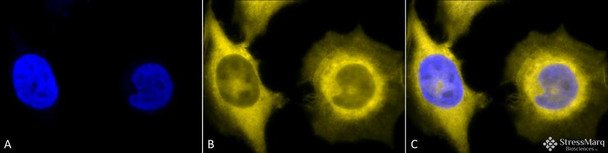
GRP94 Antibody [9G10] is a rat monoclonal antibody directed against GRP94, offered by Assay Genie for research applications. Reported applications include WB, ICC/IF, IP and FCM. Reported reactivity: Human, Mouse, Rat, Bovine, Dog, Chicken, Guinea Pig (Cavia porcellus), Hamster, Horse, Monkey, Pig, Rabbit, Sheep and African clawed frog (Xenopus laevis). Supplied as IgG2a, purified by Protein G.
GRP94 (also known as gp96) is a constitutively expressed ER-resident chaperone and a member of the HSP90 family. It is upregulated in response to cellular stressors such as heat shock, oxidative damage, and glucose deprivation—conditions frequently observed in neurodegenerative diseases. Functionally, GRP94 supports protein translocation, folding, and quality control within the ER. It also plays a key role in immune regulation by facilitating antigen presentation through the MHC class I pathway, linking ER stress to immune responses. In the nervous system, GRP94 contributes to proteostasis and immune surveillance, both of which are disrupted in diseases like Alzheimer’s and Parkinson’s. Structurally, GRP94 forms homodimers and contains a KDEL sequence that ensures ER retention. Despite its homology with cytosolic HSP90, GRP94 exhibits distinct ATP-binding and hydrolysis characteristics, making it a unique therapeutic target. Its dual role in stress adaptation and immune signaling positions GRP94 as a valuable biomarker and potential intervention point in neurodegenerative disease research. This antibody is also available conjugated to ATTO 390, ATTO 488, ATTO 594, APC, Biotin, FITC, HRP, PerCP and RPE. Supplied in 200 µg. For research use only; not for diagnostic or therapeutic procedures.
Product Name:
GRP94 Antibody [9G10]
Product SKU:
STMA00003
Size:
200 µg
Target:
GRP94
Host Species:
Rat
Antibody Type:
Monoclonal
Clone ID:
9G10
Research Areas:
Cancer, Heat Shock, Cell Signaling, Protein Trafficking, ER Proteins, Tags and Cell Markers, Organelle Markers, Cancer, Cancer Metabolism, Response to Hypoxia, Cell Signaling, Metabolism, Metabolism processes, Hypoxia
Buffer:
PBS pH7.2, 50% glycerol, 0.09% sodium azide
Storage & Shipping:
Store at -20°C. Shipped on Blue Ice or 4°C. Conjugated variants should be stored according to the product label.
1. Rudolph R.W., and Bedows E. (1997) J Biol Chem 272: 3125-3128. 2. Srivastava P.K., et al. (1994) Immunogenetics. 39(2):93-98. 3. Mazzarella R.A., and Green M. (1987) J Biol Chem 262:8875-8883. 4. Kang, H.S. and Welch W.J. (1991) J Biol Chem 266(9):5643-5649. 5. Soldano K.L., et al. (2003) J Biol Chem 278(48): 48330-48338. 6. Chu F., et al. (2006) Protein Sci 15(6): 1260-1269. 7. Peter F., et al., (1992) J Biol Chem 267: 10631-10637. 8. Allen S. et al. (2000) Blood 96(2): 560-568. 9. Sato K et al. (2001) Blood 98(6): 1852-1857. 10. Yun S.-W. et al (2000) Brain Research Bulletin.52(5):371-378. 11. Choukhi A., et al. (1998) J. Virol. 72: 3851-3858. 12. Hoshino T., et al. (1998) Blood 91(11): 4379-4386. 13. Riera M. et al. (1999) Mol. Cell Biochem. 191: 97-104. 14. Gusarova V., et al. (2001) J. Biol. Chem. 276(27): 24891-24900.


![Anti-GRP94 [R02-9F8] Monoclonal Antibody (AGMB02704)](https://cdn11.bigcommerce.com/s-h68l9z2lnx/images/stencil/590x590/products/273993/677878/anti-grp94-r02-9f8-monoclonal-antibody-agmb02704__98620.1773033988.jpg?c=2 "Anti-GRP94 [R02-9F8] Monoclonal Antibody (AGMB02704)")
![Anti-CD35 [6H10-8B7-9G10] Monoclonal Antibody (AGMB06059)](https://cdn11.bigcommerce.com/s-h68l9z2lnx/images/stencil/590x590/products/277340/677528/anti-cd35-6h10-8b7-9g10-monoclonal-antibody-agmb06059__28370.1773032901.jpg?c=2 "Anti-CD35 [6H10-8B7-9G10] Monoclonal Antibody (AGMB06059)")
![Anti-GRP94 [6F6-W3-U2] Monoclonal Antibody (AGMB04890)](https://cdn11.bigcommerce.com/s-h68l9z2lnx/images/stencil/590x590/products/276175/676321/anti-grp94-6f6-w3-u2-monoclonal-antibody-agmb04890__49914.1773029065.jpg?c=2 "Anti-GRP94 [6F6-W3-U2] Monoclonal Antibody (AGMB04890)")
![Anti-Cytokeratin 19 [10G10-6A4-9G10] Monoclonal Antibody (AGMB04574)](https://cdn11.bigcommerce.com/s-h68l9z2lnx/images/stencil/590x590/products/275862/679653/anti-cytokeratin-19-10g10-6a4-9g10-monoclonal-antibody-agmb04574__18277.1773039618.jpg?c=2 "Anti-Cytokeratin 19 [10G10-6A4-9G10] Monoclonal Antibody (AGMB04574)")
![Anti-T7 Tag [4C7-9G10-2C3] Monoclonal Antibody (AGMB06840)](https://cdn11.bigcommerce.com/s-h68l9z2lnx/images/stencil/590x590/products/278121/732896/anti-t7-tag-4c7-9g10-2c3-monoclonal-antibody-agmb06840__64519.1777188316.jpg?c=2 "Anti-T7 Tag [4C7-9G10-2C3] Monoclonal Antibody (AGMB06840)")