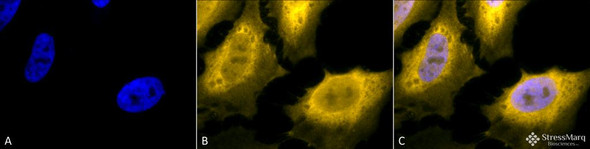
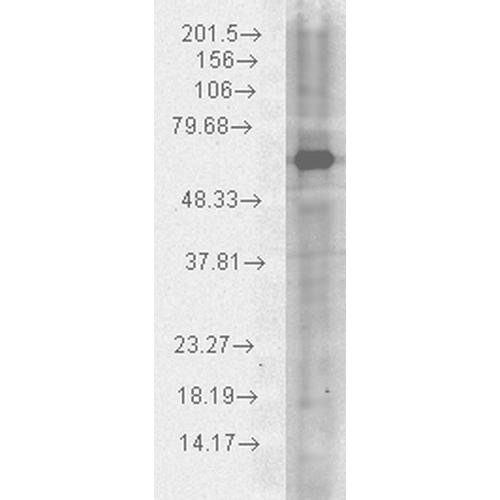
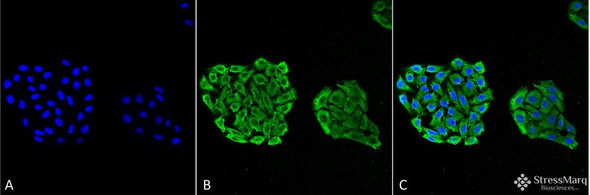
HSP70 Antibody [5A5] is a mouse monoclonal antibody directed against HSP70, offered by Assay Genie for research applications. Reported applications include WB, IHC, ICC/IF, IP and AM. Reported reactivity: Human, Mouse, Rat, Amphibians, Chicken, Fish, Yeast, Yeast (Saccharomyces cerevisiae) and Fruit Fly (Drosophila melanogaster). Supplied as IgG1, purified by Protein G.
HSP70 proteins are a highly conserved family of 70-kDa molecular chaperones encoded by a multigene family in most eukaryotes and prokaryotes. Found in nearly all cellular compartments—including the cytosol, nucleus, mitochondria, endoplasmic reticulum, and chloroplasts—HSP70s are constitutively expressed and strongly upregulated in response to cellular stress. These chaperones play a vital role in protein homeostasis by binding to nascent polypeptides and partially folded or misfolded proteins, preventing aggregation and facilitating proper folding. HSP70s exhibit high-affinity ATP binding and weak ATPase activity, which is stimulated upon interaction with unfolded substrates. ATP hydrolysis triggers conformational changes that regulate substrate binding and release, enabling dynamic cycles of protein folding and refolding. Structurally, the N-terminal domain of HSP70 is responsible for ATP binding, while the C-terminal domain mediates substrate interaction. This modular design allows HSP70s to coordinate with co-chaperones such as HSP40, HIP, HOP, and BAG-1, integrating folding with degradation and transport pathways. In neurodegenerative disease research, HSP70 is of particular interest due to its ability to counteract protein misfolding and aggregation—hallmarks of disorders like Alzheimer’s, Parkinson’s, and Huntington’s disease. By stabilizing toxic intermediates and promoting their clearance, HSP70 enhances neuronal survival and resilience under proteotoxic stress. This antibody is also available conjugated to ATTO 390, ATTO 488, ATTO 594, APC, Biotin, FITC, HRP, PerCP and RPE. Supplied in 100 µg. For research use only; not for diagnostic or therapeutic procedures.
1. Balashova N. et al. (2005) J Biol Chem 280:2186-96. 2. Boorstein W. R., Ziegelhoffer T. & Craig E. A. (1993) J. Mol. Evol.38 (1): 1-17. 3. Rothman J. (1989) Cell 59: 591 -601. 4. DeLuca-Flaherty et al. (1990) Cell 62: 875-887. 5. Bork P., Sander C. & Valencia A. (1992) Proc. Nat Acad. Sci. USA 89: 7290-7294. 6. Fink A.L. (1999) Physiol. Rev. 79: 425-449.