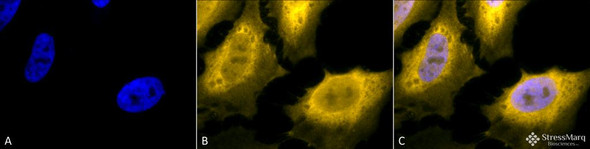
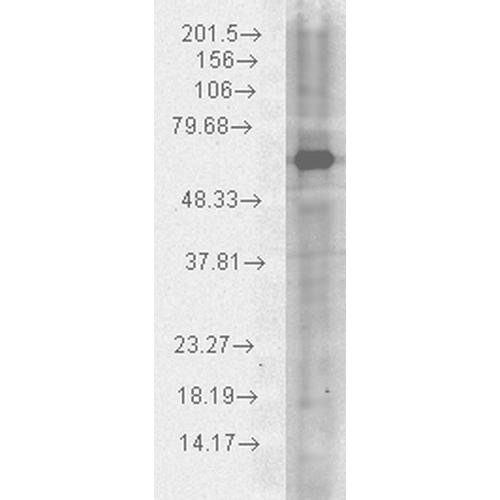
HSP70/HSC70 Antibody [N27F3-4] is a mouse monoclonal antibody directed against HSP70/HSC70, offered by Assay Genie for research applications. Reported applications include WB, IHC, ICC/IF, IP, FCM and IEM. Reported reactivity: Human, Mouse, Rat, Bovine, Nematode (Caenorhabditis elegans), Beluga, Dog, Chicken, Fruit Fly (Drosophila melanogaster), Fish, Guinea Pig (Cavia porcellus), Hamster, Monkey, Pig, Plant, Cucumber, Pea (Pisum sativum), Rabbit, Sheep and African clawed frog (Xenopus laevis). Supplied as IgG1, purified by Protein G.
HSP70 proteins are a highly conserved family of 70-kDa molecular chaperones essential for maintaining protein homeostasis across all domains of life. In eukaryotes, HSP70 genes form a multigene family, with isoforms localized to the cytosol, nucleus, mitochondria, endoplasmic reticulum, and chloroplasts. These chaperones are either constitutively expressed (HSC70) or stress-inducible (HSP70), and share over 50% sequence identity across species. Functionally, HSP70s bind ATP with high affinity and exhibit ATPase activity that is stimulated by interaction with unfolded or misfolded proteins. The N-terminal domain mediates ATP binding, while the C-terminal domain is responsible for substrate recognition. This ATP-driven cycle enables HSP70s to bind and release hydrophobic regions of nascent or damaged proteins, preventing aggregation and facilitating proper folding, transport, and assembly. In neuroscience, HSP70 and HSC70 are critical for neuronal survival under proteotoxic stress—conditions commonly associated with neurodegenerative diseases such as Alzheimer’s, Parkinson’s, and Huntington’s disease. These chaperones stabilize misfolded proteins, support autophagic clearance, and modulate apoptotic signaling pathways. Their ability to interact with co-chaperones and degradation machinery further enhances their role in maintaining neuronal proteostasis. Given their central role in stress response and protein quality control, HSP70/HSC70 are promising therapeutic targets and biomarkers in neurodegeneration research. This antibody is also available conjugated to ATTO 390, ATTO 488, ATTO 594, APC, Biotin, FITC, HRP, PerCP and RPE. Supplied in 200 µg. For research use only; not for diagnostic or therapeutic procedures.