Description
Human CD229/LY9 Recombinant Protein (C-His)
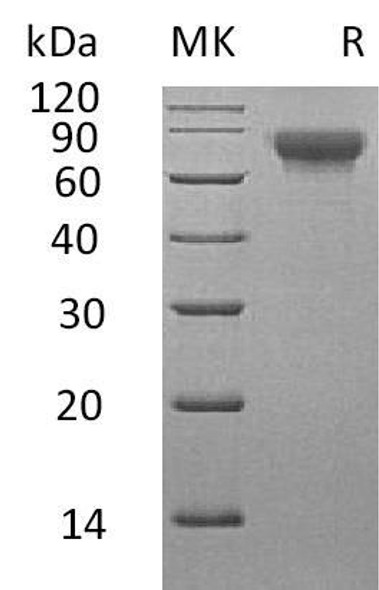
Human CD229/LY9 Recombinant Protein (C-His) is a recombinant protein expressed in mammalian cells, spanning Lys48-Lys454, with a C-terminal His tag. Predicted molecular weight: 48.00 kDa. Purity: >90% as determined by SDS-PAGE. Supplied lyophilized from a solution in PBS pH 7.4, 1 mM EDTA, 4% Trehalose, 1% Mannitol. Applications: ELISA, immunogen, SDS-PAGE and Western blot. T-lymphocyte surface antigen Ly-9 is a ~72 kDa protein. Self-ligand receptor of the signaling lymphocytic activation molecule (SLAM) family. For research use only.
SLAM receptors triggered by homo- or heterotypic cell-cell interactions are modulating the activation and differentiation of a wide variety of immune cells and thus are involved in the regulation and interconnection of both innate and adaptive immune response. Activities are controlled by presence or absence of small cytoplasmic adapter proteins, SH2D1A/SAP and/or SH2D1B/EAT-2. May participate in adhesion reactions between T lymphocytes and accessory cells by homophilic interaction. Promotes T-cell differentiation into a helper T-cell Th17 phenotype leading to increased IL-17 secretion; the costimulatory activity requires SH2D1A.
| Product Name: | Human CD229/LY9 Recombinant Protein (C-His) |
| SKU: | GXRP12287 |
| Size: | 50 µg, 100 µg, 1 mg |
| Species: | Human |
| Synonyms: | CD229, Cell surface molecule Ly-9, LY9, Lymphocyte antigen 9, SLAM family member 3, SLAMF3, Signaling lymphocytic activation molecule 3, T-lymphocyte surface antigen Ly-9 |
| Tag: | C-His |
| Expression Host: | Mammalian cells |
| Protein Length: | Lys48-Lys454 |
| Calculated MW: | 48.00 kDa |
| UniProt: | Q9HBG7 |
| Applications: | ELISA, Immunogen, SDS-PAGE, WB |
| Purity: | >90% as determined by SDS-PAGE. |
| Form: | Lyophilized |
| Formulation: | Lyophilized from a solution in PBS pH 7.4, 1 mM EDTA, 4% Trehalose, 1% Mannitol. |
| Reconstitution: | Reconstitute in sterile water for a stock solution. A copy of datasheet will be provided with the products, please refer to it for details. |
| Storage: | Store at 2 to 8°C for frequent use. Store at -20 to -80°C for twelve months from the date of receipt. |
| Shipping: | In general, proteins are provided as lyophilized powder/frozen liquid. They are shipped out with dry ice/blue ice unless customers require otherwise. |
| Note: | For research use only |