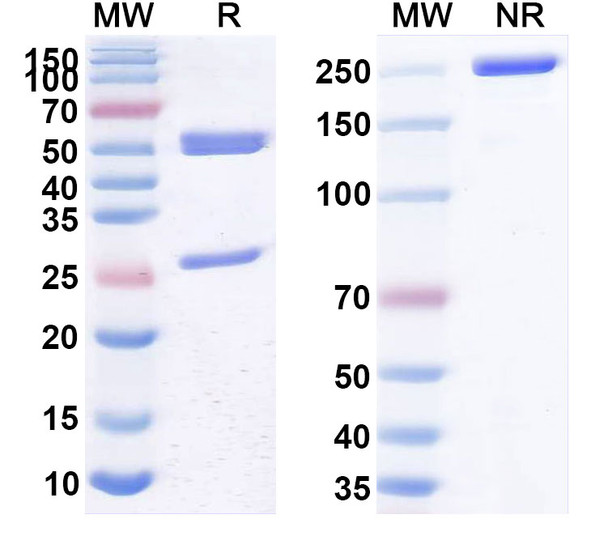
Human CD28 (FR-104) Antibody is a research-grade biosimilar monoclonal antibody targeting CD28. It is a human IgG antibody. Reactivity: Human. Supplied as a liquid in 0.01M PBS pH 7.4. Applications: ELISA, flow cytometry, functional assays and in vivo research. Endotoxin: < 10 EU/mg. Purity: >95% purity as determined by SDS-PAGE. For research use only.
T-cell-specific surface glycoprotein CD28 is a ~25 kDa protein. Receptor that plays a role in T-cell activation, proliferation, survival and the maintenance of immune homeostasis. Functions not only as an amplifier of TCR signals but delivers unique signals that control intracellular biochemical events that alter the gene expression program of T-cells. Stimulation upon engagement of its cognate ligands CD80 or CD86 increases proliferation and expression of various cytokines in particular IL2 production in both CD4(+) and CD8(+) T-cell subsets. Mechanistically, ligation induces recruitment of protein kinase C-theta/PRKCQ and GRB2 leading to NF-kappa-B activation via both PI3K/Akt-dependent and -independent pathways. In conjunction with TCR/CD3 ligation and CD40L costimulation, enhances the production of IL4 and IL10 in T-cells.
Product Name:
Human CD28 (FR-104) Antibody
SKU:
GXBS01044
Size:
100 µg, 1 mg
Antibody Type:
Monoclonal Antibody
Clone:
FR-104
Target:
CD28
Isotype:
IgG
Host Species:
Human
Reactivity:
Human
Applications:
ELISA, FACS, Functional assay, Research in vivo
Expression Host:
Mammalian cells
Synonyms:
FR-104, FR104, FR104
Purity:
>95% purity as determined by SDS-PAGE.
Endotoxin Level:
< 10 EU/mg
Formulation:
0.01M PBS pH 7.4
State of Matter:
Liquid
Regulatory Status:
For research use only. Not suitable for clinical or therapeutic use.
Product Preparation:
Protein A/G purified from cell culture supernatant.
Storage and Handling:
Store at 2 to 8°C for frequent use. Store at -20 to -80°C for twelve months from the date of receipt.