Description
Human CD316/IGSF8 Recombinant Protein (C-His)
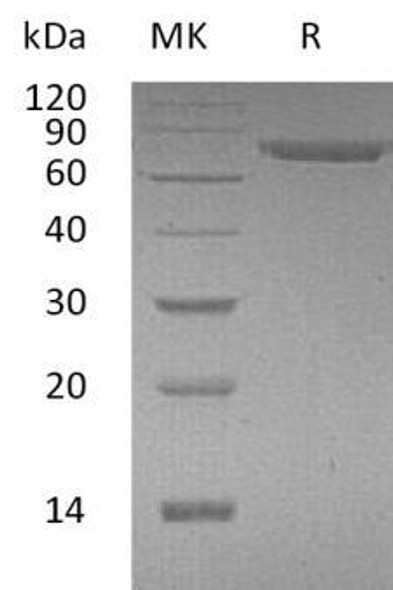
Human CD316/IGSF8 Recombinant Protein (C-His) is a recombinant protein expressed in mammalian cells, spanning Met1-Thr579, with a C-terminal His tag. Predicted molecular weight: 62.38 kDa. Purity: >90% as determined by SDS-PAGE. Supplied lyophilized from a solution in PBS pH 7.4, 1 mM EDTA, 4% Trehalose, 1% Mannitol. Applications: ELISA, immunogen, SDS-PAGE and Western blot. Immunoglobulin superfamily member 8 (CD316/IGSF8) is a ~65 kDa protein. Member of the immunoglobulin superfamily (IgSF) that links tetraspanin-enriched microdomains to the actin cytoskeleton and plays several important roles in innate and adaptive immunity. For research use only.
Acts as an inducible receptor of HSPA8 on dendritic cells to enhance the CCL21/SLC-dependent migration of activated mature dendritic cells while attenuating their antigen-specific stimulatory capacities. In complex with alpha-actinins ACTN1 and ACTN4, regulates actin dynamics in the immune synapse and subsequent T-cell activation. Inhibits the entry of several viruses such as hepatitis C Virus (HCV) or HIV-1. Mechanistically, promotes a change in CD81 organization at the plasma membrane by significantly restricting its diffusion which in turn influences CD81 interaction with Claudin-1/CLDN1, preventing CLDN1 from acting as a co-receptor required for HCV entry.
| Product Name: | Human CD316/IGSF8 Recombinant Protein (C-His) |
| SKU: | GXRP03879 |
| Size: | 50 µg, 100 µg, 1 mg |
| Species: | Human |
| Synonyms: | EWI2, IGSF8, CD316, Glu-Trp-Ile EWI motif-containing protein 2, Keratinocytes-associated transmembrane protein 4, LIR-D1, Prostaglandin regulatory-like protein, CD81P3, EWI-2, KCT-4, CD81 partner 3, Immunoglobulin superfamily member 8, IgSF8, KCT4, PGRL |
| Tag: | C-His |
| Expression Host: | Mammalian cells |
| Protein Length: | Met1-Thr579 |
| Calculated MW: | 62.38 kDa |
| UniProt: | Q969P0 |
| Applications: | ELISA, Immunogen, SDS-PAGE, WB |
| Purity: | >90% as determined by SDS-PAGE. |
| Form: | Lyophilized |
| Formulation: | Lyophilized from a solution in PBS pH 7.4, 1 mM EDTA, 4% Trehalose, 1% Mannitol. |
| Reconstitution: | Reconstitute in sterile water for a stock solution. Adjust the volume of sterile water so that, after reconstitution, the final stock concentration matches the value indicated on the product label or datasheet. |
| Storage: | Store at 2 to 8°C for frequent use. Store at -20 to -80°C for twelve months from the date of receipt. |
| Shipping: | In general, proteins are provided as lyophilized powder/frozen liquid. They are shipped out with dry ice/blue ice unless customers require otherwise. |
| Note: | For research use only. |