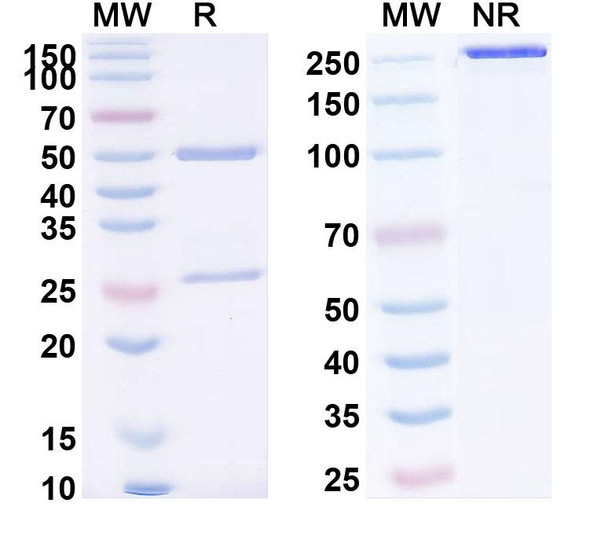
Description
Human CD328/SIGLEC7 Recombinant Protein (C-His)
Human CD328/SIGLEC7 Recombinant Protein (C-His) is a recombinant protein expressed in mammalian cells, spanning Met1-Leu353, with a C-terminal His tag. Predicted molecular weight: 40.02 kDa. Purity: >90% as determined by SDS-PAGE. Supplied lyophilized from a solution in PBS pH 7.4, 1 mM EDTA, 4% Trehalose, 1% Mannitol. Applications: ELISA, immunogen, SDS-PAGE and Western blot. Sialic acid-binding Ig-like lectin 7 is a ~51 kDa protein. Putative adhesion molecule that mediates sialic-acid dependent binding to cells. For research use only.
Preferentially binds to alpha-2,3- and alpha-2,6-linked sialic acid. Also binds disialogangliosides (disialogalactosyl globoside, disialyl lactotetraosylceramide and disialyl GalNAc lactotetraoslylceramide). The sialic acid recognition site may be masked by cis interactions with sialic acids on the same cell surface. In the immune response, may act as an inhibitory receptor upon ligand induced tyrosine phosphorylation by recruiting cytoplasmic phosphatase(s) via their SH2 domain(s) that block signal transduction through dephosphorylation of signaling molecules.
| Product Name: | Human CD328/SIGLEC7 Recombinant Protein (C-His) |
| SKU: | GXRP12335 |
| Size: | 50 µg, 100 µg, 1 mg |
| Species: | Human |
| Synonyms: | AIRM-1, AIRM1, Adhesion inhibitory receptor molecule 1, CD328, CDw328, D-siglec, QA79 membrane protein, SIGLEC7, Sialic acid-binding Ig-like lectin 7, Siglec-7, p75 |
| Tag: | C-His |
| Expression Host: | Mammalian cells |
| Protein Length: | Met1-Leu353 |
| Calculated MW: | 40.02 kDa |
| UniProt: | Q9Y286 |
| Applications: | ELISA, Immunogen, SDS-PAGE, WB |
| Purity: | >90% as determined by SDS-PAGE. |
| Form: | Lyophilized |
| Formulation: | Lyophilized from a solution in PBS pH 7.4, 1 mM EDTA, 4% Trehalose, 1% Mannitol. |
| Reconstitution: | Reconstitute in sterile water for a stock solution. A copy of datasheet will be provided with the products, please refer to it for details. |
| Storage: | Store at 2 to 8°C for frequent use. Store at -20 to -80°C for twelve months from the date of receipt. |
| Shipping: | In general, proteins are provided as lyophilized powder/frozen liquid. They are shipped out with dry ice/blue ice unless customers require otherwise. |
| Note: | For research use only |