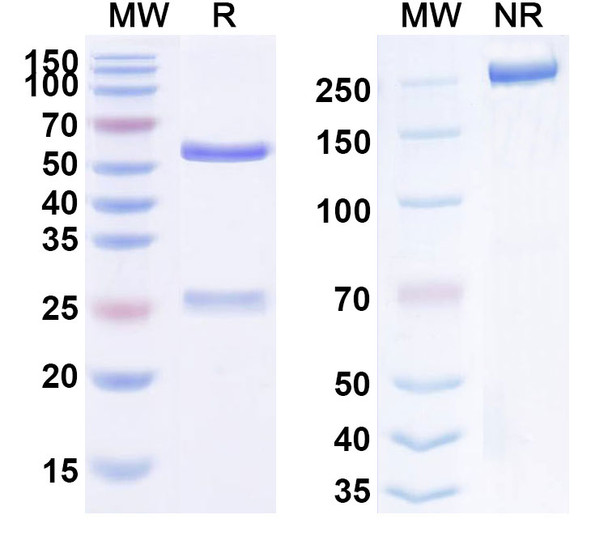
Human CD332/FGFR2 (GP369) Antibody is a research-grade biosimilar monoclonal antibody. It is a human IgG antibody. Reactivity: Human. Supplied as a liquid in 0.01M PBS pH 7.4. Applications: ELISA, flow cytometry, functional assays and in vivo research. Endotoxin: < 10 EU/mg. Purity: >95% purity as determined by SDS-PAGE. For research use only.
Fibroblast growth factor receptor 2 (CD332/FGFR2) is a ~92 kDa protein. Tyrosine-protein kinase that acts as a cell-surface receptor for fibroblast growth factors and plays an essential role in the regulation of cell proliferation, differentiation, migration and apoptosis, and in the regulation of embryonic development. Required for normal embryonic patterning, trophoblast function, limb bud development, lung morphogenesis, osteogenesis and skin development. Plays an essential role in the regulation of osteoblast differentiation, proliferation and apoptosis, and is required for normal skeleton development. Promotes cell proliferation in keratinocytes and immature osteoblasts, but promotes apoptosis in differentiated osteoblasts. Phosphorylates PLCG1, FRS2 and PAK4.
Product Name:
Human CD332/FGFR2 (GP369) Antibody
SKU:
GXBS01303
Size:
100 µg, 1 mg
Antibody Type:
Monoclonal Antibody
Clone:
GP369
Target:
K-sam
Isotype:
IgG
Host Species:
Human
Reactivity:
Human
Applications:
ELISA, FACS, Functional assay, Research in vivo
Expression Host:
Mammalian cells
Synonyms:
GP369
Biological Activity:
GP369 (0.001-1000 nM, 2-5 days) can significantly inhibit the proliferation of various cells, including FDCP-1, SUM52PE and MCF7 cells [1]. GP369 (0.001-100 nM, 2 days) inhibits FGFR2 IIIb driven proliferation and has no effect on FGFR2 IIIc in FDCP-1 (IC 50 = 1.4 nM) cells [1]. GP369 (30 ug/mL, 3 days) inhibits proliferation induced by FGF7 (25 ng/mL) in MCF7 cells [1]. GP369 (10 ug/mL, 1-48 h) suppresses FGFR2 and ERK1/2 phosphorylation and downstream signaling in Ba/F3 and SNU-16 cells [1]. Cell Proliferation Assay [1] Cell Line: FDCP-1 cells Concentration: 0.001-100 nM Incubation Time: 2 days Result: Significantly inhibited FGFR2 IIIb driven proliferation, including FGFR2 IIIb WT, FGFR2 IIIb N550K and FGFR2 IIIb S252W. Western Blot Analysis [1] Cell Line: SNU-16 cells Concentration: 10 ug/mL Incubation Time: 2, 6, 24 and 48 h Result: Reduced the level of FGFR2 protein. Western Blot Analysis [1] Cell Line: Ba/F3 cells and SNU-16 cells Concentration: 5 ug/mL Incubation Time: Incubated for 1 h and then combinated with FGF7 for 15 min Result: Significantly inhibited FGF7 induced phosphorylation and downstream protein levels, including p-FGFR and p-ERK1/2. GP369 (2-20 mg/kg; i.p.; twice weekly; for 43 days) significantly inhibits tumor growth and reduces FGFR2 phosphorylation and protein levels in C.B-17 severe combined immunodeficient (SCID) mice bearing SNU-16 xenografts [1]. GP369 (20 mg/kg, i.p.; twice weekly; for 27 days) realizes tumor arrest and significantly reduces FGFR2 phosphorylation and protein levels in NCr nude mice bearing MFM-223 xenografts [1].
Purity:
>95% purity as determined by SDS-PAGE.
Endotoxin Level:
< 10 EU/mg
Formulation:
0.01M PBS pH 7.4
State of Matter:
Liquid
Regulatory Status:
For research use only. Not suitable for clinical or therapeutic use.
Product Preparation:
Protein A/G purified from cell culture supernatant.
Storage and Handling:
Store at 2 to 8°C for frequent use. Store at -20 to -80°C for twelve months from the date of receipt.