Description
Human CD69 Recombinant Protein (N-His)
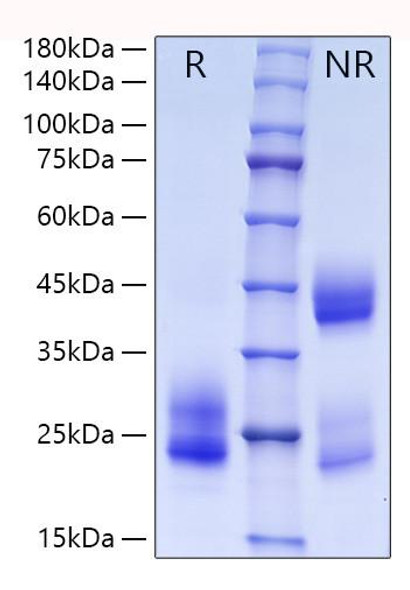
Human CD69 Recombinant Protein (N-His) is a recombinant protein expressed in E. coli, spanning Ser62-Lys199, with an N-terminal His tag. Predicted molecular weight: 18.27 kDa. Purity: >90% as determined by SDS-PAGE. Supplied lyophilized from a solution in PBS pH 7.4, 0.02% NLS, 1 mM EDTA, 4% Trehalose, 1% Mannitol. Applications: ELISA, immunogen, SDS-PAGE and Western blot. Early activation antigen CD69 is a ~22 kDa protein. Transmembrane protein expressed mainly on T-cells resident in mucosa that plays an essential role in immune cell homeostasis. For research use only.
Rapidly expressed on the surface of platelets, T-lymphocytes and NK cells upon activation by various stimuli, such as antigen recognition or cytokine signaling, stimulates different signaling pathways in different cell types. Negatively regulates Th17 cell differentiation through its carbohydrate dependent interaction with galectin-1/LGALS1 present on immature dendritic cells. Association of CD69 cytoplasmic tail with the JAK3/STAT5 signaling pathway regulates the transcription of RORgamma/RORC and, consequently, differentiation toward the Th17 lineage. Also acts via the S100A8/S100A9 complex present on peripheral blood mononuclear cells to promote the conversion of naive CD4 T-cells into regulatory T-cells. 1. de la Fuente, H. et al. (2014) Molecular and cellular biology 34, 2479-87. PMID: 24752896 2. Lin, CR. et al. (2015) FASEB journal : official publication of the Federation of American Societies for Experimental Biology 29, 5006-17. PMID: 26296369 3. Jiménez-Fernández, M. et al. (2022) Cellular and molecular life sciences : CMLS 79, 468. PMID: 35930205 4. Jiang, Y. et al. (2021) Clinical and translational medicine 11, e563. PMID: 34841721 5. Chen, H. et al. (2023) eLife 12. PMID: 37039481
| Product Name: | Human CD69 Recombinant Protein (N-His) |
| SKU: | GXRP02083 |
| Size: | 50 µg, 100 µg, 1 mg |
| Species: | Human |
| Synonyms: | AIM, CD69, C-type lectin domain family 2 member C, Early T-cell activation antigen p60, BL-AC/P26, GP32/28, MLR-3, Early activation antigen CD69, Leukocyte surface antigen Leu-23, CLEC2C, EA1, Activation inducer molecule |
| Tag: | N-His |
| Expression Host: | E. coli |
| Protein Length: | Ser62-Lys199 |
| Calculated MW: | 18.27 kDa |
| UniProt: | Q07108 |
| Applications: | ELISA, Immunogen, SDS-PAGE, WB |
| Purity: | >90% as determined by SDS-PAGE. |
| Form: | Lyophilized |
| Formulation: | Lyophilized from a solution in PBS pH 7.4, 0.02% NLS, 1 mM EDTA, 4% Trehalose, 1% Mannitol. |
| Reconstitution: | Reconstitute in sterile water for a stock solution. Adjust the volume of sterile water so that, after reconstitution, the final stock concentration matches the value indicated on the product label or datasheet. |
| Storage: | Store at 2 to 8°C for frequent use. Store at -20 to -80°C for twelve months from the date of receipt. |
| Shipping: | In general, proteins are provided as lyophilized powder/frozen liquid. They are shipped out with dry ice/blue ice unless customers require otherwise. |
| Note: | For research use only. |