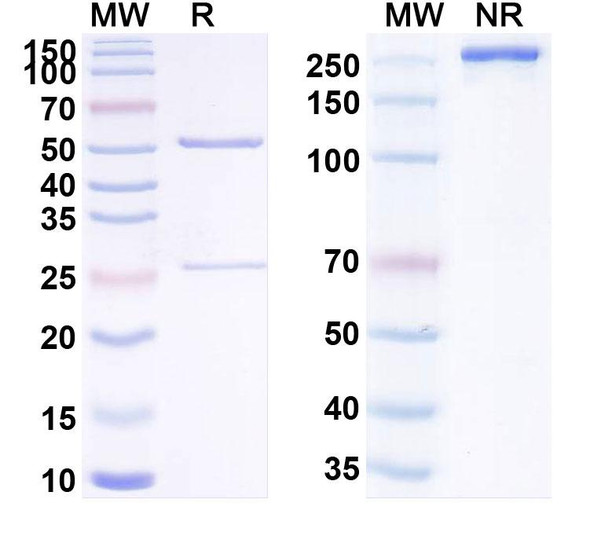
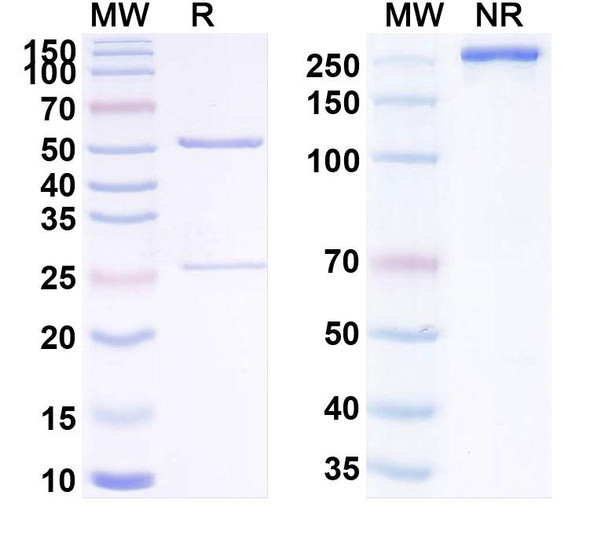
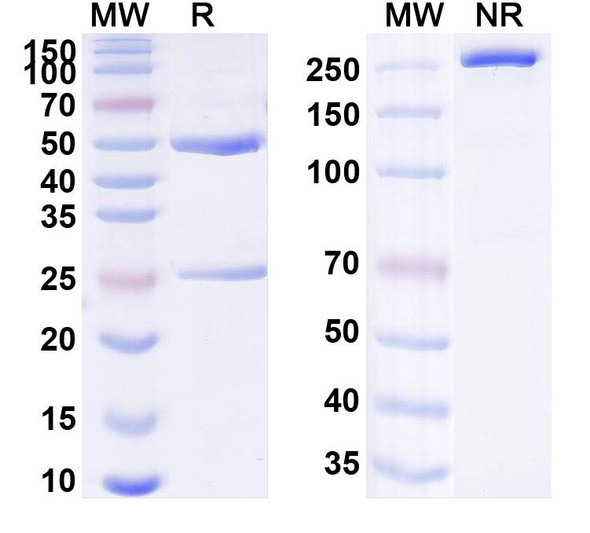
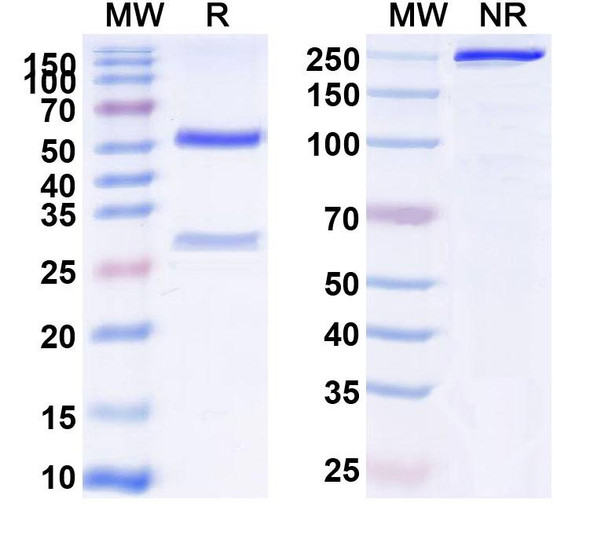
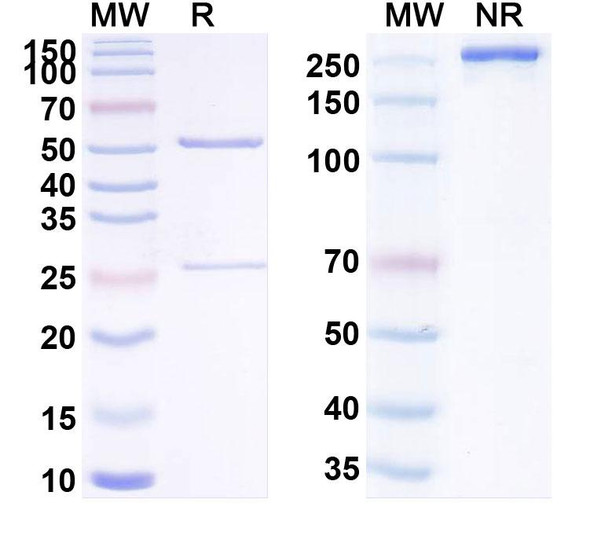
Human CD71/TFRC (JST-TFR09) Antibody is a research-grade biosimilar monoclonal antibody. It is a human IgG1 antibody. Reactivity: Human. Supplied as a liquid in 0.01M PBS pH 7.4. Applications: ELISA, flow cytometry, functional assays and in vivo research. Endotoxin: < 10 EU/mg. Purity: >95% purity as determined by SDS-PAGE. For research use only.
Transferrin receptor protein 1 (CD71/TFRC) is a ~84 kDa protein. Cellular uptake of iron occurs via receptor-mediated endocytosis of ligand-occupied transferrin receptor into specialized endosomes. Endosomal acidification leads to iron release. The apotransferrin-receptor complex is then recycled to the cell surface with a return to neutral pH and the concomitant loss of affinity of apotransferrin for its receptor. Transferrin receptor is necessary for development of erythrocytes and the nervous system. A second ligand, the hereditary hemochromatosis protein HFE, competes for binding with transferrin for an overlapping C-terminal binding site.
Product Name:
Human CD71/TFRC (JST-TFR09) Antibody
SKU:
GXBS01882
Size:
100 µg, 1 mg
Antibody Type:
Monoclonal Antibody
Clone:
JST-TFR09
Target:
CD71
Isotype:
IgG1
Host Species:
Human
Reactivity:
Human
Applications:
ELISA, FCM, Functional assay, Research in vivo
Synonyms:
JST-TFR09, JSTTFR09, JSTTFR09
Recommended Dilutions:
ELISA: 1:2000-1:20000
Biological Activity:
JST-TfR09 (10 ng/well-200 ng; 48 h) reduces viability of MT2, Su9T1, and KK1, and this cell death is inhibited by ferrostatin-1 [1]. JST-TfR09 (100 ng/mL; 48 h) downregulates TFR1, FTH1, and FTL, upregulates IRP2 and NCOA4, and induces lysosome-dependent ferritin degradation and autophagy in ED, KK1, and MT2 ATLL cell lines [1]. JST-TfR09 (100 ng/mL; 48 h) increases intracellular ferrous iron, ROS, and lipid peroxidation (MDA) levels, key hallmarks of ferroptosis, in Su9T1, MT2, ST1, SO4, KK1, and ED ATLL cell lines and MOLT4, JURKAT T-ALL cell lines [1]. JST-TfR09 induces in vitro toxicity to human erythroblasts differentiated from CD34 hematopoietic stem cells at concentrations greater than 156 ng/mL [2]. . Increased cell viability to almost 80% in MT2, Su9T1, and KK1 ATLL cell lines when co-treated with ferrostatin-1. Western Blot Analysis [1] Cell Line: ATLL cell lines (ED, KK1, MT2) Concentration: 100 ng/mL; 25 uM Aloxistatin () + 50 uM Pepstatin A () (pretreatment); 10 uM MG132 () (pretreatment) Incubation Time: 48 h (JST-TfR09); 24 h (pretreatment prior to JST-TfR09) Result: Decreased TFR1, FTH1, and FTL protein levels in ED and KK1 cells. Increased IRP2 and NCOA4 protein levels in ED and KK1 cells. Prevented JST-TfR09-induced ferritin degradation in cells pretreated with lysosomal inhibitors, while proteasomal inhibitor pretreatment did not. Increased LC3-II expression relative to LC3-I in cells, indicating autophagy activation, which was blocked by lysosomal inhibitor co-treatment.
Purity:
>95% as determined by SDS-PAGE.
Endotoxin Level:
< 10 EU/mg
Formulation:
0.01M PBS pH 7.4.
State of Matter:
Liquid
Regulatory Status:
For research use only. Not suitable for clinical or therapeutic use.
Product Preparation:
Protein A/G purified from cell culture supernatant.
Storage and Handling:
Store at 2 to 8°C for frequent use. Store at -20 to -80°C for twelve months from the date of receipt.