Description
Human CD82 Recombinant Protein (N-His)
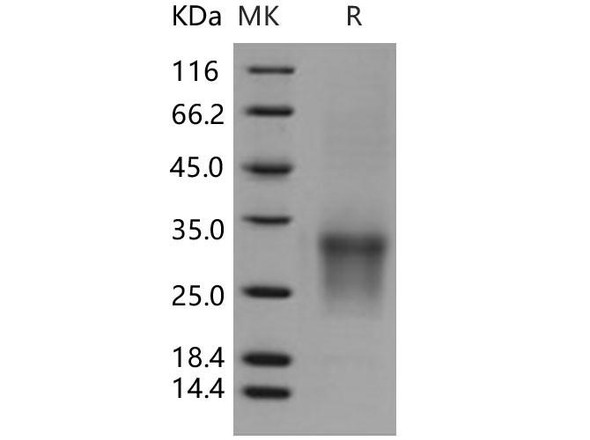
Human CD82 Recombinant Protein (N-His) is a recombinant protein expressed in E. coli, spanning Gly111-Leu228, with an N-terminal His tag. Predicted molecular weight: 15.84 kDa. Purity: >90% as determined by SDS-PAGE. Supplied lyophilized from a solution in PBS pH 7.4, 0.02% NLS, 1 mM EDTA, 4% Trehalose, 1% Mannitol. Applications: ELISA, immunogen, SDS-PAGE and Western blot. CD82 antigen is a ~29 kDa protein. Structural component of specialized membrane microdomains known as tetraspanin-enriched microdomains (TERMs), which act as platforms for receptor clustering and signaling. For research use only.
Participates thereby in diverse biological functions such as cell signal transduction, adhesion, migration and protein trafficking. Acts as a attenuator of EGF signaling, facilitating ligand-induced endocytosis of the receptor and its subsequent desensitization. Mechanistically, modulates ligand-induced ubiquitination and trafficking of EGFR via E3 ligase CBL phosphorylation by PKC. Increases cell-matrix adhesion by regulating the membrane organization of integrin alpha4/ITA4.
| Product Name: | Human CD82 Recombinant Protein (N-His) |
| SKU: | GXRP07265 |
| Size: | 50 µg, 100 µg, 1 mg |
| Species: | Human |
| Synonyms: | CD82 antigen, C33 antigen, IA4, Inducible membrane protein R2, Metastasis suppressor Kangai-1, Suppressor of tumorigenicity 6 protein, Tetraspanin-27, Tspan-27, CD82, CD82, KAI1, SAR2, ST6, TSPAN27 |
| Tag: | N-His |
| Expression Host: | E. coli |
| Protein Length: | Gly111-Leu228 |
| Calculated MW: | 15.84 kDa |
| UniProt: | P27701 |
| Applications: | ELISA, Immunogen, SDS-PAGE, WB |
| Purity: | >90% as determined by SDS-PAGE. |
| Form: | Lyophilized |
| Formulation: | Lyophilized from a solution in PBS pH 7.4, 0.02% NLS, 1 mM EDTA, 4% Trehalose, 1% Mannitol. |
| Reconstitution: | Reconstitute in sterile water for a stock solution. Adjust the volume of sterile water so that, after reconstitution, the final stock concentration matches the value indicated on the product label or datasheet. |
| Storage: | Store at 2 to 8°C for frequent use. Store at -20 to -80°C for twelve months from the date of receipt. |
| Shipping: | In general, proteins are provided as lyophilized powder/frozen liquid. They are shipped out with dry ice/blue ice unless customers require otherwise. |
| Note: | For research use only. |