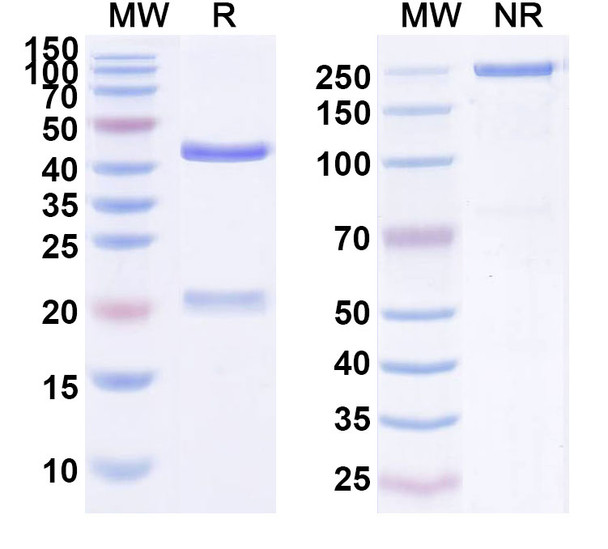
Human EMP2 (PG-101) Antibody is a research-grade biosimilar monoclonal antibody targeting Epithelial membrane protein 2. It is a human IgG antibody. Reactivity: Human. Supplied as a liquid in 0.01M PBS pH 7.4. Applications: ELISA, flow cytometry, functional assays and in vivo research. Endotoxin: < 10 EU/mg. Purity: >95% purity as determined by SDS-PAGE. For research use only.
Epithelial membrane protein 2 (EMP2) is a ~19 kDa protein. Functions as a key regulator of cell membrane composition by regulating protein surface expression. Also, plays a role in regulation of processes including cell migration, cell proliferation, cell contraction and cell adhesion. Regulates transepithelial migration of neutrophils into the alveolar lumen, potentially via mediation of cell surface expression of adhesion markers and lipid raft formation. Negatively regulates caveolae formation by reducing CAV1 expression and CAV1 amount by increasing lysosomal degradation. Facilitates surface trafficking and formation of lipid rafts bearing GPI-anchor proteins.
Product Name:
Human EMP2 (PG-101) Antibody
SKU:
GXBS01273
Size:
100 µg, 1 mg
Antibody Type:
Monoclonal Antibody
Clone:
PG-101
Target:
Epithelial membrane protein 2
Isotype:
IgG
Host Species:
Human
Reactivity:
Human
Applications:
ELISA, FACS, Functional assay, Research in vivo
Expression Host:
Mammalian cells
Synonyms:
PG-101, PG101, PG101
Purity:
>95% purity as determined by SDS-PAGE.
Endotoxin Level:
< 10 EU/mg
Formulation:
0.01M PBS pH 7.4
State of Matter:
Liquid
Regulatory Status:
For research use only. Not suitable for clinical or therapeutic use.
Product Preparation:
Protein A/G purified from cell culture supernatant.
Storage and Handling:
Store at 2 to 8°C for frequent use. Store at -20 to -80°C for twelve months from the date of receipt.