Description
Human HEMK2 Recombinant Protein (C-His)
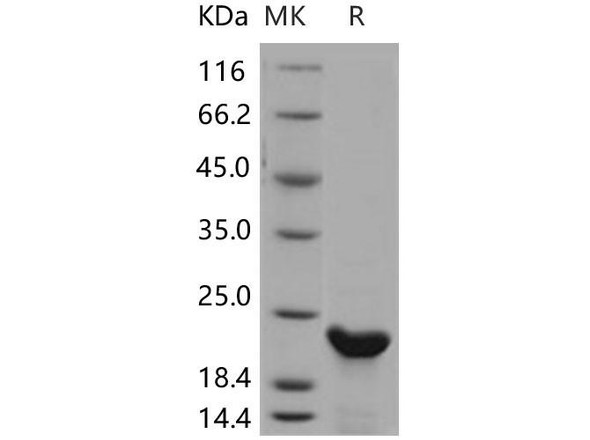
Human HEMK2 Recombinant Protein (C-His) is a recombinant protein expressed in E. coli, spanning Met1-Ser214, with a C-terminal His tag. Purity: >90% as determined by SDS-PAGE. Supplied lyophilized from a solution in PBS pH 7.4, 1 mM EDTA, 4% Trehalose, 1% Mannitol. Applications: ELISA, immunogen, SDS-PAGE and Western blot. Methyltransferase HEMK2 is a ~22 kDa protein. Methyltransferase that can methylate proteins and, to a lower extent, arsenic. For research use only.
Catalytic subunit of a heterodimer with TRMT112, which monomethylates 'Lys-12' of histone H4 (H4K12me1), a modification present at the promoters of numerous genes encoding cell cycle regulators. Catalytic subunit of a heterodimer with TRMT112, which catalyzes N5-methylation of Glu residue of proteins with a Gly-Gln-Xaa-Xaa-Xaa-Arg motif. Methylates ETF1 on 'Gln-185'; ETF1 needs to be complexed to ERF3 in its GTP-bound form to be efficiently methylated. May also play a role in the modulation of arsenic-induced toxicity by mediating the conversion of monomethylarsonous acid (3+) into the less toxic dimethylarsonic acid.
| Product Name: | Human HEMK2 Recombinant Protein (C-His) |
| SKU: | GXRP13666 |
| Size: | 50 µg, 100 µg, 1 mg |
| Species: | Human |
| Synonyms: | C21orf127, EC:2.1.1.-, HEMK2, HemK methyltransferase family member 2, KMT9, Lysine N-methyltransferase 9, M.HsaHemK2P, Methylarsonite methyltransferase N6AMT1, Methyltransferase HEMK2, Methyltransferase N6AMT1, N6AMT1, PRED28, Protein N(5)-glutamine methyltransferase |
| Tag: | C-His |
| Expression Host: | E. coli |
| Protein Length: | Met1-Ser214 |
| UniProt: | Q9Y5N5 |
| Applications: | ELISA, Immunogen, SDS-PAGE, WB |
| Purity: | >90% as determined by SDS-PAGE. |
| Form: | Lyophilized |
| Formulation: | Lyophilized from a solution in PBS pH 7.4, 1 mM EDTA, 4% Trehalose, 1% Mannitol. |
| Reconstitution: | Reconstitute in sterile water for a stock solution. A copy of datasheet will be provided with the products, please refer to it for details. |
| Storage: | Store at 2 to 8°C for frequent use. Store at -20 to -80°C for twelve months from the date of receipt. |
| Shipping: | In general, proteins are provided as lyophilized powder/frozen liquid. They are shipped out with dry ice/blue ice unless customers require otherwise. |
| Note: | For research use only |