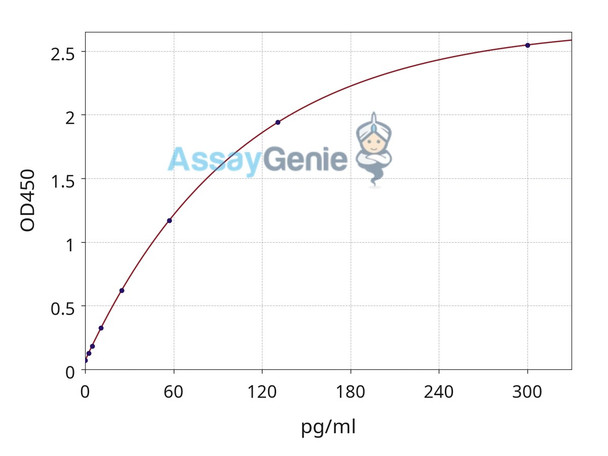
The Human IL6 ELISA Kit (SKU: GXEL00271) is a quantitative sandwich ELISA for the measurement of Human IL6 in serum, plasma and other biological fluids. The assay has a detection range of 4.68 - 300 pg/mL and a sensitivity of 2.37 pg/mL.
This assay employs the quantitative sandwich enzyme immunoassay technique. An antibody specific for Human IL6 has been pre-coated onto a microplate. Standards or samples are pipetted into the wells and any Human IL6 present is bound by the immobilized antibody. After washing away any unbound substances, a biotin-labeled Human IL6 antibody is added to the wells. After washing away any unbound substances, Streptavidin-HRP is added to the wells. Following a wash to remove any unbound enzyme reagent, a substrate solution is added to the wells and color develops in proportion to the amount of Human IL6 bound in the initial step. The color development is stopped and the intensity of the color is measured.
Product Name:
Human IL6 ELISA Kit
SKU:
GXEL00271
Size:
96 Assays
Reactivity:
Human
Assay Type:
Sandwich
Detection Method:
Colorimetric (450 nm)
Sensitivity:
2.37 pg/mL
Range:
4.68 - 300 pg/mL
Precision:
Intra-assay CV ≤ 9.4%; inter-assay CV ≤ 10.8%
Recovery:
80-93% (average, by sample type and dilution)
Sample Type:
Serum, plasma and other biological fluids
UniProt:
P17676, P49716, P05231
Storage:
2-8°C for 12 months.
Stability:
When the kit was stored at the recommended temperature for 12 months, the signal intensity decreased by less than 30%. For unopened kits, if you want to prolong the storage time, please store the Standard, Detection A, Detection B and Microplate at - 20 °C, the rest reagents should be store at 4°C.
Note:
For Research Use Only. Not for diagnostic procedures.
Precision:
Intra 1
Intra 2
Intra 3
Inter 1
Inter 2
Inter 3
n
16
16
16
24
24
24
Mean (pg/mL)
158.0
36.3
9.0
153.5
34.1
8.9
Standard deviation
13.3
3.4
0.5
16.6
3.3
1.0
CV (%)
8.4
9.4
5.9
10.8
9.7
10.7
Recovery:
Sample
Dilution
Average (%)
Range (%)
Human serum (n=2)
1:2
80
73-99
Human serum (n=2)
1:4
87
75-116
Human serum (n=2)
1:8
90
79-111
Human serum (n=2)
1:16
84
71-93
Cell Culture Supernate (n=3)
1:2
93
83-106
Linearity:
Sample
Dilution
Average (%)
Range (%)
Human serum (n=7)
1:2
100
-
Human serum (n=7)
1:4
106
102-113
Human serum (n=7)
1:8
112
108-117
Human serum (n=7)
1:16
114
104-122
Cell Culture Supernate (n=4)
1:2
100
-
Cell Culture Supernate (n=4)
1:4
101
92-108
Cell Culture Supernate (n=4)
1:8
109
106-111
Cell Culture Supernate (n=4)
1:16
112
109-114
Note: The below protocol is a sample protocol. Protocols are specific to each batch/lot. For the correct instructions please follow the protocol included in your kit.
Step
Procedure
1
Preparation: Bring all reagents and samples to room temperature and prepare reagents, working standards and samples as directed. Assay all standards and samples in duplicate.
2
Standard & Sample Incubation: Add 100 µL standard or samples to each well; incubate for 2 hours at 37°C. Wash 3 times with Wash Buffer (300 µL).
3
Detection: Add 100 µL of Detection A (working solution) to each well; incubate for 1 hour at 37°C. Add 100 µL of Detection B (working solution) to each well; incubate for 30 minutes at 37°C. Wash 5 times with Wash Buffer (300 µL).
4
Color Development: Add 100 µL of Color Reagent to each well; incubate for 15 minutes at 37°C; protect from light.
5
Stop & Read: Add 50 µL of Stop Solution to each well, then read the optical density at 450 nm within 10 minutes (correction 630 nm or 620 nm).
Sample Type
Protocol
Serum
Use a serum separator tube (SST) and allow samples to clot for 30 minutes at room temperature before centrifugation for 15 minutes at 1000 x g. Remove serum and assay immediately or aliquot and store samples at ≤ -20°C. Avoid repeated freeze-thaw cycles.
Plasma
Collect plasma using EDTA, heparin, or citrate as an anticoagulant. Centrifuge for 15 minutes at 1000 x g within 30 minutes of collection. Assay immediately or aliquot and store samples at ≤ -20°C. Avoid repeated freeze-thaw cycles.
Other Sample Types
For more information about how to process other sample types, (e.g., body fluids, breast milk & more), please contact our Tech Support Team at techsupport@assaygenie.com.