Description
Human KEAP1 Recombinant Protein (N-His)
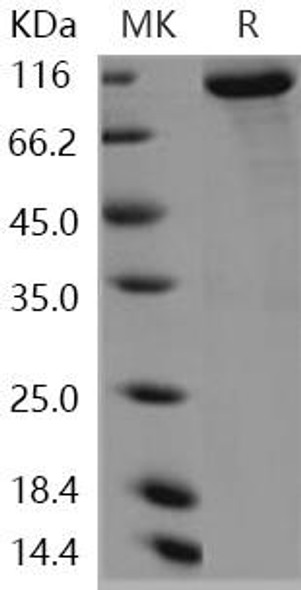
Human KEAP1 Recombinant Protein (N-His) is a recombinant protein expressed in E. coli, spanning Gly325-Cys624, with an N-terminal His tag. Predicted molecular weight: 35.3 kDa. Purity: >90% as determined by SDS-PAGE. Supplied lyophilized from a solution in PBS pH 7.4, 0.02% NLS, 1 mM EDTA, 4% Trehalose, 1% Mannitol. Applications: ELISA, immunogen, SDS-PAGE and Western blot. Kelch-like ECH-associated protein 1 (KEAP1) is a ~69 kDa protein. Substrate-specific adapter of a BCR (BTB-CUL3-RBX1) E3 ubiquitin ligase complex that regulates the response to oxidative stress by targeting NFE2L2/NRF2 for ubiquitination. For research use only.
KEAP1 acts as a key sensor of oxidative and electrophilic stress: in normal conditions, the BCR(KEAP1) complex mediates ubiquitination and degradation of NFE2L2/NRF2, a transcription factor regulating expression of many cytoprotective genes. In response to oxidative stress, different electrophile metabolites trigger non-enzymatic covalent modifications of highly reactive cysteine residues in KEAP1, leading to inactivate the ubiquitin ligase activity of the BCR(KEAP1) complex, promoting NFE2L2/NRF2 nuclear accumulation and expression of phase II detoxifying enzymes. In response to selective autophagy, KEAP1 is sequestered in inclusion bodies following its interaction with SQSTM1/p62, leading to inactivation of the BCR(KEAP1) complex and activation of NFE2L2/NRF2. The BCR(KEAP1) complex also mediates ubiquitination of SQSTM1/p62, increasing SQSTM1/p62 sequestering activity and degradation.
| Product Name: | Human KEAP1 Recombinant Protein (N-His) |
| SKU: | GXRP02253 |
| Size: | 50 µg, 100 µg, 1 mg |
| Species: | Human |
| Synonyms: | INrf2, INRF2, KLHL19, KEAP1, KIAA0132, Kelch-like ECH-associated protein 1, Cytosolic inhibitor of Nrf2, Kelch-like protein 19 |
| Tag: | N-His |
| Expression Host: | E. coli |
| Protein Length: | Gly325-Cys624 |
| Calculated MW: | 35.3 kDa |
| UniProt: | Q14145 |
| Applications: | ELISA, Immunogen, SDS-PAGE, WB |
| Purity: | >90% as determined by SDS-PAGE. |
| Form: | Lyophilized |
| Formulation: | Lyophilized from a solution in PBS pH 7.4, 0.02% NLS, 1 mM EDTA, 4% Trehalose, 1% Mannitol. |
| Reconstitution: | Reconstitute in sterile water for a stock solution. Adjust the volume of sterile water so that, after reconstitution, the final stock concentration matches the value indicated on the product label or datasheet. |
| Storage: | Store at 2 to 8°C for frequent use. Store at -20 to -80°C for twelve months from the date of receipt. |
| Shipping: | In general, proteins are provided as lyophilized powder/frozen liquid. They are shipped out with dry ice/blue ice unless customers require otherwise. |
| Note: | For research use only. |