Description
Human PRKCI Recombinant Protein (N-His)
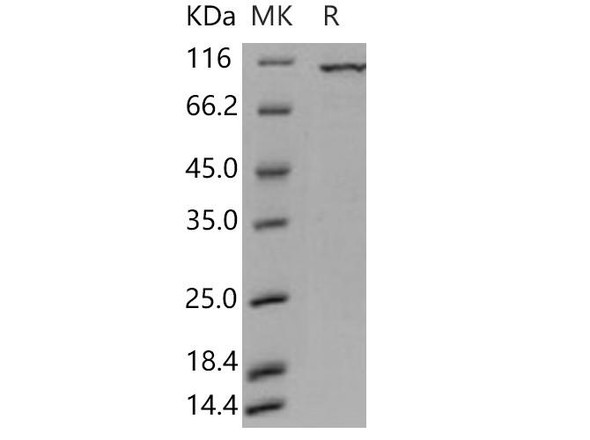
Human PRKCI Recombinant Protein (N-His) is a recombinant protein expressed in E. coli, spanning Ile375-Val596, with an N-terminal His tag. Predicted molecular weight: 27.59 kDa. Purity: >90% as determined by SDS-PAGE. Supplied lyophilized from a solution in PBS pH 7.4, 0.02% NLS, 1 mM EDTA, 4% Trehalose, 1% Mannitol. Applications: ELISA, immunogen, SDS-PAGE and Western blot. Protein kinase C iota type (PRKCI) is a ~68 kDa protein. Calcium- and diacylglycerol-independent serine/ threonine-protein kinase that plays a general protective role against apoptotic stimuli, is involved in NF-kappa-B activation, cell survival, differentiation and polarity, and contributes to the regulation of microtubule dynamics in the early secretory pathway. For research use only.
Is necessary for BCR-ABL oncogene-mediated resistance to apoptotic drug in leukemia cells, protecting leukemia cells against drug-induced apoptosis. In cultured neurons, prevents amyloid beta protein-induced apoptosis by interrupting cell death process at a very early step. In glioblastoma cells, may function downstream of phosphatidylinositol 3-kinase (PI(3)K) and PDPK1 in the promotion of cell survival by phosphorylating and inhibiting the pro-apoptotic factor BAD. Can form a protein complex in non-small cell lung cancer (NSCLC) cells with PARD6A and ECT2 and regulate ECT2 oncogenic activity by phosphorylation, which in turn promotes transformed growth and invasion.
| Product Name: | Human PRKCI Recombinant Protein (N-His) |
| SKU: | GXRP01578 |
| Size: | 50 µg, 100 µg, 1 mg |
| Species: | Human |
| Synonyms: | Protein kinase C iota type, nPKC-iota, PRKCI, DXS1179E, aPKC-lambda/iota, Atypical protein kinase C-lambda/iota, PRKC-lambda/iota |
| Tag: | N-His |
| Expression Host: | E. coli |
| Protein Length: | Ile375-Val596 |
| Calculated MW: | 27.59 kDa |
| UniProt: | P41743 |
| Applications: | ELISA, Immunogen, SDS-PAGE, WB |
| Purity: | >90% as determined by SDS-PAGE. |
| Form: | Lyophilized |
| Formulation: | Lyophilized from a solution in PBS pH 7.4, 0.02% NLS, 1 mM EDTA, 4% Trehalose, 1% Mannitol. |
| Reconstitution: | Reconstitute in sterile water for a stock solution. Adjust the volume of sterile water so that, after reconstitution, the final stock concentration matches the value indicated on the product label or datasheet. |
| Storage: | Store at 2 to 8°C for frequent use. Store at -20 to -80°C for twelve months from the date of receipt. |
| Shipping: | In general, proteins are provided as lyophilized powder/frozen liquid. They are shipped out with dry ice/blue ice unless customers require otherwise. |
| Note: | For research use only. |