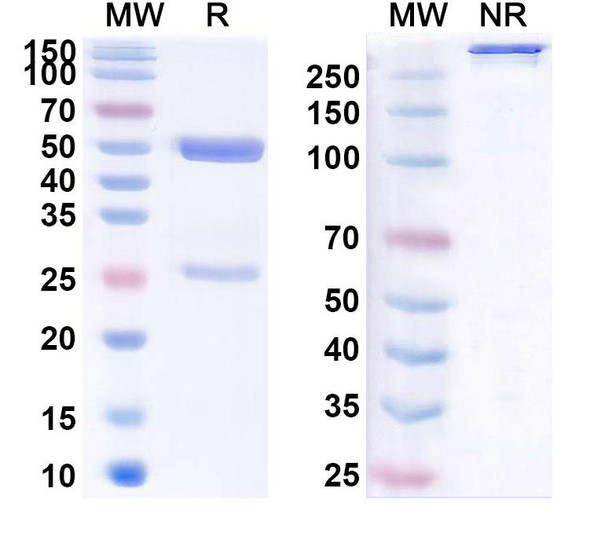
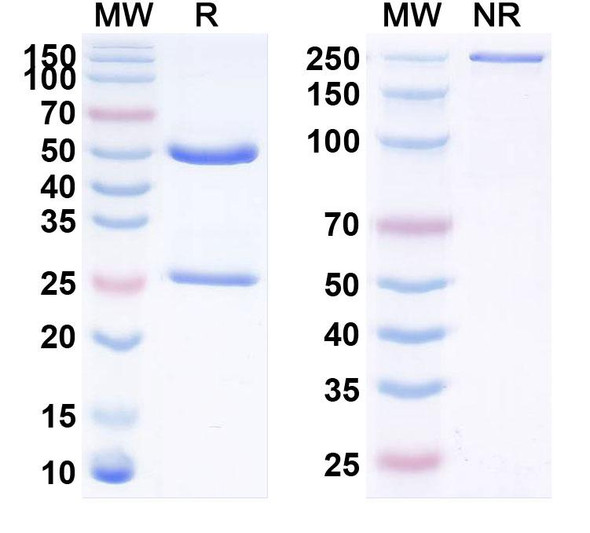
Human PRLR (XOMA 213) Antibody is a research-grade biosimilar monoclonal antibody. It is a human IgG antibody. Reactivity: Human. Supplied as a liquid in 0.01M PBS pH 7.4. Applications: ELISA, flow cytometry, functional assays and in vivo research. Endotoxin: < 10 EU/mg. Purity: >95% purity as determined by SDS-PAGE. For research use only.
Prolactin receptor (PRLR) is a ~69 kDa protein. This is a receptor for the anterior pituitary hormone prolactin (PRL). Acts as a prosurvival factor for spermatozoa by inhibiting sperm capacitation through suppression of SRC kinase activation and stimulation of AKT. Isoform 4 is unable to transduce prolactin signaling. Isoform 6 is unable to transduce prolactin signaling.
Product Name:
Human PRLR (XOMA 213) Antibody
SKU:
GXBS01807
Size:
100 µg, 1 mg
Antibody Type:
Monoclonal Antibody
Clone:
XOMA 213
Target:
PRLR
Isotype:
IgG
Host Species:
Human
Reactivity:
Human
Applications:
ELISA, FACS, Functional assay, Research in vivo
Expression Host:
Mammalian cells
Synonyms:
XOMA-213, XOMA213, XOMA213
Biological Activity:
XOMA-213 (10 ug/mL) specifically binds to endogenous human and rat PRLR expressed on the surface of T47D, MCF7, Nb2-11, BaF3/hPRLR cells and primary human breast tumor cells, but does not bind to mouse PRLR or PRLR-negative BaF3 cells [1]. XOMA-213 (0.01-10 ug/mL; pre-incubated on ice for 45 min) binds to T47D cells without interfering with the PRL-PRLR interaction, exhibiting a non-ligand competitive binding mode [1]. XOMA-213 (0.05-10 ug/mL; 30 min pre-incubation at 37°C) potently inhibits hPRL-induced phosphorylation of Stat5, Akt and ERK1/2 in T47D cells, suppresses hPRL-induced Stat5 phosphorylation in MCF7 cells, and completely blocks hPRL-induced Stat5 phosphorylation in ER+/PR+/HER2- primary human breast tumor cells, with no detectable agonist activity [1]. XOMA-213 (0.01-100 ug/mL; 96-168 h) completely blocks hPRL-induced proliferation of T47D cells, potently inhibits the survival of Nb2-11 cells, suppresses hPRL- and hGH-induced proliferation in BaF3/hPRLR cells (EC 50 = 0.5 ug/mL), and inhibits autocrine PRL-dependent growth in BaF3/hPRLR/hPRL cells. It performs better than ligand-competitive antagonists in high-ligand environments [1]. XOMA-213 (0.001-100 ug/mL; 24 h) induces antibody-dependent cell-mediated cytotoxicity (ADCC) against T47D cells, with a maximum cell killing rate of 50% and an EC 50 of 0.13 ug/mL, demonstrating an additional antitumor mechanism of action [1]. Western Blot Analysis [1] Cell Line: T47D human ER+ breast cancer cells, MCF7 human ER+ breast cancer cells, dissociated primary human breast tumor cells (ER+/PR+/HER2-) Concentration: 0.05, 0.1, 0.5, 1, 5 ug/mL (T47D/MCF7 cells); 10 ug/mL (primary tumor cells); 50 ng/mL hPRL Incubation Time: 30 min (pre-incubation at 37°C); 30 min (hPRL stimulation) Result: Neutralized hPRL-induced phosphorylation of Stat5, Akt, and ERK1/2 in a concentration-dependent manner in T47D cells. Antagonized hPRL-induced Stat5 phosphorylation efficiently in MCF7 cells.
Purity:
>95% purity as determined by SDS-PAGE.
Endotoxin Level:
< 10 EU/mg
Formulation:
0.01M PBS pH 7.4
State of Matter:
Liquid
Regulatory Status:
For research use only. Not suitable for clinical or therapeutic use.
Product Preparation:
Protein A/G purified from cell culture supernatant.
Storage and Handling:
Store at 2 to 8°C for frequent use. Store at -20 to -80°C for twelve months from the date of receipt.