Description
Human RGMA Recombinant Protein (C-His)
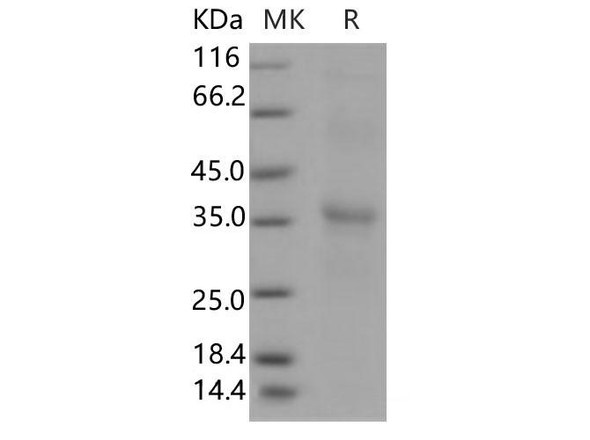
Human RGMA Recombinant Protein (C-His) is a recombinant protein expressed in mammalian cells, spanning Met1-Gly422, with a C-terminal His tag. Predicted molecular weight: 47.50 kDa. Purity: >90% as determined by SDS-PAGE. Supplied lyophilized from a solution in PBS pH 7.4, 1 mM EDTA, 4% Trehalose, 1% Mannitol. Applications: ELISA, immunogen, SDS-PAGE and Western blot. Repulsive guidance molecule A (RGMA) is a ~49 kDa protein. Member of the repulsive guidance molecule (RGM) family that performs several functions in the developing and adult nervous system. For research use only.
Regulates cephalic neural tube closure, inhibits neurite outgrowth and cortical neuron branching, and the formation of mature synapses. Binding to its receptor NEO1/neogenin induces activation of RHOA-ROCK1/Rho-kinase signaling pathway through UNC5B-ARHGEF12/LARG-PTK2/FAK1 cascade, leading to collapse of the neuronal growth cone and neurite outgrowth inhibition. Furthermore, RGMA binding to NEO1/neogenin leads to HRAS inactivation by influencing HRAS-PTK2/FAK1-AKT1 pathway. It also functions as a bone morphogenetic protein (BMP) coreceptor that may signal through SMAD1, SMAD5, and SMAD8.
| Product Name: | Human RGMA Recombinant Protein (C-His) |
| SKU: | GXRP02698 |
| Size: | 50 µg, 100 µg, 1 mg |
| Species: | Human |
| Synonyms: | RGM domain family member A, RGMA, RGM, Repulsive guidance molecule A |
| Tag: | C-His |
| Expression Host: | Mammalian cells |
| Protein Length: | Met1-Gly422 |
| Calculated MW: | 47.50 kDa |
| UniProt: | Q96B86 |
| Applications: | ELISA, Immunogen, SDS-PAGE, WB |
| Purity: | >90% as determined by SDS-PAGE. |
| Form: | Lyophilized |
| Formulation: | Lyophilized from a solution in PBS pH 7.4, 1 mM EDTA, 4% Trehalose, 1% Mannitol. |
| Reconstitution: | Reconstitute in sterile water for a stock solution. Adjust the volume of sterile water so that, after reconstitution, the final stock concentration matches the value indicated on the product label or datasheet. |
| Storage: | Store at 2 to 8°C for frequent use. Store at -20 to -80°C for twelve months from the date of receipt. |
| Shipping: | In general, proteins are provided as lyophilized powder/frozen liquid. They are shipped out with dry ice/blue ice unless customers require otherwise. |
| Note: | For research use only. |