Description
Human RSPO1 Recombinant Protein (N-His)
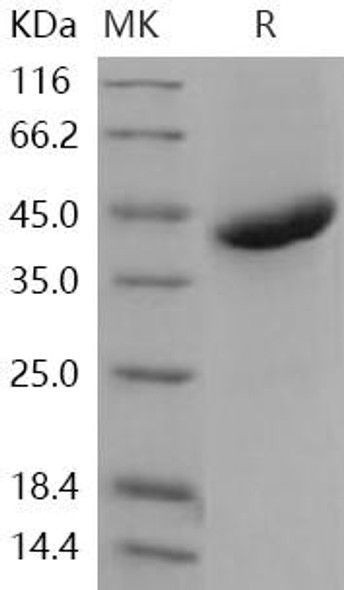
Human RSPO1 Recombinant Protein (N-His) is a recombinant protein expressed in E. coli, spanning Ser21-Ala135, with an N-terminal His tag. Predicted molecular weight: 14.99 kDa. Purity: >90% as determined by SDS-PAGE. Supplied lyophilized from a solution in PBS pH 7.4, 0.02% NLS, 1 mM EDTA, 4% Trehalose, 1% Mannitol. Applications: ELISA, immunogen, SDS-PAGE and Western blot. R-spondin-1 (RSPO1) is a ~28 kDa protein. Activator of the canonical Wnt signaling pathway by acting as a ligand for LGR4-6 receptors. For research use only.
Upon binding to LGR4-6 (LGR4, LGR5 or LGR6), LGR4-6 associate with phosphorylated LRP6 and frizzled receptors that are activated by extracellular Wnt receptors, triggering the canonical Wnt signaling pathway to increase expression of target genes. Also regulates the canonical Wnt/beta-catenin-dependent pathway and non-canonical Wnt signaling by acting as an inhibitor of ZNRF3, an important regulator of the Wnt signaling pathway. Acts as a ligand for frizzled FZD8 and LRP6. May negatively regulate the TGF-beta pathway.
| Product Name: | Human RSPO1 Recombinant Protein (N-His) |
| SKU: | GXRP02401 |
| Size: | 50 µg, 100 µg, 1 mg |
| Species: | Human |
| Synonyms: | R-spondin-1, hRspo1, RSPO1, Roof plate-specific spondin-1 |
| Tag: | N-His |
| Expression Host: | E. coli |
| Protein Length: | Ser21-Ala135 |
| Calculated MW: | 14.99 kDa |
| UniProt: | Q2MKA7 |
| Applications: | ELISA, Immunogen, SDS-PAGE, WB |
| Purity: | >90% as determined by SDS-PAGE. |
| Form: | Lyophilized |
| Formulation: | Lyophilized from a solution in PBS pH 7.4, 0.02% NLS, 1 mM EDTA, 4% Trehalose, 1% Mannitol. |
| Reconstitution: | Reconstitute in sterile water for a stock solution. Adjust the volume of sterile water so that, after reconstitution, the final stock concentration matches the value indicated on the product label or datasheet. |
| Storage: | Store at 2 to 8°C for frequent use. Store at -20 to -80°C for twelve months from the date of receipt. |
| Shipping: | In general, proteins are provided as lyophilized powder/frozen liquid. They are shipped out with dry ice/blue ice unless customers require otherwise. |
| Note: | For research use only. |