Description
Human SNAI1 Recombinant Protein (N-His)
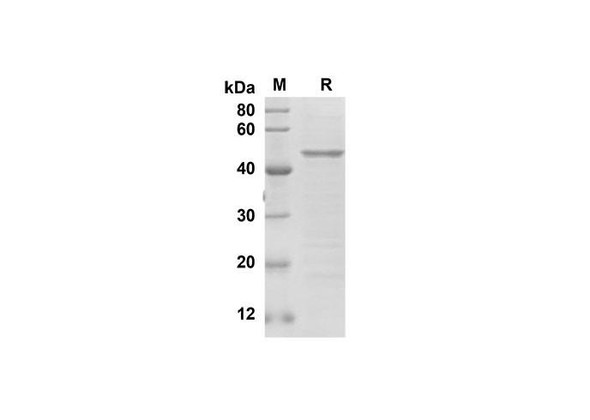
Human SNAI1 Recombinant Protein (N-His) is a recombinant protein expressed in E. coli, spanning Met1-Arg264, with an N-terminal His tag. Predicted molecular weight: 31.24 kDa. Purity: >90% as determined by SDS-PAGE. Supplied lyophilized from a solution in PBS pH 7.4, 0.02% NLS, 1 mM EDTA, 4% Trehalose, 1% Mannitol. Applications: ELISA, immunogen, SDS-PAGE and Western blot. Zinc finger protein SNAI1 is a ~29 kDa protein. Involved in induction of the epithelial to mesenchymal transition (EMT), formation and maintenance of embryonic mesoderm, growth arrest, survival and cell migration. For research use only.
Binds to 3 E-boxes of the E-cadherin/CDH1 gene promoter and to the promoters of CLDN7 and KRT8 and, in association with histone demethylase KDM1A which it recruits to the promoters, causes a decrease in dimethylated H3K4 levels and represses transcription. The N-terminal SNAG domain competes with histone H3 for the same binding site on the histone demethylase complex formed by KDM1A and RCOR1, and thereby inhibits demethylation of histone H3 at 'Lys-4' (in vitro). During EMT, involved with LOXL2 in negatively regulating pericentromeric heterochromatin transcription. SNAI1 recruits LOXL2 to pericentromeric regions to oxidize histone H3 and repress transcription which leads to release of heterochromatin component CBX5/HP1A, enabling chromatin reorganization and acquisition of mesenchymal traits.
| Product Name: | Human SNAI1 Recombinant Protein (N-His) |
| SKU: | GXRP00332 |
| Size: | 50 µg, 100 µg, 1 mg |
| Species: | Human |
| Synonyms: | Protein sna, SNAI1, Zinc finger protein SNAI1, Protein snail homolog 1, SNAH |
| Tag: | N-His |
| Expression Host: | E. coli |
| Protein Length: | Met1-Arg264 |
| Calculated MW: | 31.24 kDa |
| UniProt: | O95863 |
| Applications: | ELISA, Immunogen, SDS-PAGE, WB |
| Purity: | >90% as determined by SDS-PAGE. |
| Form: | Lyophilized |
| Formulation: | Lyophilized from a solution in PBS pH 7.4, 0.02% NLS, 1 mM EDTA, 4% Trehalose, 1% Mannitol. |
| Reconstitution: | Reconstitute in sterile water for a stock solution. Adjust the volume of sterile water so that, after reconstitution, the final stock concentration matches the value indicated on the product label or datasheet. |
| Storage: | Store at 2 to 8°C for frequent use. Store at -20 to -80°C for twelve months from the date of receipt. |
| Shipping: | In general, proteins are provided as lyophilized powder/frozen liquid. They are shipped out with dry ice/blue ice unless customers require otherwise. |
| Note: | For research use only. |