Description
Human SRPK1 Recombinant Protein (N-His)
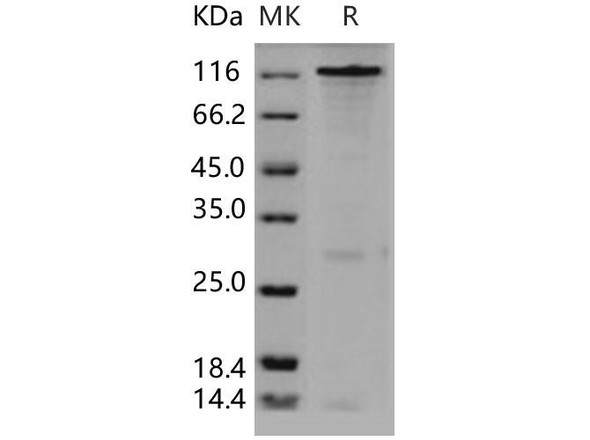
Human SRPK1 Recombinant Protein (N-His) is a recombinant protein expressed in E. coli, spanning Gln513-Ser655, with an N-terminal His tag. Predicted molecular weight: 18.73 kDa. Purity: >90% as determined by SDS-PAGE. Supplied lyophilized from a solution in PBS pH 7.4, 0.02% NLS, 1 mM EDTA, 4% Trehalose, 1% Mannitol. Applications: ELISA, immunogen, SDS-PAGE and Western blot. SRSF protein kinase 1 (SRPK1) is a ~74 kDa protein. Serine/arginine-rich protein-specific kinase which specifically phosphorylates its substrates at serine residues located in regions rich in arginine/serine dipeptides, known as RS domains and is involved in the phosphorylation of SR splicing factors and the regulation of splicing. For research use only.
Plays a central role in the regulatory network for splicing, controlling the intranuclear distribution of splicing factors in interphase cells and the reorganization of nuclear speckles during mitosis. Can influence additional steps of mRNA maturation, as well as other cellular activities, such as chromatin reorganization in somatic and sperm cells and cell cycle progression. Isoform 2 phosphorylates SFRS2, ZRSR2, LBR and PRM1. Isoform 2 phosphorylates SRSF1 using a directional (C-terminal to N-terminal) and a dual-track mechanism incorporating both processive phosphorylation (in which the kinase stays attached to the substrate after each round of phosphorylation) and distributive phosphorylation steps (in which the kinase and substrate dissociate after each phosphorylation event).
| Product Name: | Human SRPK1 Recombinant Protein (N-His) |
| SKU: | GXRP04688 |
| Size: | 50 µg, 100 µg, 1 mg |
| Species: | Human |
| Synonyms: | SRPK1, Serine/arginine-rich protein-specific kinase 1, SFRS protein kinase 1, SRSF protein kinase 1, SR-protein-specific kinase 1 |
| Tag: | N-His |
| Expression Host: | E. coli |
| Protein Length: | Gln513-Ser655 |
| Calculated MW: | 18.73 kDa |
| UniProt: | Q96SB4 |
| Applications: | ELISA, Immunogen, SDS-PAGE, WB |
| Purity: | >90% as determined by SDS-PAGE. |
| Form: | Lyophilized |
| Formulation: | Lyophilized from a solution in PBS pH 7.4, 0.02% NLS, 1 mM EDTA, 4% Trehalose, 1% Mannitol. |
| Reconstitution: | Reconstitute in sterile water for a stock solution. Adjust the volume of sterile water so that, after reconstitution, the final stock concentration matches the value indicated on the product label or datasheet. |
| Storage: | Store at 2 to 8°C for frequent use. Store at -20 to -80°C for twelve months from the date of receipt. |
| Shipping: | In general, proteins are provided as lyophilized powder/frozen liquid. They are shipped out with dry ice/blue ice unless customers require otherwise. |
| Note: | For research use only. |