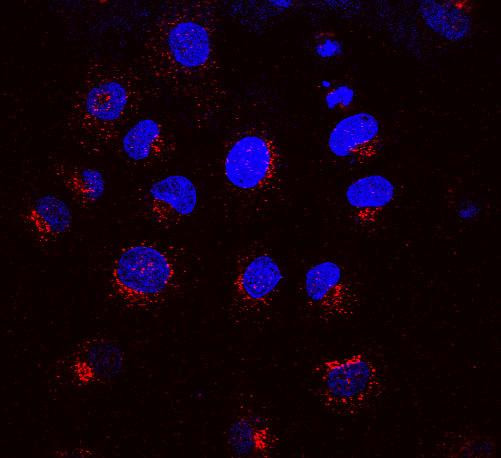
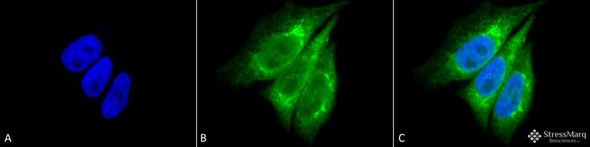
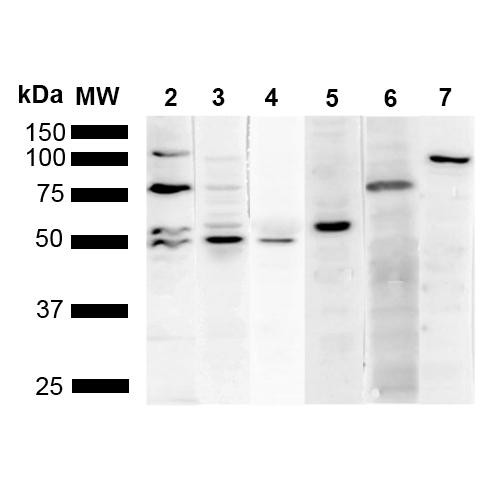
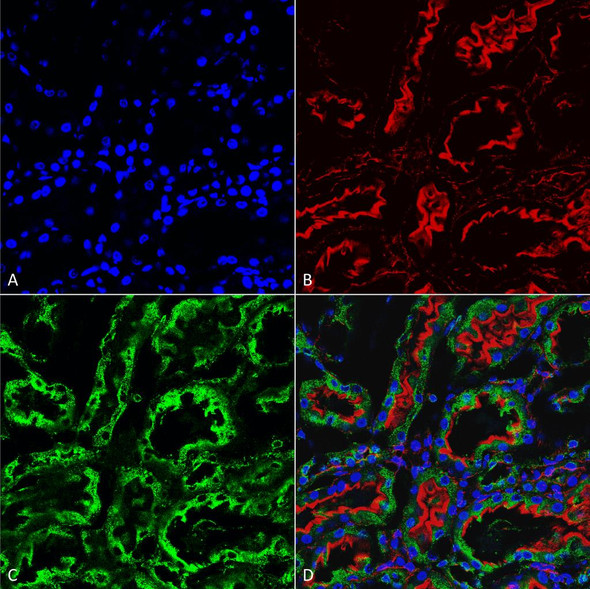
KDEL Receptor Antibody [KR-10] is a mouse monoclonal antibody directed against KDEL Receptor, offered by Assay Genie for research applications. Reported applications include WB, IHC, ICC/IF and IP. Reported reactivity: Human, Mouse, Rat, Bovine, Monkey, Hamster, Rabbit, Pig, Sheep, Dog, Chicken, Fruit Fly (Drosophila melanogaster) and African clawed frog (Xenopus laevis). Supplied as IgG1, purified by Protein G.
KDEL receptors are key components of the endoplasmic reticulum (ER) protein quality control system, essential for maintaining cellular homeostasis. These receptors recognize and retrieve ER-resident proteins bearing the KDEL (Lys-Asp-Glu-Leu) C-terminal motif, preventing their loss during vesicular transport to the Golgi apparatus. Variants of the KDEL sequence also contribute to ER retention, reflecting the system’s adaptability. In mammalian cells, three highly conserved KDEL receptor isoforms are localized to the cis-Golgi and ER-Golgi intermediate compartments. Functionally, KDEL receptors interact with ARF1 GTPase-activating proteins (GAPs), facilitating COPI-dependent retrograde vesicle transport. This retrieval mechanism is critical for sustaining ER function, especially under conditions of proteotoxic stress. In the context of neurodegenerative diseases—such as Alzheimer’s, Parkinson’s, and ALS—chronic ER stress and impaired protein folding are central pathological features. Dysregulation of KDEL receptor function can disrupt the unfolded protein response (UPR), exacerbate protein misfolding, and contribute to neuronal dysfunction and degeneration. Moreover, the KDEL receptor shares significant sequence identity with the yeast Erd2p, underscoring its evolutionary conservation and fundamental role in ER homeostasis. As interest grows in targeting ER stress pathways for therapeutic intervention, the KDEL receptor is emerging as a promising molecular target in neurodegenerative disease research. This antibody is also available conjugated to ATTO 390, ATTO 488, ATTO 594, APC, Biotin, FITC, HRP, PerCP and RPE. Supplied in 100 µg. For research use only; not for diagnostic or therapeutic procedures.
Product Name:
KDEL Receptor Antibody [KR-10]
Product SKU:
STMA00017
Size:
100 µg
Target:
KDEL Receptor
Host Species:
Mouse
Antibody Type:
Monoclonal
Clone ID:
KR-10
Research Areas:
Cell Signaling, Tags and Cell Markers, Organelle Markers, Protein Trafficking, Chaperone Proteins
Buffer:
PBS pH7.2, 50% glycerol, 0.09% sodium azide
Storage & Shipping:
Store at -20°C. Shipped on Blue Ice or 4°C. Conjugated variants should be stored according to the product label.
Format:
Liquid
Applications:
WB, IHC, ICC/IF, IP
Antibody Isotype:
IgG1
Purification:
Protein G Purified
Concentration:
1 mg/ml
Reactivity:
Human, Mouse, Rat, Bovine, Monkey, Hamster, Rabbit, Pig, Sheep, Dog, Chicken, Fruit Fly (Drosophila melanogaster), African clawed frog (Xenopus laevis)
Recommended Dilution:
WB (1:1000), ICC/IF (1:1000); optimal dilutions for assays should be determined by the user.
Specificity:
Detects ~25kDa.
Guarantee:
12 months from date of dispatch
Immunogen:
A 21 residue synthetic peptide (amino acids 192-212) based on the bovine KDEL receptor and the peptide coupled to KLH
1. Whiteman P., and Handford P.A. (2003) Hum Mol Genet 12(7): 727-737. 2. Forthoffer N., et al. (2002) J Bioenerg Biomemb 34(3): 209-219. 3. Aoe T., et al. (1997) EMBO J. 16: 7305-7316. 4. Tang B.L., Wong S.H, Qi X.L. Low S.H., and Hong W. (1993) J. Cell Biol. 120: 325-328. 5. Lewis M.J. and Pelham H.R. (1990) Nature 348: 162-163. 6. Spurger L. (2002). Endoplasmic reticulum: Structure and function. University of Texas Medical Branch. Retrieved September 13, 2006, from http://cellbio.utmb.edu/cellbio/rer1.htm




![Anti-KDEL [R93-3J-9] Monoclonal Antibody (AGMB03324)](https://cdn11.bigcommerce.com/s-h68l9z2lnx/images/stencil/590x590/products/274613/678775/anti-kdel-r93-3j-9-monoclonal-antibody-agmb03324__62669.1773036854.jpg?c=2 "Anti-KDEL [R93-3J-9] Monoclonal Antibody (AGMB03324)")

