The Mouse CD45.2 Monoclonal Antibody FITC Conjugated (104-2) is a top-quality research tool for scientists studying immune cell populations in mouse samples. This antibody, specifically designed for detecting CD45.2, a widely used marker for leukocytes, is ideal for flow cytometry applications due to its FITC conjugation.CD45.2, a member of the CD45 family of proteins, is crucial for immune cell development and activation. Its presence on leukocytes makes it a valuable target for immunologists investigating immune responses in various experimental settings. With the Mouse CD45.
2 Monoclonal Antibody FITC Conjugated (104-2), researchers can accurately identify and quantify CD45.2-expressing cells, providing essential data for understanding immune cell dynamics in health and disease.This antibody's high specificity and sensitivity ensure reliable results in flow cytometry assays, enabling precise analysis of immune cell subsets in mouse models. Its compatibility with various cell types and experimental conditions make it a versatile tool for immunological research, offering valuable insights into immune system function and dysregulation.
Product Title:
FITC Anti-Mouse CD45.2 Antibody [104.2]
SKU:
AGEL1515
Size:
50 Tests, 100 Tests, 200 Tests
Clone No:
104.2
Synonyms:
Ly-5.2; LCA;
Host Species:
Mouse
Reactivity:
Mouse
Application:
FCM
Isotype:
Mouse IgG2a, κ
Isotype Control:
FITC Mouse IgG2a, κ Isotype Control[C1.18.4]
Form:
Liquid
Conjugation:
FITC
Recommended Use:
Each lot of this antibody is quality control tested by flow cytometric analysis. The amount of the reagent is suggested to be used 5 µL of antibody per test (million cells in 100 µL staining volume or per 100 µL of whole blood). Please check your vial before the experiment. Since applications vary, the appropriate dilutions must be determined for individual use.
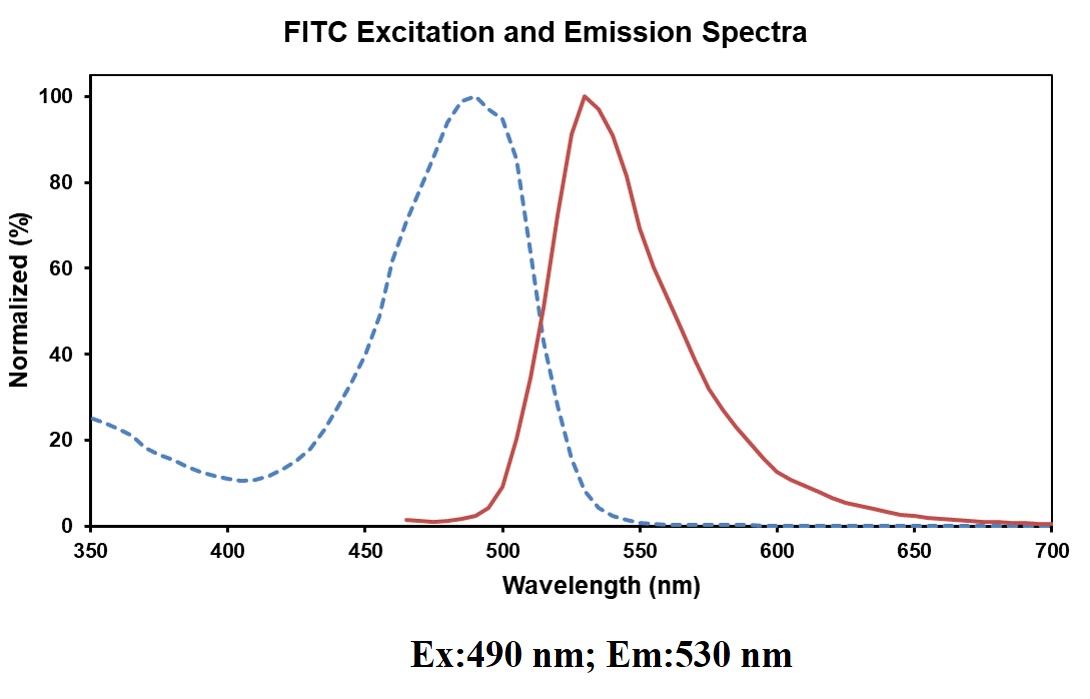
Spectrum:
Gene ID:
19264
Storage Buffer:
Phosphate buffered solution, pH 7.2, containing 0.09% stabilizer and 1% protein protectant.
Stability & Storage:
Keep as concentrated solution. Store at 2~8°C and protected from prolonged exposure to light. Do not freeze. Centrifuge before opening to ensure complete recovery of vial contents. This product is guaranteed up to one year from purchase.
Background:
CD45.2 is an alloantigen of CD45, expressed by Ly5.2 bearing mouse strains (e.g., A, AKR, BALB/c, CBA/Ca, CBA/J, C3H/He, C57BL, C57BR, C57L, C58, DBA/1, DBA/2, NZB, SWR, 129). CD45, a member of the protein tyrosine phosphatase (PTP) family, is a 180-240 kD glycoprotein expressed on all hematopoietic cells except mature erythrocytes and platelets. There are multiple isoforms in the mouse that play key roles in TCR and BCR signal transduction. These isoforms are very specific to the activation and maturation states of the cell as well as specific cell type. The primary ligands for CD45 are galectin-1, CD2, CD3, CD4, TCR, CD22, and Thy-1.

![FITC Anti-Mouse CD45.2 Antibody [104.2] (AGEL1515)](https://cdn11.bigcommerce.com/s-h68l9z2lnx/images/stencil/1280x1280/products/22046/607246/fitc-anti-mouse-cd45.2-antibody-104.2-agel1515__98784.1707500583.jpg?c=2?imbypass=on "FITC Anti-Mouse CD45.2 Antibody [104.2] (AGEL1515)")
![FITC Anti-Mouse CD45.2 Antibody [104.2] (AGEL1515)](https://cdn11.bigcommerce.com/s-h68l9z2lnx/images/stencil/1280x1280/products/22046/773946/fitc-anti-mouse-cd45.2-antibody-104.2-agel1515__84916.1785551851.jpg?c=2?imbypass=on "FITC Anti-Mouse CD45.2 Antibody [104.2] (AGEL1515)")
![FITC Anti-Mouse CD45.2 Antibody [104.2] (AGEL1515)](https://cdn11.bigcommerce.com/s-h68l9z2lnx/images/stencil/608x608/products/22046/607246/fitc-anti-mouse-cd45.2-antibody-104.2-agel1515__98784.1707500583.jpg?c=2 "FITC Anti-Mouse CD45.2 Antibody [104.2] (AGEL1515)")
![FITC Anti-Mouse CD45.2 Antibody [104.2] (AGEL1525)](https://cdn11.bigcommerce.com/s-h68l9z2lnx/images/stencil/590x590/products/237529/618012/fitc-anti-mouse-cd45.2-antibody-104.2-agel1525__68979.1732237652.jpg?c=2 "FITC Anti-Mouse CD45.2 Antibody [104.2] (AGEL1525)")
![FITC Anti-Mouse CD45.2 Antibody [104.2] (AGEL1525)](https://cdn11.bigcommerce.com/s-h68l9z2lnx/images/stencil/590x590/products/237529/752409/fitc-anti-mouse-cd45.2-antibody-104.2-agel1525__56607.1785057322.jpg?c=2 "FITC Anti-Mouse CD45.2 Antibody [104.2] (AGEL1525)")
![PE Anti-Mouse CD45.2 Antibody [104.2] (AGEL1526)](https://cdn11.bigcommerce.com/s-h68l9z2lnx/images/stencil/590x590/products/22057/605438/pe-anti-mouse-cd45.2-antibody-104.2-agel1526__38855.1707494840.jpg?c=2 "PE Anti-Mouse CD45.2 Antibody [104.2] (AGEL1526)")
![PE Anti-Mouse CD45.2 Antibody [104.2] (AGEL1526)](https://cdn11.bigcommerce.com/s-h68l9z2lnx/images/stencil/590x590/products/22057/768100/pe-anti-mouse-cd45.2-antibody-104.2-agel1526__74629.1785533368.jpg?c=2 "PE Anti-Mouse CD45.2 Antibody [104.2] (AGEL1526)")
![Biotin Anti-Mouse CD45.2 Antibody [104.2] (AGEL1514)](https://cdn11.bigcommerce.com/s-h68l9z2lnx/images/stencil/590x590/products/22045/606917/biotin-anti-mouse-cd45.2-antibody-104.2-agel1514__04020.1707499519.jpg?c=2 "Biotin Anti-Mouse CD45.2 Antibody [104.2] (AGEL1514)")
![Purified Anti-Mouse CD45.2 Antibody [104.2] (AGEL1513)](https://cdn11.bigcommerce.com/s-h68l9z2lnx/images/stencil/590x590/products/22044/606037/anti-mouse-cd45.2-antibody-104.2-agel1513__78939.1707496751.jpg?c=2 "Purified Anti-Mouse CD45.2 Antibody [104.2] (AGEL1513)")
![APC Anti-Mouse CD45.2 Antibody [104.2] (AGEL1527)](https://cdn11.bigcommerce.com/s-h68l9z2lnx/images/stencil/590x590/products/237530/618113/apc-anti-mouse-cd45.2-antibody-104.2-agel1527__19820.1732237908.jpg?c=2 "APC Anti-Mouse CD45.2 Antibody [104.2] (AGEL1527)")
![APC Anti-Mouse CD45.2 Antibody [104.2] (AGEL1527)](https://cdn11.bigcommerce.com/s-h68l9z2lnx/images/stencil/590x590/products/237530/755630/apc-anti-mouse-cd45.2-antibody-104.2-agel1527__84571.1785067518.jpg?c=2 "APC Anti-Mouse CD45.2 Antibody [104.2] (AGEL1527)")