Description
Mouse FLT4 Recombinant Protein (N-His)
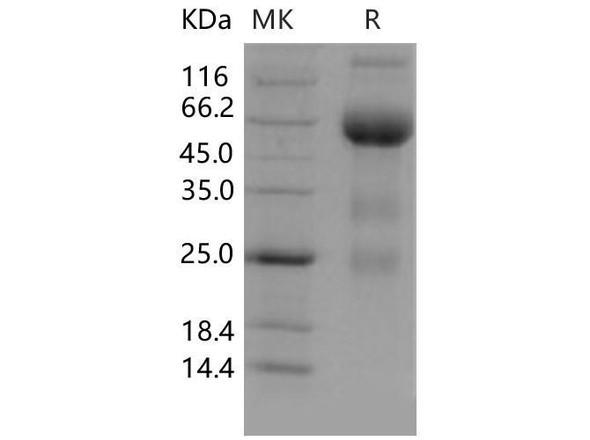
Mouse FLT4 Recombinant Protein (N-His) is a recombinant protein expressed in E. coli, spanning Glu36-Glu329, with an N-terminal His tag. Predicted molecular weight: 35.81 kDa. Purity: >90% as determined by SDS-PAGE. Supplied lyophilized from a solution in PBS pH 7.4, 0.02% NLS, 1 mM EDTA, 4% Trehalose, 1% Mannitol. Applications: ELISA, immunogen, SDS-PAGE and Western blot. Vascular endothelial growth factor receptor 3 (FLT4/VEGFR3) is a ~153 kDa protein. Tyrosine-protein kinase that acts as a cell-surface receptor for VEGFC and VEGFD, and plays an essential role in adult lymphangiogenesis and in the development of the vascular network and the cardiovascular system during embryonic development. For research use only.
Promotes proliferation, survival and migration of endothelial cells, and regulates angiogenic sprouting. Signaling by activated FLT4 leads to enhanced production of VEGFC, and to a lesser degree VEGFA, thereby creating a positive feedback loop that enhances FLT4 signaling. Modulates KDR signaling by forming heterodimers. Mediates activation of the MAPK1/ERK2, MAPK3/ERK1 signaling pathway, of MAPK8 and the JUN signaling pathway, and of the AKT1 signaling pathway.
| Product Name: | Mouse FLT4 Recombinant Protein (N-His) |
| SKU: | GXRP05916 |
| Size: | 50 µg, 100 µg, 1 mg |
| Species: | Mouse |
| Synonyms: | Vegfr3, Flt-4, Flt4, FLT-4, Fms-like tyrosine kinase 4, VEGFR-3, Vascular endothelial growth factor receptor 3, Tyrosine-protein kinase receptor FLT4 |
| Tag: | N-His |
| Expression Host: | E. coli |
| Protein Length: | Glu36-Glu329 |
| Calculated MW: | 35.81 kDa |
| UniProt: | P35917 |
| Applications: | ELISA, Immunogen, SDS-PAGE, WB |
| Purity: | >90% as determined by SDS-PAGE. |
| Form: | Lyophilized |
| Formulation: | Lyophilized from a solution in PBS pH 7.4, 0.02% NLS, 1 mM EDTA, 4% Trehalose, 1% Mannitol. |
| Reconstitution: | Reconstitute in sterile water for a stock solution. Adjust the volume of sterile water so that, after reconstitution, the final stock concentration matches the value indicated on the product label or datasheet. |
| Storage: | Store at 2 to 8°C for frequent use. Store at -20 to -80°C for twelve months from the date of receipt. |
| Shipping: | In general, proteins are provided as lyophilized powder/frozen liquid. They are shipped out with dry ice/blue ice unless customers require otherwise. |
| Note: | For research use only. |