Description
Mouse HMGB1 Recombinant Protein (N-His)
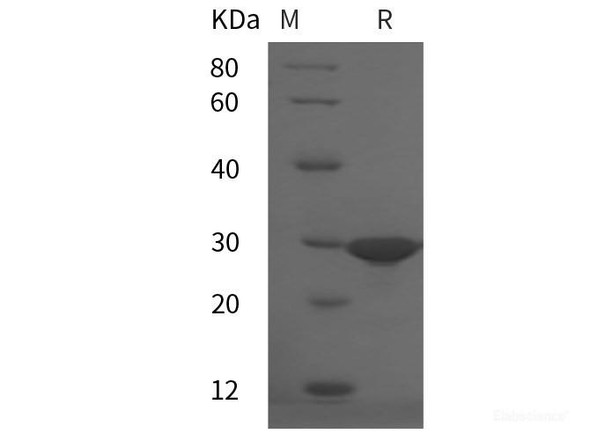
Mouse HMGB1 Recombinant Protein (N-His) is a recombinant protein expressed in mammalian cells, spanning Met1-Glu215, with an N-terminal His tag. Predicted molecular weight: 27.02 kDa. Purity: >90% as determined by SDS-PAGE. Supplied lyophilized from a solution in PBS pH 7.4, 1 mM EDTA, 4% Trehalose, 1% Mannitol. Applications: ELISA, immunogen, SDS-PAGE and Western blot. High mobility group protein B1 (HMGB1) is a ~24 kDa protein. Multifunctional redox sensitive protein with various roles in different cellular compartments. For research use only.
In the nucleus is one of the major chromatin-associated non-histone proteins and acts as a DNA chaperone involved in replication, transcription, chromatin remodeling, V(D)J recombination, DNA repair and genome stability. Proposed to be an universal biosensor for nucleic acids. Promotes host inflammatory response to sterile and infectious signals and is involved in the coordination and integration of innate and adaptive immune responses. In the cytoplasm functions as a sensor and/or chaperone for immunogenic nucleic acids implicating the activation of TLR9-mediated immune responses, and mediates autophagy.
| Product Name: | Mouse HMGB1 Recombinant Protein (N-His) |
| SKU: | GXRP03605 |
| Size: | 50 µg, 100 µg, 1 mg |
| Species: | Mouse |
| Synonyms: | High mobility group protein B1, HMGB1, HMG1, HMG-1, High mobility group protein 1 |
| Tag: | N-His |
| Expression Host: | Mammalian cells |
| Protein Length: | Met1-Glu215 |
| Calculated MW: | 27.02 kDa |
| UniProt: | P63158 |
| Applications: | ELISA, Immunogen, SDS-PAGE, WB |
| Purity: | >90% as determined by SDS-PAGE. |
| Form: | Lyophilized |
| Formulation: | Lyophilized from a solution in PBS pH 7.4, 1 mM EDTA, 4% Trehalose, 1% Mannitol. |
| Reconstitution: | Reconstitute in sterile water for a stock solution. Adjust the volume of sterile water so that, after reconstitution, the final stock concentration matches the value indicated on the product label or datasheet. |
| Storage: | Store at 2 to 8°C for frequent use. Store at -20 to -80°C for twelve months from the date of receipt. |
| Shipping: | In general, proteins are provided as lyophilized powder/frozen liquid. They are shipped out with dry ice/blue ice unless customers require otherwise. |
| Note: | For research use only. |