Description
Mouse PGLYRP1 Recombinant Protein (N-His)
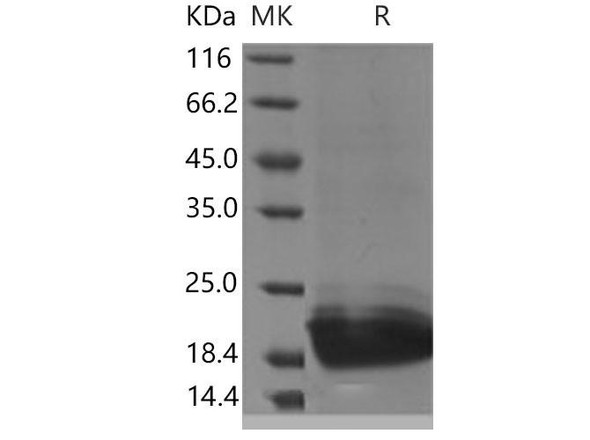
Mouse PGLYRP1 Recombinant Protein (N-His) is a recombinant protein expressed in E. coli, spanning Val41-Glu182, with an N-terminal His tag. Predicted molecular weight: 18.50 kDa. Purity: >90% as determined by SDS-PAGE. Supplied lyophilized from a solution in PBS pH 7.4, 0.02% NLS, 1 mM EDTA, 4% Trehalose, 1% Mannitol. Applications: ELISA, immunogen, SDS-PAGE and Western blot. Peptidoglycan recognition protein 1 (PGLYRP1) is a ~20 kDa protein. Innate immunity protein that plays several important functions in antimicrobial and antitumor defense systems. For research use only.
Acts as a pattern receptor that binds to murein peptidoglycans (PGN) of Gram-positive bacteria and thus provides bactericidal activity. Forms an equimolar complex with heat shock protein HSPA1A and induces programmed cell death through apoptosis and necroptosis in tumor cell lines by activating the TNFR1 receptor on the target cell membrane. In addition, acts in complex with the Ca(2+)-binding protein S100A4 as a chemoattractant able to induce lymphocyte movement. Mechanistically, this complex acts as a ligand of the chemotactic receptors CCR5 and CXCR3 which are present on the cells of the immune system.
| Product Name: | Mouse PGLYRP1 Recombinant Protein (N-His) |
| SKU: | GXRP05948 |
| Size: | 50 µg, 100 µg, 1 mg |
| Species: | Mouse |
| Synonyms: | Pglyrp, Peptidoglycan recognition protein 1, Pgrps, Cytokine tag7, Peptidoglycan recognition protein short, PGRP-S, Pglyrp1, Tag7, Pgrp |
| Tag: | N-His |
| Expression Host: | E. coli |
| Protein Length: | Val41-Glu182 |
| Calculated MW: | 18.50 kDa |
| UniProt: | O88593 |
| Applications: | ELISA, Immunogen, SDS-PAGE, WB |
| Purity: | >90% as determined by SDS-PAGE. |
| Form: | Lyophilized |
| Formulation: | Lyophilized from a solution in PBS pH 7.4, 0.02% NLS, 1 mM EDTA, 4% Trehalose, 1% Mannitol. |
| Reconstitution: | Reconstitute in sterile water for a stock solution. Adjust the volume of sterile water so that, after reconstitution, the final stock concentration matches the value indicated on the product label or datasheet. |
| Storage: | Store at 2 to 8°C for frequent use. Store at -20 to -80°C for twelve months from the date of receipt. |
| Shipping: | In general, proteins are provided as lyophilized powder/frozen liquid. They are shipped out with dry ice/blue ice unless customers require otherwise. |
| Note: | For research use only. |