Description
Mouse TGFBR2 Recombinant Protein (N-His)
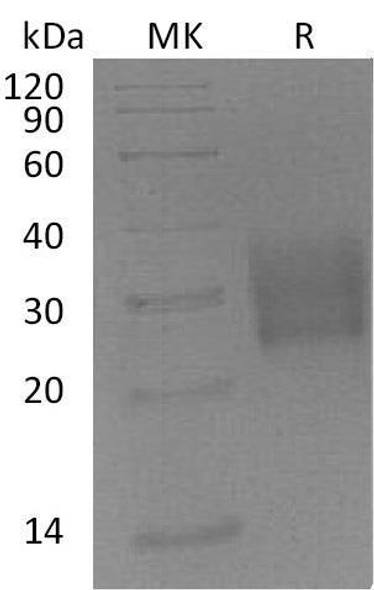
Mouse TGFBR2 Recombinant Protein (N-His) is a recombinant protein expressed in E. coli, spanning Ile24-Glu166, with an N-terminal His tag. Predicted molecular weight: 18.27 kDa. Purity: >90% as determined by SDS-PAGE. Supplied lyophilized from a solution in PBS pH 7.4, 1 mM EDTA, 4% Trehalose, 1% Mannitol. Applications: ELISA, immunogen, SDS-PAGE and Western blot. TGF-beta receptor type-2 is a ~64 kDa protein. Transmembrane serine/threonine kinase forming with the TGF-beta type I serine/threonine kinase receptor, TGFBR1, the non-promiscuous receptor for the TGF-beta cytokines TGFB1, TGFB2 and TGFB3. For research use only.
Transduces the TGFB1, TGFB2 and TGFB3 signal from the cell surface to the cytoplasm and is thus regulating a plethora of physiological and pathological processes including cell cycle arrest in epithelial and hematopoietic cells, control of mesenchymal cell proliferation and differentiation, wound healing, extracellular matrix production, immunosuppression and carcinogenesis. The formation of the receptor complex composed of 2 TGFBR1 and 2 TGFBR2 molecules symmetrically bound to the cytokine dimer results in the phosphorylation and the activation of TGFRB1 by the constitutively active TGFBR2. Activated TGFBR1 phosphorylates SMAD2 which dissociates from the receptor and interacts with SMAD4. The SMAD2-SMAD4 complex is subsequently translocated to the nucleus where it modulates the transcription of the TGF-beta-regulated genes.
| Product Name: | Mouse TGFBR2 Recombinant Protein (N-His) |
| SKU: | GXRP14042 |
| Size: | 50 µg, 100 µg, 1 mg |
| Species: | Mouse |
| Synonyms: | EC:2.7.11.30, TGF-beta receptor type II, TGF-beta receptor type-2, TGF-beta type II receptor, TGFR-2, TbetaR-II, Tgfbr2, Transforming growth factor-beta receptor type II |
| Tag: | N-His |
| Expression Host: | E. coli |
| Protein Length: | Ile24-Glu166 |
| Calculated MW: | 18.27 kDa |
| UniProt: | Q62312 |
| Applications: | ELISA, Immunogen, SDS-PAGE, WB |
| Purity: | >90% as determined by SDS-PAGE. |
| Form: | Lyophilized |
| Formulation: | Lyophilized from a solution in PBS pH 7.4, 1 mM EDTA, 4% Trehalose, 1% Mannitol. |
| Reconstitution: | Reconstitute in sterile water for a stock solution. A copy of datasheet will be provided with the products, please refer to it for details. |
| Storage: | Store at 2 to 8°C for frequent use. Store at -20 to -80°C for twelve months from the date of receipt. |
| Shipping: | In general, proteins are provided as lyophilized powder/frozen liquid. They are shipped out with dry ice/blue ice unless customers require otherwise. |
| Note: | For research use only |